Chiro Methods Exam 2
 Call Kai
 Learn
 Practice Test
 Spaced Repetition
 Match
 Flashcards
 Knowt Play
1/303

There's no tags or description
Looks like no tags are added yet.
304 Terms
Patella (Anatomy & Attachments)
Largest sesamoid bone. Located in quadriceps tendon; superiorly attaches to quadriceps tendon, inferiorly to patellar ligament.
Trochlear Groove (Anatomy & Function)
Anterior distal femur groove where the patella glides; stabilizes patellar tracking during flexion/extension.
Lateral Femoral Condyle (Anatomy & Function)
Rounded lateral distal femur prominence; articulates with lateral tibial plateau and provides ligament attachments.
Adductor tubercle — attachment?
Small bump on superior aspect of medial femoral condyle. Attachment site for hamstring portion of adductor magnus.
Patellar Ligament (Origin & Insertion)
Origin: Apex of patella. Insertion: Tibial tuberosity. Function: Extends the knee.
Tibial tuberosity — attachment?
Bony prominence on anterior proximal tibia. Attachment site for patellar ligament; transfers quadriceps force.
Medial plateau — general info?
Superior surface of medial tibia. Articulates with medial femoral condyle; weight-bearing surface.
Lateral plateau — general info?
Superior surface of lateral tibia. Articulates with lateral femoral condyle; weight-bearing surface.
Gerdy's tubercle — attachment?
Bony prominence on lateral proximal tibia. Attachment site for iliotibial (IT) tract.
Fibular head — attachments?
Proximal end of fibula. Attachment for biceps femoris tendon and lateral collateral ligament (LCL).
Sternoclavicular (SC) Joint
The only true bony connection between the upper limb and the axial skeleton.
Acromioclavicular (AC) Joint
Joint between acromion and clavicle; allows scapular movement during shoulder motion.
Coracoid process — attachments?
Hook-like projection of scapula. Muscles: Pectoralis minor, biceps short head, coracobrachialis. Ligaments: Coracoacromial, coracoclavicular.
Greater tubercle — attachments?
Large lateral projection of proximal humerus. Attachment site for rotator cuff muscles: Supraspinatus, Infraspinatus, Teres minor.
Lesser tubercle — attachment?
Smaller anterior projection of proximal humerus. Attachment site for subscapularis.
Medial epicondyle — attachments?
Projection on medial distal humerus. Attachment site for forearm flexors; ulnar nerve passes posteriorly.
Lateral epicondyle — attachments?
Projection on lateral distal humerus. Attachment site for forearm extensor muscles.
Olecranon — attachment?
Posterior projection of ulna forming elbow point. Insertion site of triceps brachii tendon.
Radial head — general info?
Proximal end of radius. Articulates with capitulum of humerus; rotates during pronation and supination.
Biceps Brachii (Origin & Insertion)
Origin: Long head (supraglenoid tubercle), short head (coracoid). Insertion: Radial tuberosity and bicipital aponeurosis.
Triceps Brachii (Origin & Insertion)
Origin: Long (infraglenoid), lateral (above radial groove), medial (below groove). Insertion: Olecranon.
Deltoid — origin and insertion?
Shoulder abductor. Origin: Lateral clavicle, acromion, spine of scapula. Insertion: Deltoid tuberosity of humerus.
Wrist flexors — general origin?
Flex wrist/fingers. Most originate from medial epicondyle of humerus (common flexor tendon). Examples: FCR, FCU, palmaris longus.
Wrist extensors — general origin?
Extend wrist/fingers. Most originate from lateral epicondyle of humerus (common extensor tendon). Examples: ECRL/B, ECU.
Memory Hook: Medial vs. Lateral Epicondyle?
Medial = Flexors ("Medial = Move fingers in"). Lateral = Extensors ("Lateral = Lift wrist").
Memory Hook: Greater vs. Lesser Tubercle?
Greater tubercle = 3 rotator cuff muscles (SITS except subscapularis). Lesser tubercle = Subscapularis alone.
Memory Hook: Gerdy & Olecranon?
Gerdy gets the IT band. Olecranon = Triceps pull point (push-up muscle).
Neck pain that causes shooting pains into the arms or legs; or an extremely rigid neck when bending forward is a sign that the client MIGHT BE experiencing meningitis or cervical disk herniation. (T/F)
True
You palpate a pulsating mass in the abdomen of a patient with Low back pain. Is this an emergent Referral?
Yes
Client comes in for back pain.
Signs and Symptoms:
-flank pain
-fever and chills
-Murphy's punch test is positive
What system of the body are we working with?
And will this be an emergent referral?
Visceral, yes
Estimates of risk are based on measuring the relationship between the presence of possible risk factors and
Subsequent incidence of particular conditions
To demonstrate causation one must show both correlation and _________________.
A reasonable physiologic mechanism through which this occurs
The most significant risk factors are found in the nature of the client's presenting complaints.
True
The 5 D's of Vertebrobasilar Insufficiency / Stroke
Dizziness, Dysarthria, Drop attacks, Diplopia, Dysphagia.
Heart rates below ______ and above _________ without symptoms are cause for an urgent referral.
35; 140
A scaphoid fracture with poor apposition. Should be:
Stabilized and seen within 48 hours
Stroke or Vertebrobasilar Insufficiency has vital signs that a chiropractor must be aware of.
The 2Ns associated with Stroke are:
Nausea
Numbness
_________________ is a condition that shows up as low back pain, urinary retention/incontinence, sexual dysfunction, and a numbness between the legs.
Cauda Equina syndrome
Considering posture, it is imperative to understand that structural changes lead to functional compensation and functional changes will not alter the structural integrity of the human body.
False
In forward head posture the weight of the head is increased by ___ pounds per inch that the head is forward from the neutral position
10
Lower cross syndrome is associated with:
Hyperlordosis
Flexion and extension of the spine happen inside which plane of the body?
Sagittal
Upper Cross syndrome is a compensation due to a repetitive stress on the body.
True
Rotation of the spine happens in what plane of the body?
Transverse
Assessing posture in the lateral view includes which landmark(s)?
External acoustic meatus
Acromion
Lateral flexion occurs in what plane of the body?
Frontal
What are good screen-time recommendations for clients?
Take a break every 30-45 minutes and keep screen brightness comfortable to avoid squinting.
Lower crossed syndrome is a postural compensation presenting with:
Inhibited: Abdominals, Gluteus Min./Med./Max
Facilitated: Thoraco-lumbar extensors, rectus femoris/iliopsoas
Which of the following are involved in upper cross syndrome?
Inhibited: Deep cervical flexors, lower trap/serratus anterior
Facilitated: upper trap/levator scapula, SCM/pectoralis
Artho means:
Joint
Which cervical vertebrae does not have a spinous process?
C1
What is the evaluation of a person's body position and/or structure in standing?
posture
From which views do you assess standing posture?
Anterior, posterior, left lateral, and right lateral.
How can you learn a bit more about a patient's posture?
Prone and supine positions on the table
Where should the clinician stand during a postural assessment?
Close enough to support the client if they experience balance issues.
What instruction should you give a patient to observe their natural standing posture?
"I would like to observe how you normally stand."
To neutralize patients "normal stance" have them
close their eyes, march in place, shake it out, then open their eyes
How do you observe patient's posture after neutralizing their normal stance?
From the feet up toward the head
Postural assessment is best observed in
shorts or clothing that is form fitting
If patient has orthodics observe:
with them in and with them out
Doctor should walk around the patient during observation while
the patient stands still
Human center of gravity while standing is
Just anterior of S2
Most stable posture is in ages
20-60
Over 60 years of age stability decreases by_____ with eyes closed
50%
What are the long-term benefits of correcting posture habits?
Increased ROM, stability, muscle strength/endurance, and improved neuromuscular programming.
Methods of analysis
Visual
Posture grid with plumb line
Bilateral Scales
Applications- iphone, ipad or others
The postural muscles are
Neck extensors and flexors
Spinal extensors and flexors
Gluteus maximus
Hamstrings and quads
Gastroc and soleus
tibialis anterior
Antigravity muscles that maintain erect posture
postural muscles
Group of symptoms that consistently occur together or a condition characterized by a set of associated symptoms
Syndrome
What are the two types of postural syndromes?
Lower and upper cross syndrome
Upper and lower cross syndromes
weakness in the front and back
Tightness in the front and back
Imbalance of muscle patterns
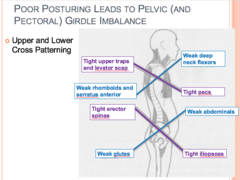
In Upper Cross Syndrome Which Muscles are inhibited (weak)
Deep Cervical flexors
lower trap and serratus anterior
In upper cross syndrome which muscles are facilitated ( tight)
SCM/Pectoralis
Upper Trap/ Levator Scapula
In lower cross syndrome, which muscles are inhibited (weak)?
Abdominals, gluteus minimus, medius, and maximus
In lower cross syndrome, which muscles are facilitated (tight)?
Rectus femoris, iliopsoas, and thoracolumbar extensors
Common postural variations
Kyphotic-lordotic, flat back (military spine), and swayback
An applied science concerned with designing and arranging things people use so that the people and things interact most efficiently and safely
Ergonomics
Key ergonomic guidelines for screen time
Break every 30-45 mins; 90-90-90-90 angles; screen perpendicular to windows; eyes at top 1/3
Contact points of the contact or indifferent hand
Pisiform, hypothenar, metacarpal/knife edge, digital, DIP, PIP, MCP/index web, thumb, calcaneal, palmar
Client palpation positions
Seated, supine, prone, side-lying, and standing
Doctor stance and table positions
HOT, SOT, FOT, fencer/lung/staggered stance, and square/straight-on stance
Which joints can become highly unstable if not supported?
Elbow and knee
How should unstable joints be supported?
Using hands, another part of the doctor's body, or the table
Correct table height for doctor longevity
Fingers/knuckles brush table top with relaxed arms; base of patella level with table top
Adjust posture and biomechanics according to
body part being treated and technique applied
Doctors should keep shoulders relaxed (t/f)
True
How to avoid whipping or snapping wrists during rapid light/moderate applications
Keep elbows flexed and wrists relaxed
stand with feet ______, place feet in the direction of______, knees and hips should be slightly______, back is _______, shoulders are ________
shoulder width apart, movement, flexed, straight, relaxed
algesia-
sensitivity to pain
Eu-
good
dys-
bad, difficult
Myelo-
spinal cord
dactyl
finger, toe
-penia
lack of
-algia
pain
primary palpating contact points for finding landmarks:
tips of fingers, pads of fingers, flat multiple finger contact
the harder you press the less you will ______
feel
a light pressure will __________ the beds of the fingernail
blanch and whiten
a hard pressure is uncomfortable on
your closed eyeballs
What are the two methods of palpation for vertebre?
2 Finger slide
Spider walk