Butcher quiz 4
 Call Kai
 Learn
 Practice Test
 Spaced Repetition
 Match
 Flashcards
 Knowt Play
1/76

There's no tags or description
Looks like no tags are added yet.
77 Terms
cardiovascular system forms the? it contains?
circulatory system
blood
heart system
vascular (blood vessels- circulatory network)
includes lymph system
some function of cardiovascular system
substrate delivery
waste removal
gas exchange
endocrine signaling
immune response
thermoregulation
why is CV important?
essential for maintenance of life
you have 4 min before irreversible damage occurs aka golden window
can damage other organs
diagnostic assessments of CV function
heart assessment (heart rate, rhythm, sound/murmurs, BP)
radiography, echocardiography, electrocardiography
Circulatory assessment: Respiratory rate/effort, capillary refill time (CRT), mucous membrane color, presence of edema, exercise intolerance
Blood tests: Troponin 1, brain natriuretic peptide (BNP), NT-proBNP, and pH
Advanced imaging: CT or MRI
use a combination to inform CV function
pathology: primary vs secondary
primary: direct problem with CV system
ex. hemorrhage, congenital malformations, chagas disease, equine arrhythmias
secondary: effect of CV system as a side issue to main problem (similar to a symptom ig, it causes CV issues)
liver disease, renal, vomiting, diarrhea
key portion of homeostasis?
maintenance of a constant fluid volume
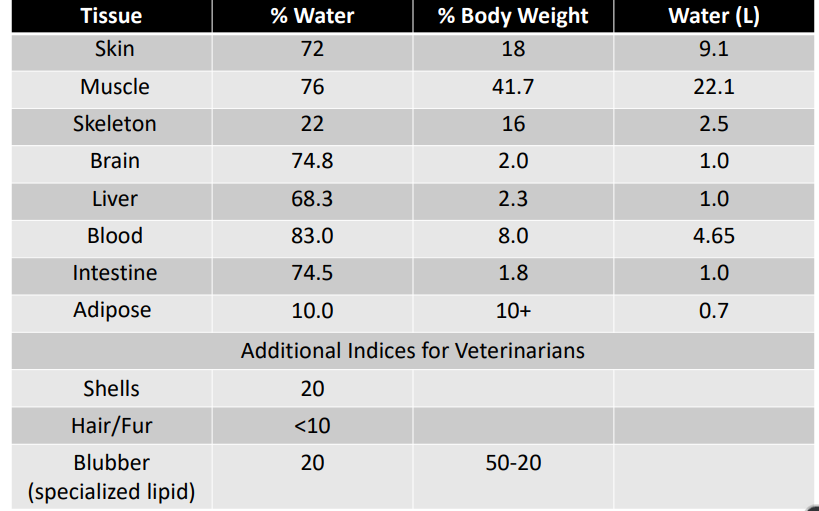
what do the components include in body fluid
solvent water and solutes (including Na, glucose, proteins, Ca)
what are the most important factors in regards to solute regulation
total concentration of all solutes (determines osmotic p.)
conc. of ind. solutes
total fluid volume
components of body fluid, which are negligible
extracellular fluid (fluid outside of cell)
eg. plasma (in vasculature), interstitial fluid ( outside vasculature), transcellular fluid (negligible, synovial-joints, peritoneal-intestines, intrapleural-lungs, pericardial)
also lymph fluid (also negligible)
intracellular fluid (fluid inside the cell)
fluid balance is dependent on?
age (increase in age cause decrease in fluid, associated with increase in % fat), sex, obesity
when talking abt avg. just know that variations exist and are dependent on those 3
60-40-20 rule

osmole
expression of solution in terms of number of particle
usually place grams with osmole
1g MW substance=1 osmole
180 g glucose= 1 osmole
osmolality vs. osmolarity
osmoles per kg of water
osmoles per liter of solution
can use inteachably
in ECF what makes 80% of osmolarity
Na and Cl
ICF: what makes total osmolarity
50% K
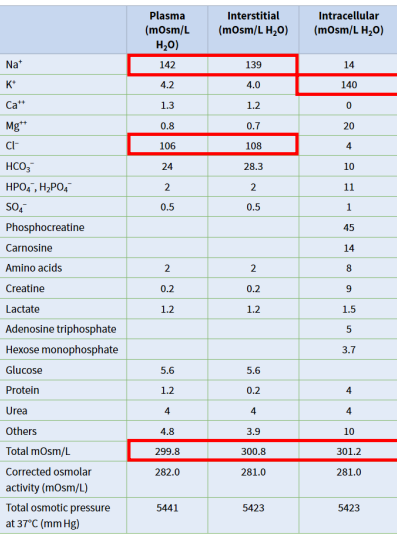
all similar bc of osmolarity
(The correction factor (using osmotic coefficient) is because some ions do not behave completely independently of each other (like NaCl)
Pressure differences:
considerable differences in pressure between sides of a semi-permeable membrane
measured by summing all of the forces striking a unit SA at a given instant
most abundant substance that diffuses through the cell?
water
water follows particles
in rbc how fast does water diffuse?
water diffuses through the membrane at a rate of 100x the volume of the cell itself, and yet the cell doesn’t swell
Osmotic pressure is exerted by?
particles in a solution, molecules or ions, and is determined by the NUMBER of particles per unit of fluid (NOT the mass)
larger particles have higher mass= slower velocity a
and vise versa
But, in some cases, a concentration difference for water develops across a membrane so NET movement of water does occur, causing the cell to
swell or shrink
what drives blood out?
Hydrostatic pressure drives blood OUT of the capillaries and into interstitial fluid
ICF constitutes _____% of total body weight
40%
ICF contains
individual mixture of different constituents based on each cell
the concentrations of these substances are similar from one cell to another.
The composition of cell fluids remains remarkably similar across animals ranging from micro-organisms to human
higher K, P, Mg, Na, Cl, Ca, bicarbonate, 4x amount of protein as ECF
ICF is separated from ECF by?
cell membrane that is highly permeable to water
ECF regulation
by kidneys
because the cells need to be “bathed” or surrounded by a proper concentration of electrolytes and nutrients for optimal cell function
Inputs to internal pool: Only way to get something inside body
Input from the external environment like ingestion, inhalation, absorption through body surface (gills) or injection
internal pool
(extracellular concentration) of a substance
decreasing internal pool?
loss via removal or metabolic consumption.
Increasing internal pool
means increase input or metabolically producing it.
For stability of pool?
input = output (balance)
outputs from internal pool
Excretion to external environment like kidneys, lungs, digestive tract, or body surface (sweat, tears, sloughed skin)

components of blood
55% plasma (water, proteins, electrolytes, dissolved gas, nutrients, waste, hormones) and 45% RBC
aka 60-40
vary via size, sex, weight etc
hematocrit: def? normal?
packed rbc cell volume
fraction of blood composed of RBC
normal is 0.37-0.55
blood volume
contain ECF (plasma) and ICF
Generally considered apart from body as it is contained within it’s own chamber (circulatory system)
crucial to CV
avg blood volume
5-8% of BW
What the 3 primary body fluid compartments?
ICF
ECF (plasma and interstitial, also transcellular and lymph but they have negligible volumes)
What is the 60-40-20 rule?
60% BW, 40% ICF, 20% ECF
Blood has a high % of water?
T
• What are the cations and anions prevalent in the ICF?
• K, Mg, phosphates, proteins
What is not able to move between the ECF compartments?
• Proteins
What is hematocrit?
• Packed red blood cell volume
muscles composition? function?
composition: myofilaments
function: movement and maintenance of the position
shortening m. vs lengthen m.
shorten: contract
lengthen: relax
types of m.
cardiac, skeletal, smooth


