nervous communciation & receptors
 Call Kai
 Learn
Learn Practice Test
 Spaced Repetition
 Match
Match Flashcards
 Knowt Play
1/40

There's no tags or description
Looks like no tags are added yet.
Name | Mastery | Learn | Test | Matching | Spaced | Call with Kai | Chat |
|---|
No analytics yet
Send a link to your students to track their progress
41 Terms
define stimuli
changes to the internal or external environment of an organism,, resulting in a response
why do animals respond to stimuli?
it increases their chance of survival
eg external: avoiding harmful environments
eg internal: make sure that cinditions are always optimal for metabolism
define receptors
they are cells or proteins that can detect stimuli and are cells or proteins on cell-surface membranes
many different types of receptors detect different stimuli
what are effectors?
cells that bring about a response to a stimulus to produce an effect
effectors include muscle cells & cells bound in glands eg pancreas
how do receptors and effectors communicate?
via the nervous system or hormonal system, sometimes using both
what are the three main types of neurons?
sensory
motor
relay
what is the role of sensory neurons?
transmit electrical impulses from receptors to CNS (brain & spinal cord)
what is the role of motor neurons?
transmit electrical impulses from CNS to effectors
what is the role of relay neurons?
transmit electrics, impulses between sensory neurons & motor neurons
what happens after a stimulus triggers the nervous system?
describe and explain this process
stimulus is detected by receptor cells & electrical impulse is sent along a sensory neuron
when electrical impulse reaches end of the neuron, chemicals called neurotransmitters take info across to next neuron, sends electrical impulse
CNS processes the info & sends impulses along motor neurons to an effector

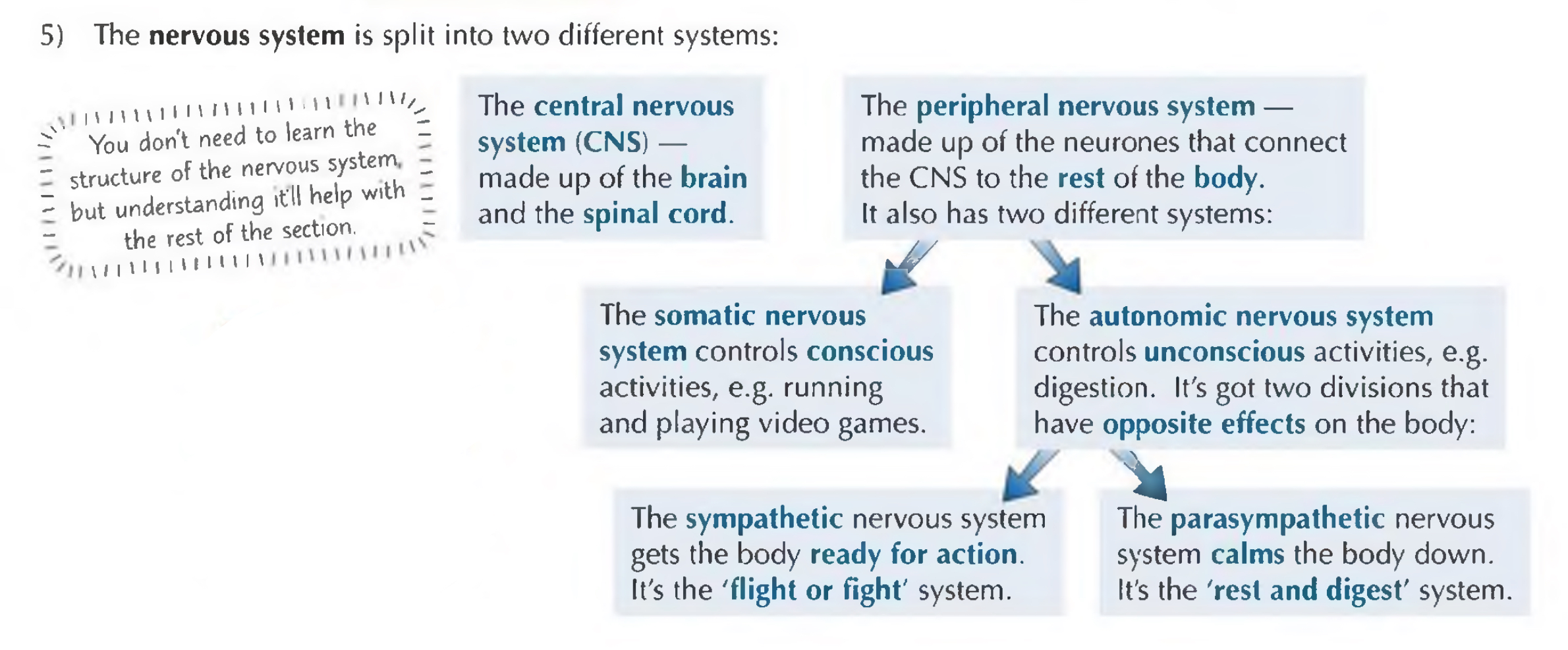
describe the structure of the nervous system
what is a reflex?
where the body responds to a stimulus without making a conscious decision to respond
How do you simple reflexes help organisms?
they are rapid- fast response
short-lived, can return to homeostasis
localised response- neurotransmitters secreted directly onto target cells
what is a reflex arc?
pathway of neurons linking receptors to effectors in a reflex
the three neurons involved are sensory relay and motor
eg receptors detect stimuli
sensory neuron carries impulse to relay neuron
relay neuron connects to motor neuron
motor neuron sends impulses to effector
muscle contracts to move away or closer to stimulus
if relay neuron involved, can override reflec
when is a nervous system receptor in resting state?
and how does this occur?
when difference in charge between inside and outside of cell
this is generated by ion pumps & ion channels
so there’s a voltage across the membrane
voltage aka potential difference
what is resting potential?
the potential difference when a cell is at rest (not stimulated)
what is generator potential? how can a bigger one be triggered?
change in potential difference across cell-surface membrane of a receptor as a result of a stimulus
bigger stimulus excites membrane more, causing a bigger movement of ions & bigger change in PD - so bigger generator potential is produced
how does potential difference become altered?
when a stimulus detected, cell membrane is excited & more permeable, so more ions to move in & out of cell
how is an action potential triggered?
generator potential is big enough it'll trigger an action potential
only triggered if generator potential reaches a certain level called the threshold level
action potentials are all one size, so strength of stimulus is measured by frequency of action potentials
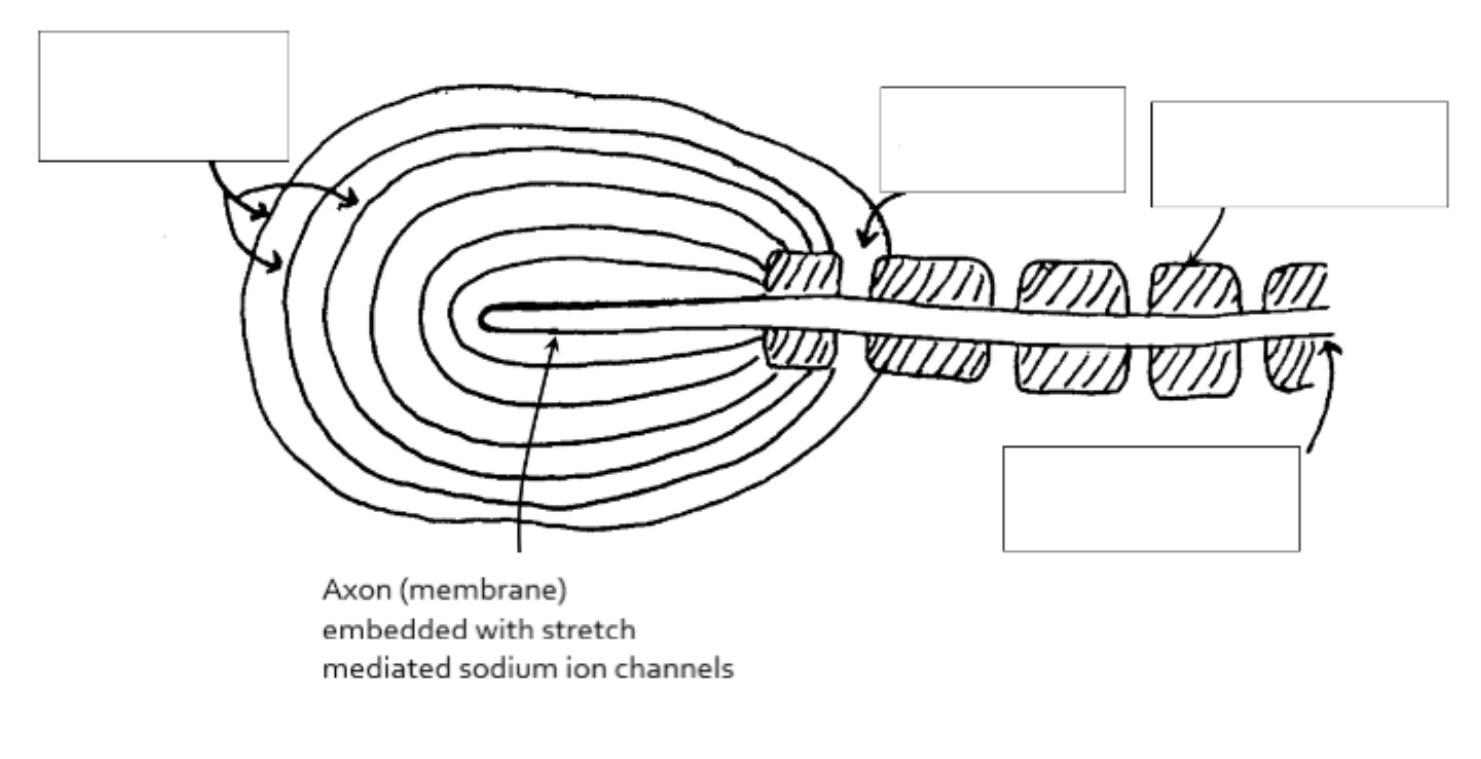
label the diagram of the pacinian corpuscle
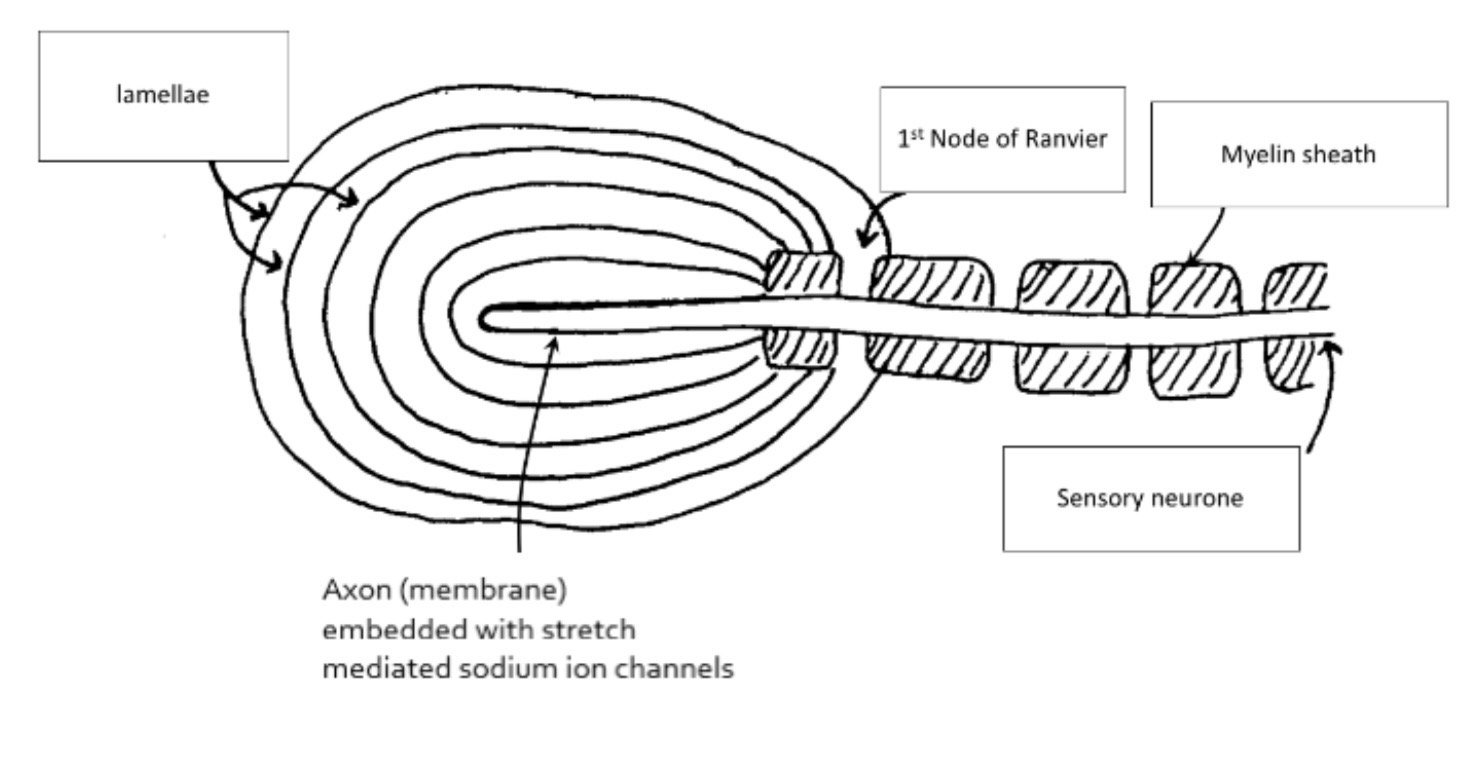
what kind of receptors are pacinian corpuscles?
they are mechanoreceptors
detect mechanical stimuli, eg pressure & vibrations (found in skin)
describe what happens in a Pacinian Corpuscle to generate an action potential in the sensory neurone
when pressure from touch/ pacinian corpuscle is stimulated, lamellae deformed & press on sensory nerve ending
stretches sensory neuron cell membrane- deforms stretch-mediated Na ion channels
channels widen & open, Na+ ions diffuse/flood into axon
axon = depolarised, establishes generator potential
if threshold reached- action potential triggered
Describe how the stimulation of a pacinian corpuscle
stimulus occurs, deforming the lamellae
stretch-mediated Na+ ion channels widen and open
Na+ ions diffuse in via the Na+/K+ pump/ depolarisation occurs due to this
Explain how the resting potential of –70 mV is maintained in the sensory neurone when no pressure is applied in the pacinoan corpuscle.
membrane is more permeable to potassium ions and less permeable to sodium ions
sodium ions are actively transported/ pumped out and potassium ions in
what is the fovea?
area in the retina where many photoreceptors are found
ALSO WHERE CONE CELLS ARE IN THE EYE
what is the retina?
retina is the layer of photoreceptor cells found at the back of the eye
what are the two types of photoreceptors in the retina?
rods and cones
where are rod cells found in the eye?
in the periphery of the retina
where are cone cells found in the eye?
in the fovea
how do photoreceptors work?
light enters the eye, hitting the photoreceptors
absorbed by the light-sensitive optical pigments
light bleaches pigments
cussing chemical change & altering membrane permeability to sodium ions
generator potential created, if reaches threshold, nerve impulse sent along a bipolar neuron
bipolar neurons connect photoreceptors to optic nerve, takes impulse to brain
what kind of information can rods give?
monochromatic (black and white)
what kind of information can cones give?
trichromatic vision- 3 colours
3 types of cones, red-sensitive, green-sensitive and blue-sensitive
when stimulated in different proportions, you can see different colours
what is visual acuity?
ability to tell apart points close together
what is sensitivity?
how easily they reach action potential
what kind of sensitivity and visual acuity do rod cells have? and why?
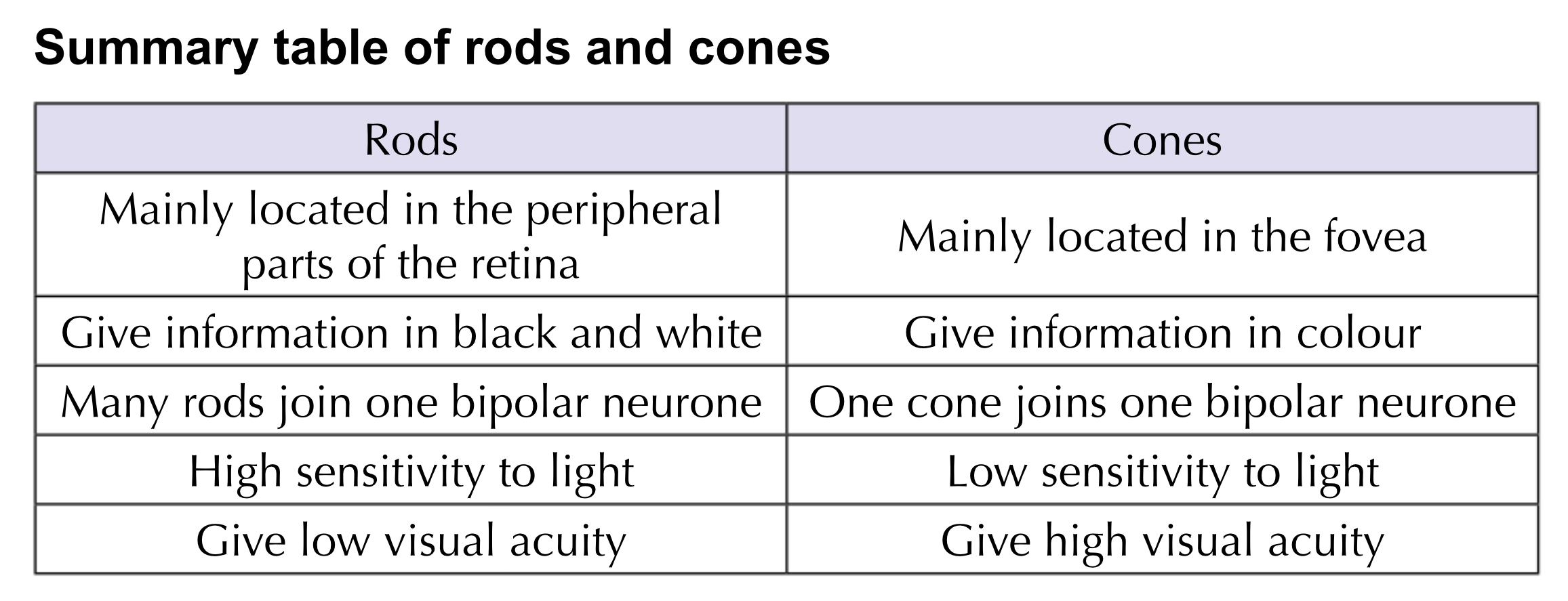
rod cells very sensitive to light (work well in dim light)- because many rods join 1 bipolar neuron, so many weaker generator potentials combine to reach threshold & trigger action potential
rods have low visual acuity- because many rods join to same bipolar neuron, so light from 2 points close together cannot be told apart
what kind of sensitivity and visual acuity do cone cells have? and why?
cones are less sensitive than rods (work best in bright light)- because one cone joins 1 bipolar neuron, so takes more light to reach the threshold & trigger action potential
cones have high visual acuity- because cones are close together & one cone joins bipolar neuron
when light from 2 points hit 2 cones, 2 action potentials go to brain, so can distinguish 2 points close together as 2 separate points
give a summary of the similarities and differences between rods and cones
explain why an image formed at the fovea is perceived in more detail than an image formed at any other point on the retina (2)
fovea has many / only cones / more cones than rest of the retina;
each cone is synapse to a single neurone / bipolar cell / no retinal convergence;
OR
the rest of the retina has mainly rods/more rods than cones;
which share/converge on neurones/bipolar cells;
fovea of the eye of an eagle has a high density of cones. An eagle focuses the image of its prey onto the fovea. Explain how the fovea enables an eagle to see its prey in detail. Do not refer to colour vision in your answer. (3)
high (visual) acuity;
(each) cone is connected to a single neurone;
(cones send) separate (sets of) impulses to brain;
retina of an owl has a high density of rod cells.
explain how this enables an owl to hunt its prey at night. do not refer to rhodopsin in your answer. (3)
high (visual) sensitivity;
several rods connected to a single neurone;
enough (neuro)transmitter to reach/overcome threshold
OR
spatial summation to reach/overcome threshold;
describe how a Pacinian corpuscle produces a generator potential when stimulated.
(increased pressure) deforms/changes stretch-mediated sodium ion channel;
(sodium channels open and) sodium ions flow in;
depolarisation (leading to generator potential);