Biol216 Exam 2
 Call Kai
 Learn
 Practice Test
 Spaced Repetition
 Match
 Flashcards
 Knowt Play
1/289

Earn XP
Description and Tags
4.1-7.3: Thermoregulation, Neurons, Ion Channels and Action Potentials, Neuronal Functioning, Brain and Nervous System, Sensory Receptors, Hearing, Vision, Taste and Smell
290 Terms

Ectotherm
Obtains heat from the environment. Typically live in a favorable environment, have lower metabolic rate that falls at low environmental temp, and have small surface-to-volume ratio.

Endotherm
Maintains body temp and balances. internal heat production with heat loss from body surface. Metabolic rates rise at low environmental temps to generate body heat.

Vasoconstriction
Blood vessels constrict to retain heat.
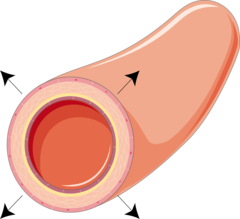
Vasodilation
Blood vessels expand to increase blood flow and release heat.

Countercurrent exchange
Blood flow currents move in opposite directions to ensure a heat gradient that facilitates for maximum retention.

Temperature homeostasis
Hypothalamus triggers mechanisms to instate vasodilation or vasoconstriction when body temperature deviates from a set point.

Ways animals manage heat conductance
1. Feathers/fur/blubber insulation to retain heat
2. Reflective surfaces to minimize heat uptake
3. Blood flow redirection to retain or release heat
Anatomical hierarchy
cells, tissues, organs, organ systems, animal
Basic tissue types
Epithelial, connective, muscle, nervous
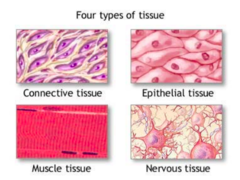

Epithelial tissue
Lines body structures and cavities to form a protective, secretory, and absorptive covering.
Types of epithelial tissue
Squamous, cuboidal, columnar.


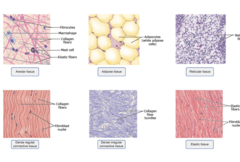
Connective tissue
Provides bodily support and binds parts.
Types of connective tissue
Loose, fibrous, cartilage, bone, blood, adipose

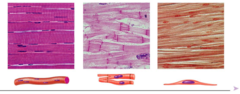
Muscle tissue
Contracts or shortens to facilitate movement.
Types of muscle tissue
Skeletal, cardiac, smooth.

Nervous tissue
Transmits information by carrying electrical messages.

Torpor
A period of inactivity aligned with variations in environmental temperature.

Hibernation
Winter torpor.

Estivation
Summer torpor.
Central Nervous System
Brain and spinal cord.

Peripheral Nervous System
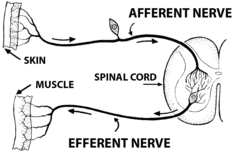
Afferent and efferent neurons.


Interneurons
Neurons in the CNS that integrate information and formulate a nervous response.
Afferent neurons
Sensory neurons that pick up stimulus and transfer it to interneurons/the CNS.

Efferent neurons
Sensory neurons that carry neuronal response signals to the muscles and glands.

Motor neurons
Efferent neurons that carry signals specifically to the skeletal muscle.

Neuron
A highly specialized cell built to receive and pass on electrical signals.

Dendrite
Branched extensions of a neuron that receive incoming signals.


Axon
A threadlike extension of a neuron that carries nerve impulses away from the cell body.

Nerve
A collection of axons that provide a common pathway for electrochemical impulses to travel upon.

Synapse
The junction between the axon tip of the sending neuron and the dendrite tip of the receiving neuron.
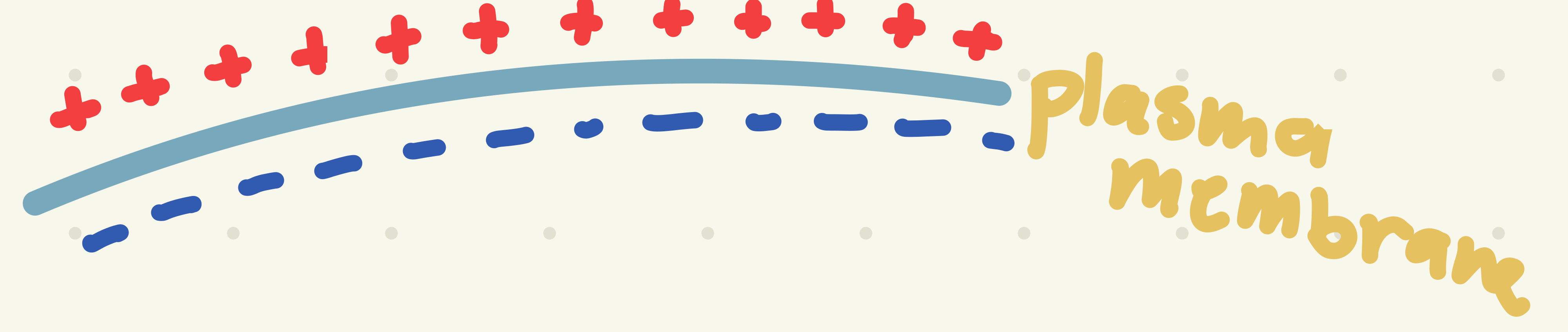
Membrane Potential
The voltage difference across a cell's plasma membrane.


Nervous system organization
Stimulus, PNS (afferent neurons), CNS (interneurons), PNS (efferent neurons), effectors, action.


White matter
Myelinated axons and glial cells.


Gray matter
Neuronal cell bodies.


Glial cells (neuroglia)
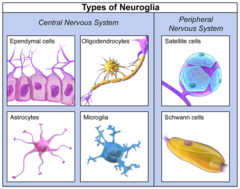
Non-neuronal cells in the PNS and CNS that support, protect, and nourish neuronal cells.
Types of glial cells
Ependymal, microglial, astrocytes, satellite, Schwann, oligodendrocytes

Ependymal cells
CNS. Produce cerebrospinal fluid.
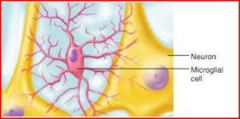
Microglial cells
CNS. Defensive cells that ingest and break down pathogens and waste products.

Astrocytes
CNS. Provide structural support to blood vessels and maintain ion concentration in surrounding fluid.

Satellite cells
PNS. Protect neuron cell bodies (astrocytes but in PNS).
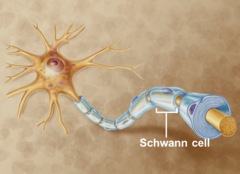
Schwann cells
PNS. Form myeline sheath around PNS nerve fibers.
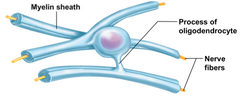
Oligodendrocytes
CNS. Form myelin sheath around CNS nerve fibers.

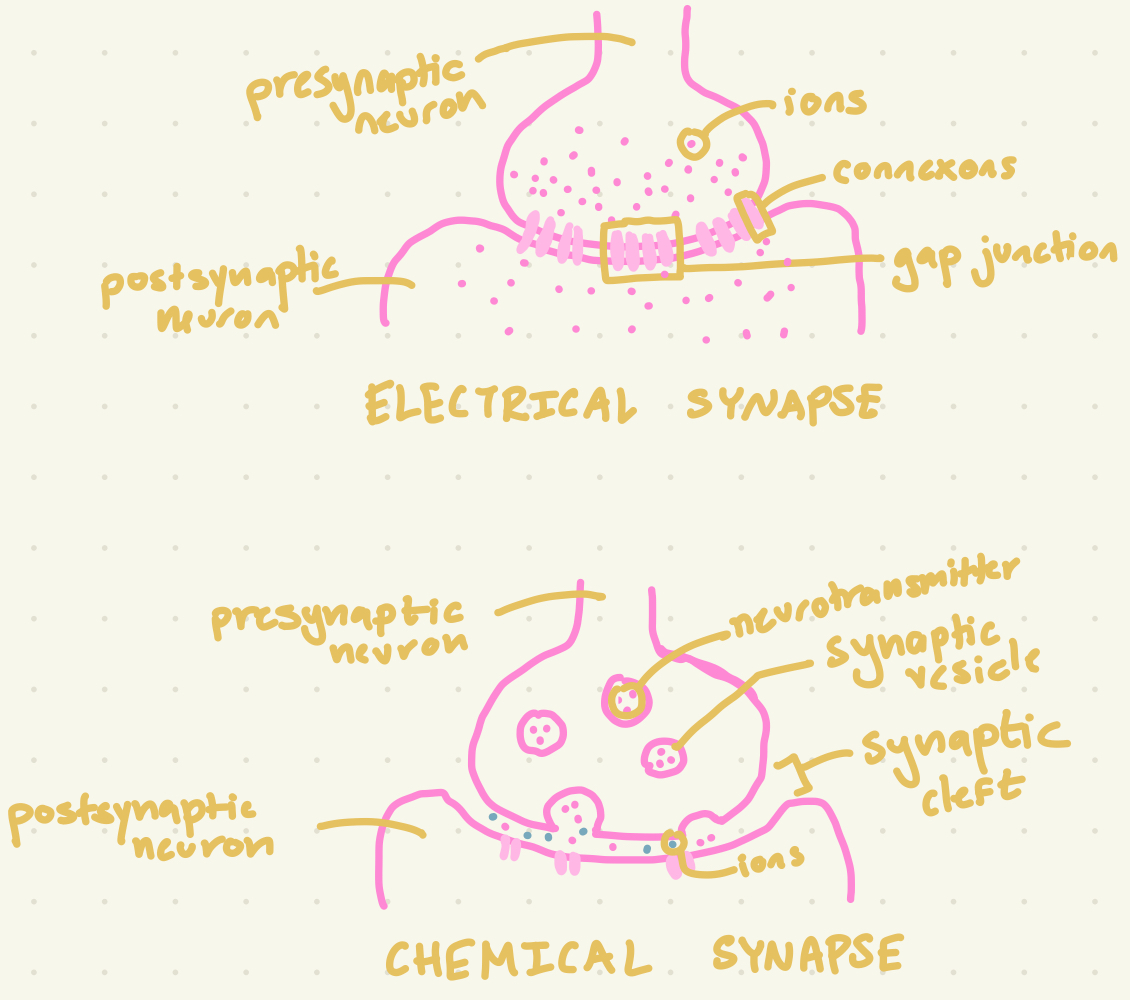
Synapse types
Electrical and chemical


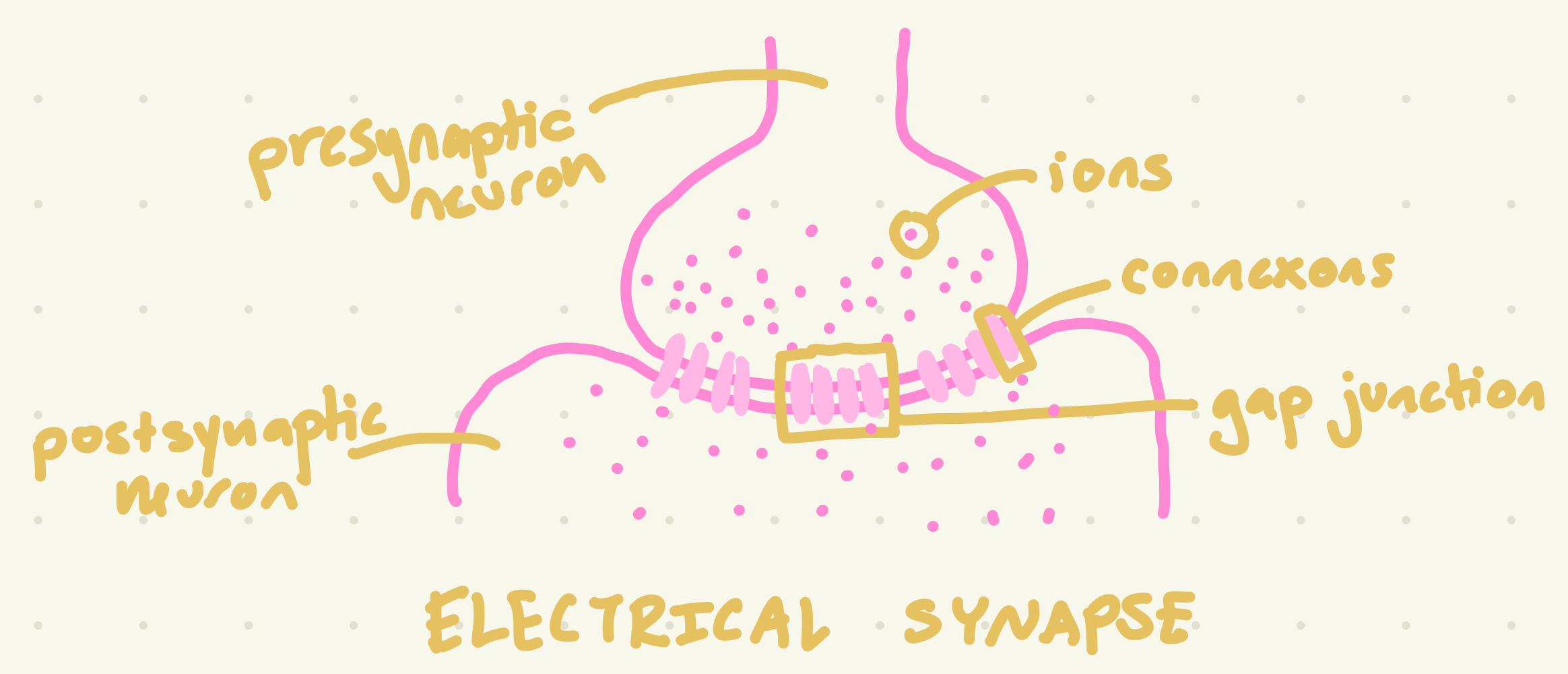
Electrical synapses
Have a direct flow of current between cells where the action potential of one cells causes the formation and travel of an action potential in the next. Located in smooth and cardiac muscle, and tooth pulp. Important for uniform, synchronized, contractile activity across a group of cells.

Chemical synapses
Electrical impulse arrives at the terminal on the presynaptic cell before a neurotransmitter is released and diffuses across the synaptic cleft and binds to a receptor on the postsynaptic cell. With enough neurotransmitters bound, a new electrical impulse is generated on the postsynaptic cell.


Electrical vs chemical synapses
Electrical:
near-instantaneous, poor modulation, synchrony.
Chemical:
slower, delayed by diffusion and binding, better modulation, no synchrony


Action potential
The change in electrical potential associated with the passage of an impulse along the membrane of a muscle cell or nerve cell


Resting neuron
Not conducting an action potential. Closed Na+ and K+ voltage gated channels, while K+ leak channels remain open. Na+/K+ ATPase pump continues pumping.

Resting membrane potential
Equilibrium condition of a cell. No net flow of ions across the membrane; describes a cell not currently transmitting an impulse.
Equilibrium potential
Membrane potential when the voltage gradient of a particular ion exactly balances that ion’s concentration gradient

Resting potential
-70mV
[Na+]>[K+] outside, [Na+]


Influences where ions cross membrane
Diffusion due to a concentration gradient
Electric fields due to charge differences


Resting potential causal mechanisms
Na+/K+ pump
Selective permeability (resting membrane more permeable to K+ than Na+ (leak channels), so net negative charge within the cell)


Ungated/leak channel
Channels that are always open. Often found in resting neurons.


Voltage-gated channel
A channel triggered by a change in membrane voltage. Found in the axon membrane.


Ligand-gated channel
A channel triggered by the binding of a ligand. Found in synapses.


Mechanically-gated channel
A channel triggered by physical deformities. Found in sensory receptors.


Universal functions of members of voltage-gated channel family
Ion conductance, pore gating, and regulation.

Voltage-gated Na+ channel
Voltage-gated K+ channel

Action potential firing sequence
Stimulus causes positive charges to flow into the neuron
Cell membrane becomes less negative (depolarization)
Depolarization occurs slowly until the membrane potential reaches the threshold point
Firing (increase in membrane potential) due to increase in positive ions
Membrane potential falls below resting potential (hyperpolarization)
Membrane returns to resting potential


All-or-nothing principle
Depolarization and firing will occur once the threshold is reached regardless of the strength of the stimulus

Key features of action potentials
All-or-nothing principle
Maintain size as AP travels along axon
Propagate
Action potential propagation mechanism
APs generated locally. Resulting currents trigger APs on neighboring membrane stretches.
Ions flow between currently-firing and unfired axon segments. Each firing causes the next one.
Refractory period
A period after an action potential fires in which the membrane temporarily cannot respond to new stimulus.
Absolute refractory period
Period where an excitable membrane (absolutely) cannot generate an action potential.
Absolute period mechanistic basis
Occurs because voltage-gated Na+ channels are already open or are in an inactive state. This state may only be removed by repolarization and closing of the membrane pore.
Relative refractory period
Period when an excitable membrane will produce an action potential ONLY in response to a stimulus of greater strength than usual.
Relative period mechanistic basis
Occurs because some voltage-gated Na+ channels have returned to resting (closed) gate status, with some still inactivated and some voltage-gated K+ channels are still open.
Relative period re-firing requirements
High magnitude stimulus
Stimulus outlasts relative refractory period
Reasoning behind difference in appearance of refractory-period fired action potentials
Smaller-than-normal size occurs because of some K+ channels still being open
Some Na+ channels still being inactivated
Stimulus intensity encoding
Because an action potential’s peak size never changes regardless of stimulus strength, intensity cannot be encoded by AP amplitude, therefore, intensity is encoded by the frequency of APs. Increased frequency = increased intensity.

Axon diameter differences
Increased diameter yields lower internal resistance, resulting in increased speed of neuronal firing


A-alpha axons
Carry proprioception-related information


A-beta axons
Carry touch-related info


A-delta axons
Carry pain and temperature-related info


C axons
Carry pain, temperature, and itch-related info. Unmyelated, slow.


Quantitative model for relationship between axon diameter and conduction velocity
Cable Theory


Capacitances
Stored electric energy caused by electrostatic forces acting through the phospholipid bilayer.


Resistance (cause)
Due to cytosol’s resistance to movement of electric charge

Measure of the length constant
37% decrease for each length. Approximately 1/3.
Effect of length constant on conductance velocity
Increased measure of lambda (length constant) yields an increase in distance voltage travels down the axon. Voltage reaches a further threshold the greater the value of lambda.
Membrane resistance
Increases with myelin

Benefits of the chemical synapse
Allows neurons to receive inputs from numerous axon terminals simultaneously and facilitates modulation


2 Types of chemical synapses
Direct and indirect


Direct chemical synapses process
Neurotransmitter binds directly to ligand-gated ion channel
Gate opens/closes, affecting the flow of ions in the postsynaptic cell


Indirect chemical synapses process
Neurotransmitter binds to G-protein coupled receptors on postsynaptic membrane
Secondary pathway is activated
Ion channels are opened/closed and signal is propogated


Direct vs indirect chemical synapses
Direct: Fast. Ionotropic receptors form an ion channel pore.
Indirect: Slower, effects last longer. Metatropic receptors indirectly link to ion channels via signal transduction, often G-proteins.

Neurotransmitter types
Acetylcholine, GABA, glycine, glutamate, norepinephrine and epinephrine, dopamine, serotonin, endorphins, enkephalins, substance P, dissolved carbon monoxide (CO), dissolved nitrogen monoxide (NO)
Acetylcholine
Neurotransmitter between nerves and muscle; in brain and in heart. Related to Alzheimer’s Disease (AD)
GABA (Gamma aminobutyric acid)
Cl- channel opening neurotransmission inhibitor.
Glycine
Neurotransmission inhibitor
Glutamate
Excitatory neurotransmitter involved in learning and memory
Norepinephrine and epinephrine
Dual-role hormones and neurotransmitters that can be excitatory and inhibitory depending on the receptor they bind to. Involved in attention, mental focus, memory, motor control, and the pleasure/reward pathway.
Dopamine
Neurotransmitter/neurohormone involved in behavior, cognition, voluntary movement, motivation and reward, prolactin production inhibition, sleep, mood, attention, and learning. Degeneration of neurons that release this neurohormone is related to Parkinson’s.
Serotonin
Regulates intestinal movements, involved in mood, appetite, and sleep
Endorphins
Works on PNS, released during pleasurable experiences
Enkephalins
A subset of endorphins that works in the CNS and modulates pain response
Substance P
A neurotransmitter released by the spinal cord that increases pain perception
Dissolved CO (carbon monoxide)
A neurotransmitter that regulated the release of hormones from the hypothalamus