Drug Delivery Systems - Exam #1
 Call Kai
 Learn
Learn Practice Test
 Spaced Repetition
 Match
Match Flashcards
 Knowt Play
1/113

There's no tags or description
Looks like no tags are added yet.
Name | Mastery | Learn | Test | Matching | Spaced | Call with Kai | Chat |
|---|
No analytics yet
Send a link to your students to track their progress
114 Terms
List the steps in the Drug Development Cycle (6)
1. Discovery
2. Preclinical studies
3. IND application
4. Clinical trials
5. NDA application
6. Post-marketing surveillance

Time period of the Drug Discovery Process in the Drug Development Cycle
2-4+ years
Time period of the Preclinical Studies in the Drug Development Cycle
1-2+ years
What are some of the challenges in the Drug Development Process? (14)
-Potent
-Selective
-Reversible
-Targeted
-Soluble
-Long-lasting
-Metabolically stable
-Permeable
-Non-toxic
-Non-mutagenic
-Non-teratogenic
-Physically stable
-Patentable
-Manufacturable
What are the roles of The Food and Drug Administration? (3)
1. Regulates pharmaceutical market
2. Ensures human safety and efficacy
3. Has authority by Federal Food, Drug, and Cosmetic Act
Experts from what areas come together to form a drug discovery project team? (5)
1. Biology
2. Chemistry
3. ADME
4. Toxicology
5. Pharmaceutical Sciences
Target Identification
As disease biology becomes more understood, new potential drug intervention points are identified (receptors, enzymes, ion-channels, agonists, etc.)
Target Validation (2 points)
-Clinical Proof of Concept (POC) = Right Target + Right Drug
-Evaluate target and confirm its role in disease
What components are a part of the Preclinical Stage of the Drug Discovery Process? (4)
1. Basic material properties
2. In vitro cell testing
3. In vivo animal testing
4. ADME/Toxicity studies
Lead Optimization (2 points)
-Chemically related series that survive screening are optimized to improve their safety/efficacy
-Structure-Activity Relationship (SAR) with chemical structure of current drug
True or False. An IND application does not need to be approved before First-in-Human (FIH) clinical trials.
False
What is contained within an Investigational New Drug (IND) application? (3)
1. Acute toxicity of drug substance in at least 1 animal species
2. Short-term toxicity studies
3. Pharmacological profile of drug substance
Components of Phase I Clinical Trials (4)
-First-in-human dosing to healthy volunteers
-Administration of single escalating doses to a small number of subjects (10-15)
-Short-term multiple doses (~2 weeks)
-Assess safety & PK
Components of Phase II Clinical Trials (4)
-First dosing to patients (20-100 subjects)
-First evaluation of efficacy
-Safety profile & PK monitored
-Assess proof-of-concept
Components of Phase III Clinical Trials (3)
-Test effectiveness of drug for particular indications in patients
-Common effects documented in larger populations (>1000 subjects)
-Finalize prescribing label
Components of Phase IV Clinical Trials (2)
-Post-marketing approval studies
-Additional information about effectiveness and safety (300-3000 volunteers)
What is required for a New Drug Application (NDA)? (5)
1. Results from clinical trials
2. Results on safety/efficacy
3. Method of manufacture and quality control analysis
4. Proposed labeling details for product
5. Details on long-term studies and post-marketing surveillance
Brand name drug requirements for an NDA (8)
1. Chemistry
2. Manufacturing
3. Controls
4. Labeling
5. Testing
6. Animal studies
7. Clinical studies
8. Bioavailability
Generic drug requirements for an ANDA (6)
1. Chemistry
2. Manufacturing
3. Controls
4. Labeling
5. Testing
6. Bioequivalence
What aspects of an NDA can be omitted from for an ANDA? (3)
1. Animal studies
2. Clinical studies
3. Bioavailability
What does Cmax correspond to?
Effectiveness, safety
What does AUC correspond to?
Exposure, effectiveness, bioavailability
What does Tmax correspond to?
Absorption rate, input rate
What does t1/2 correspond to?
Elimination rate
What does ∂Ct/∂t stand for in the Noyes-Whitney equation?
dissolution rate
What does Cs stand for in the Noyes-Whitney equation?
solubility of drug
What does Ct stand for in the Noyes-Whitney equation?
drug concentration of bulk fluid
What does k stand for in the Noyes-Whitney equation?
dissolution rate constant
What does S stand for in the Noyes-Whitney equation?
surface area
What does Fick's First Law equation evaluate?
how efficiently drugs cross barriers
What is Fick's First Law equation (sink condition)?
J = DKC(0)/I
What is Fick's First Law equation (amount/time)?
∂m/∂t = ADKC(0)/I
Physiochemical properties influencing drug absorption (5)
1. Lipid solubility
2. pKa
3. MW and volume
4. Aqueous solubility
5. Chemical stability
What are the typical oral drug absorption routes? (3)
1. Transcellular pathway
2. Paracellular pathway
3. Transport via protein pump

Lipinski's Rule of 5
1. MW < 500 g/mol
2. logK < 5
3. <5 hydrogen bond donors
4. <10 hydrogen bond acceptors (N & O)
A _________ is a medication that is metabolized into a pharmacologically active drug
prodrug
Which BCS classifications (I, II, III, or IV) apply to the most difficult drugs to deliver orally?
Class II and IV
Class I of Biopharmaceutics Classification System (BCS)
High solubility, high permeability (ex. Metoprolol)
Class II of Biopharmaceutics Classification System (BCS)
Low solubility, high permeability (ex. Carbamazepine)
Class III of Biopharmaceutics Classification System (BCS)
High solubility, low permeability (ex. Atenolol)
Class IV of Biopharmaceutics Classification System (BCS)
Low solubility, low permeability (ex. Ritonavir)
Role of Excipients in Drug Products
Promote
-manufacturability
-stability
-bioavailability
-accurate dosing
-patient acceptance and convenience

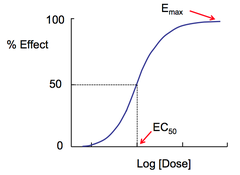
What is a common measurement of drug potency?
EC50 (lower EC = higher potency)
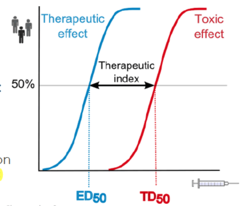
Therapeutic Index (TI)
Degree of separation between toxic and therapeutic doses
Systemic controlled drug delivery routes (7)
1. Oral route
2. Intravenous route
3. IM or SC
4. Transdermal
5. Sublingual or buccal
6. Intranasal
7. Pulmonary
Dissolution
the process and rate at which a drug moves from the solid state into solution

What does the model called the "Hixon-Crowell Cube Root Law" take into consideration that other models don't consider?
Particle size shrinkage during dissolution
Which parameter is present in all dissolution mathematical models?
Solubility
Which dissolution technique would you use to select the most preferable salt or polymorph of an insoluble drug?
Intrinsic dissolution test
What biologic component(s) can be added to a dissolution medium to better simulate fed and fasted conditions in the intestinal tract?
Lecithin and sodium taurocholate
What effect can excessive lubricant have on drug absorption from tablets and capsules?
Decreased dissolution rate
How can the unstirred layer thickness surrounding a dissolving drug particle be reduced to increase the dissolution rate?
Increase the agitation rate
Dissolution rates are directly proportional to what? (3)
1. Drug diffusion coefficient
2. Surface area of exposed drug
3. Drug solubility
What are the three necessary qualities for successful tablet product development captured in the Product Development Triangle?
1. Stability
2. Manufacturability
3. Bioavailability

At what part of the intestinal tract is it most likely for a weakly basic drug to rapidly dissolve?
Stomach
Why is helpful to establish an in vitro/in vivo (IVIVC) correlation during development of a drug product? (3)
1. To help choose a manufacturing process
2. To help choose appropriate excipients
3. To assist with selecting storage conditions for shelf life determination
Why should we choose the oral route for medications? (3)
1. Most convenient form of administration
2. Most cost effective
3. Flexibility in dosage regimen

What is Surface Area (A) affected by? (3)
1. Particle size
2. Dispersibility of powdered solid
3. Porosity of solid particles
What is Saturated Solubility (Cs) affected by? (5)
1. Temperature
2. Nature of medium
3. Molecular structure of solute
4. Crystalline form of solid
5. Presence of other compounds
What is Concentration of Solute at time t (Ct) affected by? (2)
1. Volume of medium
2. Processes that removed dissolved solute from medium
What is the Dissolution Rate Constant (k) affected by? (2)
1. Diffusion coefficient D of solute
2. Viscosity of medium
What is Thickness of Boundary (h) affected by?
Degree of agitation
Generally, as A (surface area) increases, the dissolution rate will...
also increase
What component can be added to a formulation to overcome aggregation due to particle size?
Surfactants
The apparent thickness of the stagnant layer can be reduced when a drug dissolves into a ___________ medium (ex. weak base in an acidic medium)
reactive
Salts of weak acids and weak bases generally have a much _________ aqueous solubility than the free acid or base (ex. Penicillin V)
higher

What are the types of tablets?
Compressed and molded
Purpose of a diluent in a tablet
Increases bulk
What are the types of diluents used in tablets?
Organic and inorganic
What is the purpose of tablet binders?
work as binding agents to assist in granulation
What is the purpose of disintegrators in tablets?
cause the tablet to break apart into solution
What is the purpose of lubricants in tablets?
reduce friction and prevent sticking during production
What is the purpose of glidants in tablets?
improve the powder flow into the tableting machines for compaction
What are the two super disintegrants that can break up a tablet/capsule within 15 minutes?
croscarmellose sodium, sodium starch glycolate
Purpose of tablet coating (9)
1. Enhance palatability
2. Increase stability
3. Increase mechanical integrity
4. Enhance appearance
5. Avoid staining
6. Avoid side effects
7. Separate incompatible substances
8. Modify drug release profiles
9. Identifier

List the types of tablet coatings (5)
1. Sugar
2. Film
3. IR
4. Delayed release (enteric)
5. CR
What are the types of capsules?
hard gelatin and soft gelatin
Hard gelatin capsules are filled with... (4)
1. Solids (tablets)
2. Powders
3. Granular or pelletized materials
4. Oils
Soft gelatin capsules are filled with... (3)
1. Semisolids
2. Liquids
3. Granular or pelletized materials
Capsules sizes are identified by numbers. The sizes commonly used for human consumption are...
000, 00, 0, 1, 2, 3, 4, 5
Hard gelatin capsules containing hydrophobic drug particles should contain...
hydrophilic diluent particles
Alternate material to gelatin in capsules (2)
1. Pullulan, water soluble polysaccharide
2. HPMC, a water soluble polymer
Buccal - General location
Cheek
Sublingual - General location
Ventral tongue; floor of mouth
Gingival - General location
Gums surrounding teeth
Palatal - General location
"Roof" of mouth
Magnesium stearate - Role of Excipient
Lubricant
Corn starch - Role of Excipient
Disintegrant (also a diluent, binder)
Colloidal silicion dioxide - Role of Excipient
Glidant
Gelatin - Role of Excipient
Binder/diluent
Calcium stearate - Role of Excipient
Lubricant
Stearic Acid - Role of Excipient
Lubricant
Titanium Dioxide - Role of Excipient
Coloring agent
Sodium laurel sulfate - Role of Excipient
Lubricant
PVP or Povidone - Role of Excipient
Disintegrant
Propyl paraben - Role of Excipient
Preservative
Benzalkonium bromide - Role of Excipient
Preservative
Ferric oxide - Role of Excipient
Coloring agent
Controlled release definition
delivers a drug in a manner that is planned, predictable, and slower-than normal
What are the 4 types of controlled release systems
1. Sustained-release
2. Delayed-release
3. Targeted-release
4. Responsive-release