Advanced Para 2 Exam
 Call Kai
 Learn
 Practice Test
 Spaced Repetition
 Match
 Flashcards
 Knowt Play
1/152

There's no tags or description
Looks like no tags are added yet.
153 Terms
What are the indications and contraindications of Adrenaline?
Indications
Severe/Life threatening Asthma
Anaphylaxis
Cardiac Arrest
Post ROSC
Contraindications
Nil
What are the indications and contraindications of Amiodorone?
Indications
Cardiac Arrest with persistent, shock-resistant VF or pulseless VT post 3rd shock
Contraindications
NIl in cardiac arrest
What are the indications and contraindications of Aspirin?
Indications
Suspected acute coronary syndrome
Contraindications
Knowl hypersensitivity to aspirin, NSAIDs or salicylates
What are the indications and contraindications of Atropine?
Indications
Symptomatic bradycardia that is haemodynamically unstable, associated with poor signs of perfusion, including hypotension, altered GCS, diaphoresis, SOB, syncope, and/or cyanosis
Contraindications
Known hypersensitivity
Patients with a cardiac transplant
What are the indications and contraindications of Cefazolin?
Indications
Prophylactic antibiotic for open fractures or grossly contaminated wounds that cannot be cleaned
Contraindications
Immediate/severe hypersensitivity to penicillin
Closed fractures that don ot meet other indications
Isolated open fracture of the distal phalanx
What are the indications and contraindications of Cophenylcaine?
Indications
Local pain/abrasions, small cuts and wounds
Mild-Moderate epistaxis
Post-tonsillectomy haemorrhage
Intra-oral haemorrhage
Contraindications
Hypersensitivity to phenylephrine, lidocaine or other anaesthetics
Pregnancy
What are the indications and contraindications of Droperidol?
Indications
Disturbed and abnormal behaviour RASS 1-3 where risk to safety is evident and de-escalation is ineffective
Dementia and frail patients where olanzapine cannot be administered or is ineffective
Contraindications
Known allergy
Known parkinson’s disease
Where ketamine has been administered to sedate this episode
Postictal disturbed and abnormal behaviour
Age less than 6 years
Patients known or suspected to be pregnant
What are the indications and contraindications of Fentanyl Citrate?
Indications
Moderate to severe pain
Acute coronary syndrome where GTN has been ineffective
Contraindications
Hypersensitivity to fentanyl
Age less than 1 year
What are the indications and contraindications of Fentanyl?
Indications
Moderate to severe pain
Acute coronary syndrome where GTN has been ineffective
Contraindications
Hypersensitivity
Occluded nasal passages or epistaxis
What are the indications and contraindications of Glucagon?
Indications
Hypoglycaemia where oral glucose cannot be given and unable to obtain an IV.
Altered conscious state in a known diabetic or of otherwise unknown cause where BGL is <4mmol/L
Contraindications
Hypersensitivity
Known pheochromocytoma, insulinoma or glucagonoma
What are the indications and contraindications of Glucose 10%?
Indications
Hypoglycaemia where oral glucose cannot be given and unable to obtain an IV.
Altered conscious state in a known diabetic or of otherwise unknown cause where BGL is <4mmol/L
Cardiac arrest only if hypoglycaemia is suspected as contributory cause of arrest
Contraindications
No patent IV access
What are the indications and contraindications of Glucose Gel?
Indications
Hypoglycaemia
Altered conscious state in a known diabetic or of otherwise unknown cause where BGL is <4mmol/L
Contraindications
Patient is unable to safely ingest gel orally or bucally
What are the indications and contraindications of Glyceryl Trinitrate?
Indications
Chest pain/discomfort of presumed cardiac origin not relieved by rest and reassurance with systolic BP > 90 mmHg AND heart rate is within 50-150 beats per minute
Acute Cardiac Pulmonary Oedema with systolic BP> 90 mmHg
Autonomic Dysreflexia with systolic BP > 160 mmHg.
Suspected Irukandji sting with systolic BP > 160mmHg
Contraindications
Hypersensitivity
Hypotension <90mmHg
Ventricular tachycardia (VT)
Recent use of medications used for sexual dysfunction or specific regular medication used in the treatment of pulmonary arterial hypertension: Sildenafil (Viagra) or Avanafil (Spedra) use in the previous 24 hours, Tadalafil (Cialis) use in the previous 3 days, Riociguat (Adempas)
What are the indications and contraindications of Heparin?
Indications
Confirmed STEMI transporting to CATH lab
Contraindications
Hypersensitivity to Heparin
Active Bleeding (excluding menses) or disease states with increased risk of bleeding ( e.g haemophilia)
What are the indications and contraindications of Hydrocortisone?
Indications
Adrenal crisis in patients with known adrenal insufficiency.
Adults: Severe & life-threatening asthma exacerbations
Paeds: Life-threatening asthma exacerbations
Contraindications
Hypersensitivity to hydrocortisone
What are the indications and contraindications of Ipratropium Bromide?
Indications
Severe bronchospasm in Severe to life-threatening asthma or COPD
Contraindications
Hypersensitivity
What are the indications and contraindications of Ketamine?
Indications
Severe pain of traumatic origin
RASS 4 - Severely disturbed abnormal behaviour with immediate risk to safety
Sedation in pregnancy
CPR-induced consciousness
Combative TBI
Contraindications
Hypersensitivity
Active cardiovascular disease, including cardiac chest pain, heart failure, severe or poorly controlled hypertension.
Non-pregnant disturbed and abnormal behaviour that are not RASS 4 or when sedative agents have already been given ( ASMA authority required)
Rapid Tranquilisation ONLY: < 16 y.o
< 1 y.o
Patients with delayed transfer of care (i.e ramped)
What are the indications and contraindications of LIgnocaine 1%?
Indications
Local anaesthesia for: IV Cannulation or IO infusion
Cardiac Arrest with persistent or recurrent Ventricular Fibrillation/pulseless Ventricular Tachycardia, refractory to defibrillation strategies and maximum dose of amiodarone, as per Cardiac Arrest CPG (Clinical exception required)
Contraindications
Hypersensitivity
What are the indications and contraindications of Loratadine?
Indications
Symptomatic urticaria (without evidence of anaphylaxis)
Contraindications
Children under 30 kg
Hypersensitivity to loratadine
What are the indications and contraindications of Methoxyflurane?
Indications
Analgesia
Contraindications
Hypersensitivity to fluorinated anaesthetics
Children under 1 year of age
Patients unable to co-operate including those affected by alcohol or illicit drugs.
Patients with a severe head injury and altered state of consciousness
Patients susceptible to malignant hyperthermia
What are the indications and contraindications of Midazolam?
Indications
Prolonged seizure activity ≥ 5 mins OR recurrent/status activity
Focal seizure activity which is prolonged ≥ 5 mins with a GCS ≤ 12
Second- line IV agent for maintenance of sedation after droperidol for disturbed and/or abnormal behaviour.
Second-line IV agent for maintenance of sedation after Ketamine in pregnant patient
Contraindications
Hypersensitivity
Use of Midazolam for sedation after ketamine requires ASMA Authority (non- pregnant) or STORC consult (pregnant)
What are the indications and contraindications of Naloxone?
Indications
Reversal of Respiratory Depression in suspected narcotic overdose
Contraindications
Hypersensitivity to Naloxone
What are the indications and contraindications of Olanzapine?
Indications
Disturbed and Abnormal Behaviour (RASS 1-3) where risk to safety is evident and de-escalation not effective.
Patient can tolerate or self-administer oral wafer.
Preferred first-line sedation in frail patients and those with Dementia.
Contraindications
Known allergy
Known Parkinsons Disease
< 6 years old
What are the indications and contraindications of Ondansetron?
Indications
Moderate to severe nausea.
Active Vomiting
Nausea and vomiting prophylaxis for eye and spinal injuries.
Contraindications
Hypersensitivity to Ondansetron.
Treatment with apomorphine: risk of severe hypotension and loss of consciousness if given to a patient taking apomorphine.
< 2 years old
What are the indications and contraindications of Oxytocin?
Indications
Partial active management of third stage of labour.
Treatment of postpartum haemorrhage (PPH): Primary:> 500 ml blood loss within 24hours of birth. Secondary: 500 ml blood loss between 24 hours and 12 weeks postpartum
Contraindications
Foetus remaining in uterus; multiple pregnancy must be excluded prior to administration.
Within 6 hours of vaginal prostaglandins
Allergy to oxytocin. Latex allergy may be a risk factor for
What are the indications and contraindications of Paracetamol?
Indications
Mild to moderate pain e.g headache, sprain
As a component of a multimodal analgesic regimen
Contraindications
Hypersensitivity to Paracetamol
What are the indications and contraindications of Salbutamol?
Indications
Bronchospasm and respiratory distress associated with wheeze:
Acute Bronchial
Asthma
Bronchitis
smoke inhalation
Severe allergic/anaphylactic reactions
APO (Non-Cardiac)
Salt Water Aspiration Syndrome
COPD
Contraindications
Known hypersensitivity to salbutamol.
Cardiogenic pulmonary oedema
Age<12 months
What are the indications and contraindications of Sodium Chloride?
Indications
Fluid therapy for shock, DKA and hyperosmolar hyperglycaemic state
Haemorrhage
Cardiac Arrest
ROSC
Burns >15% TBSA
Contraindications
Severe Pulmonary Oedema
What are the indications and contraindications of Tranexamic Acid?
Indications
Significant trauma (<3 hours) with signs of hypovolaemia
Significant active haemorrhaging requiring torniquet or haemostatic dressings
Suspected head injury (<3 hours) with GCS motor score of 4 (withdrawing from pain) or below.
Severe primary or secondary PPH (> 500 ml) or PPH with signs of hypovolaemia (birth/bleed <3 hours).
Significant post-tonsillectomy haemorrhage.
Contraindications
Known hypersensitivity to Tranexamic Acid
Injury time more than 3 hours
What is the route, dose and repeats of adrenaline?
Severe life-threatening asthma
IM - 0.5mg repeated every 5 mins no max
Anaphylaxis
IM - 0.5mg repeated every 5 mins no max
Anaphylaxis with airway obstruction, stridor, angioedema
Post 2x IM doses - NEB - 5mg - Single dose consult for repeat
Anaphylaxis/ Peri Arrest refractory to 2x IM doses and fluid (NOT IN SAAS)
IV/IO - 10mcg diluted into 9ml saline to make 1mg/1ml and repeated every 1 minute - if not effective after 2 doses, consult for a higher dose
Cardiac arrest
IV/IO - 1mg repeated every 3-5 minutes or after every second loop
Post ROSC
IV/IO - 50mcg diluted into 9ml saline to make 1mg/10ml and repeated every 3-5 minutes as required to maintain a BP over 100mmHg post 2× 250ml saline bolus
Severe Croup
NEB - 5mg repeated again after 15 minutes if required
What is the route, dose and repeats of amiodarone?
IV/IO 300mg after 3rd shock, single rpt 150mg after 5th shock
What is the route, dose and repeats of aspirin?
PO 300mg single dose
What is the route, dose and repeats of atropine?
Symptomatic Bradycardia
IV/IO 0.6mg/0.5ml neat every 3-5mins titreated to effect to a max 3mg
Organophosphate Poisoning
IV/IO 1-2mg/10-20ml, Diluted with 11ml saline to make 1.2mg/12mls repeated every 5 minutes until atropinisation is evident
What is the route, dose and repeats of cefazolin?
IV 2g reconstituted with 19ml saline slow pushed over 3-5 minutes single dose
What is the route, dose and repeats of cophenylcaine?
IN - 10 sprays (5 per nostril) max 10 sprays
PO/Topical - 6 sprays max 5 sprays
What is the route, dose and repeats of droperidol?
IM
<70 years in nil/mild alcohol intoxication - 10mg
<70 years on moderate/severe alcohol intoxication - 5mg
>70 years nil/mild alcohol intoxication - 5mg
.70 years moderate/severe alcohol intoxication - 2.5mg
IV - Diluted with 8mls saline to make 1mg/ml
<70years 2.5-5mg titrated to effect
>70 years - 2.5mg
All routes/doses are repeated as necessary each 15 mins to max cumalative dose 20mg/24hrs (via all routes).
What is the route, dose and repeats of fentanyl citrate?
IV/IO - Adult <70 years old 1mcg/kg to a max single dose of 100mcg diluted into 8ml saline to make 100mcg/10ml and slow pushed over 3-5 minutes
IV/IO - Adult >70 years old 0.5mcg/kg to a max single dose 50mcg
25mcg after 5 mins as required (Ramped patients MUST NOT have loading doses adminsitered.
What is the route, dose and repeats of fentanyl?
IN
Small/elderly/frail - 90mcg - 2×0.15ml - Rpt 45mcg after 5-10 minutes
Adult - 180mcg 3×0.2ml - Rpt 60mcg after 5-10 mins
What is the route, dose and repeats of Glucagon?
IM - 1mg/1ml using hypokit and 3ml vanishpoint repeated 10 mins once if still unable to gain IV access
What is the route, dose and repeats of Glucose 10%?
IV - 15g (150ml) with 250mkl bas of fluids insitu for immediate flush repeating 10g/100ml titrating to effect after 5-10 minutes if BGL is less than 4mmol/L
What is the route, dose and repeats of Glucose Gel?
PO - 15g singular tube repeated after 10 minutes if required
What is the route, dose and repeats of GTN?
SL - 400mcg (1 spray) repeated after 5 minutes until resolution of symptoms, provided BP is maintained over the relevant threshold.
What is the route, dose and repeats of Heparin?
IV - 5000IU/5ml single dose only
What is the route, dose and repeats of Hydrocortisone?
IM/IV 100mg single dose only
Press doen firmyl on the activator to force dilutent into the powder and gently mix, do not shake
What is the route, dose and repeats of Ipratropium Bromide?
NEB 500mcg with 2ml saline, administered with 5mg/2.5ml salbutamol every 20mins max 3 doses
What is the route, dose and repeats of Ketamine?
Severe pain of traumatic origin given IM as a first-line agent when other means of administering pain meds are not available or as a second-line agent following IV fentanyl
IM - 1mg/kg given neat and a subsequent dose of 0.5mg/kg after 5 minutes
IV - 5- 20 mg diluted with 18ml saline to produce 10mg/ml with a subsequent dose of 4- 10 mg titrated to effect after 5 mins
Severely disturbed abnormal behaviour with an immediate risk to safety, with a RASS over 4 and no other sedative medications were administered
IM - 2mg/kg in moderate/severe alcohol intoxication or 4mg/kg in nil/mild alcohol intoxication given neat and repeated as necessary to a cumulative dose of 200mg in moderate/severe alcohol intoxication or 400mg in nil/mild alcohol intoxication
IV- Maintenance - 0.5mg/kg diluted in 200mg into 18ml to make 200mg/20ml or 10mg/1ml and repeated every 5-10 minutes as required
Sedation in pregnancy as a first-line agent when olanzapine is not suitable
IM - 4mg/kg Maintenance dose IV/IO 0.5mg/kg repeated every 5-10 minutes as required
CPR-induced consciousness
IV/IO - 0.3-0.5mg/kg diluted in 200mg into 18ml to make 200mg/20ml or 10mg/1ml and repeated ONCE after 5-10 minutes if required
Combative TBI
IM - 2mg/kg max 200mg diluted in 200mg into 18ml to make 200mg/20ml or 10mg/1ml
IV/IO- 0.5mg/kg diluted in 200mg into 18ml to make 200mg/20ml or 10mg/1ml and repeated every 5-10 minutes as required
What is the route, dose and repeats of Lignocaine?
Local anaesthesia for IV/IO insertion
ID - 0.1ml can be applied to a second site if needed
IO - small adult - 20mg (1 ampule), adult - 40mg (2 ampules) and can be used at a second site if needed
Cardiac Arrest with persistent or recurrent Ventricular Fibrillation/pulseless Ventricular Tachycardia, refractory to defibrillation strategies and maximum dose of Amiodarone as per Cardiac Arrest CPG (Clinical exception required)
IV/IO - 1mg/kg and may be repeated once if there is sufficient supply
What is the route, dose and repeats of Loratadine?
PO - 10mg single dose
What is the route, dose and repeats of methoxyflurane?
IH 3ml repeated after 30 minutes if required to a max dose of 6ml in 24 hours or 15ml in a week
What is the route, dose and repeats of Midazolam?
Prolonged seizure activity for 5 minutes or longer, or recurrent/status activity, or focal seizure activity that is prolonged for 5 minutes or longer and is associated with a GCS of 12 or less
IM - Adult <70 years - 5mg with 5mg repeated after 10 minutes if there is no IV access
IM - Adult >70 or frail - 2.5mg with 2.5mg repeated after 10 minutes if there is no IV access
IV/IO <70 years - 2.5- 5 mg diluted into 12ml saline to make 15mg/15ml or 1mg/ml, and a repeat dose of 2.5mg repeated every 5-10 minutes as required to a max dose of 15mg
IV/IO >70 years - 2.5mg diluted into 12ml saline to make 15mg/15ml or 1mg/ml, and a repeat dose of 1mg repeated every 5-10 minutes as required to a max dose of 5mg
Second-line IV agent for maintenance of sedation after droperidol for disturbed or abnormal behaviour or maintenance of sedation after ketamine in pregnant patients
IV <70 years - 1-2mg diluted into 12ml saline to make 15mg/15ml or 1mg/ml, and a repeat dose of 1-2mg titrated to effect and repeated every 5-10 minutes as required to a max dose of 5mg
IV >70 years - 0.5-1mg diluted into 12ml saline to make 15mg/15ml or 1mg/ml, and a repeat dose of 1-2mg titrated to effect and repeated every 5-10 minutes as required to a max dose of 5mg
What is the route, dose and repeats of naloxone?
IM/IV/IO - 400-800mcg rpt dose every 2 mins titrated to effect to a max 10mg
If IV then dilute 400mcg/1ml with 9ml saline to make 40mcg/1ml
If IM - neat
What is the route, dose and repeats of olanzapine?
PO <70 - 10mg (2 wafers) repeated as necessary after 15 minutes to a max dose of 20mg/24 hours
PO >70 years - 5mg (1 wafer) repeated as necessary after 15 minutes to a max dose of 10mg/24 hours
What is the route, dose and repeats of ondansetron?
PO - 4mg (1 wafer) and repeated a single second dose after 15 minutes, max dose of 8mg inclusive of all administrative means.
IM - 4mg (2ml)and repeated a single second dose after 15 minutes, max dose of 8mg inclusive of all administrative means.
IV - 4mg diluted into 8ml saline to make 4mg in 10ml and slow poushed over 30 seconds minimum, but ideally 3-5 minutes and repeated a single second dose after 15 minutes, max dose of 8mg inclusive of all administrative means.
What is the route, dose and repeats of oxytocin?
IM - 10IU/1ml sigle dose
What is the route, dose and repeats of paracetamol?
PO - 500-1000mg repeated 4-6hrly as needed to a max dose of 4g per day
What is the route, dose and repeats of salbutamol?
NEB - Moderate-severe asthma or COPD- 5mg (1 nebule) 6-8L/min of oxygen repeated as necessary
NEB - Life-threatening - 10mg (2 nebules) 6-8L/min of oxygen repeated as necessary
NEB - Other conditions - 5-10mg (1-2 nebules) with 8-8L/min oxygen repeated as necessary
MDI - 4-12 puffs (400-1200mcg) recommended use with a spacer, repeat every 20 minutes or sooner if needed within the first hour
What is the route, dose and repeats of Sodium Chloride?
Fluid therapy for shock, DKA, and hyperosmolar hyperglycaemic state
IV/IO - 250mls repeat 250ml boluses to a max 2000mls or in small/elderly adults to a max 1000ml
Haemorrhage
IV/IO - 250mls repeat 250ml boluses to a max 2000mls
Cardiac arrest
20ml/kg single bolus as a reversible cause
ROSC
IV/IO - 250mls repeat 250ml boluses to a max 500ml with reassessment between boluses
Burns in adults >15% TBSA
IV/IO - 2ml x TBSA x weight in kg give first 50% in the first 8 hours and the second 50% in the following 16 hours
What is the route, dose and repeats of TXA?
IV - 1g slowly over 10 minutes, single dose only given, but rapid administration may cause hypotension
What is the RASS?

What are target oxygen saturations?
In healthy patients >94-98%
In COPD patients - 88-92%
What is the rates of oxygen a minute for each mask type?
Nasal Cannula - 1-4l/min
Therpay/Hudson mask - 5-8L/min
Non-rebreather - 10-15L/min
Bag-valve mask - 15L/min
What are the fentanyl doses for children?
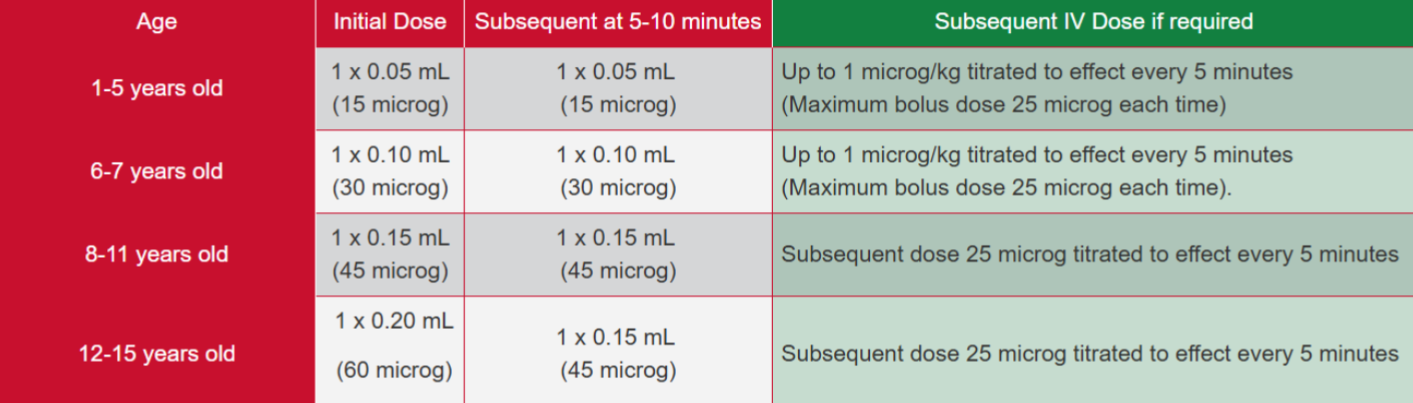
How are head injuries classified?
Mild - GCS 14-15
Moderate - GCS 9-13
Severe GCS 3-8
What is a focal vs diffuse head injury?
A focal head injury damages a specific localised area of the brain and arises from injuries such as scalp lacerations, skull fractures and surface contusions whereas a diffuse injury impacts wideapread areas or multiple regions of the brain and are caused by injurues such as hypocix/ischaemic damage, vascular injuries or diffuse axonal injuries.Diffuse injuries are impossible to diagnose in a prehospital setting.
How is cerebral blood flow maintained?
Constatnt cerebral blood flow is maintained by ensuring there is adequare cerebral perfusion pressure to force blood into the head and auto regulation, the regulatory mechanisms ehat ensures a constant blood flow by carying the resistance to blood flow as the perfusion pressure changes.
What is mean arterial pressure and what is the equations needed to work it out?
Mean arterial pressure is the average pressure for the entire cardiac cycle.
Pulse pressure = systolic pressure - diastolic pressure
MAP = diastolic pressure + 1/3 pulse pressure.
What is cerebral perfusion pressure?
CPP is the amount of pressure required to push blood through cerebral circulation and therefore maintain blood flow, oxygen and glucose delivery to the brain cells and is directly related to the intracranial pressure.
CPP = MAP - ICP
What are the normal amounts for MAP, ICP and CPP?
MAP - 85-95mmHg
ICP - <15mmHg
CPP = 70-80mmHg
What is a traumatic brain injury?
A traumatic insult to the brain capable of producing physical, intellectual, emotional, social, and vocational change that can be categorised as primary or secondary brain injury.
Primary brian injury occurs as a result of initial force whereas secondary brain injury occurs after the primary injury and is caused by hypotension, hypoxia, hypo/hyperglycaemia, seizures, ischaemia, cerebral oedema, haematomas, herniation, etc.
What is brain herniation?
When intracranial pressure increases and becomes too high, it will force brain tissue through natural folds or openings in the brain which can damage brain cells and cut off blood flow.
Cushing’s triad is a late sign of dangerously high intracranial pressure as well as blown pupils.
What is cushings triad?
High blood pressure, low heart rate and irregular breathing and is a late sign of dangerously high intracranial pressure.
What is decerebrate postureing vs decorticate posturing characterized by?
Decerebrate - rigid muscles, arched back, extended legs and arms, wrists flexed back
Decorticate - Arms flexed toward the body at the elbow, legs extended, wrists clenched
What are abnormal respiratory patterns?
Ataxia - Significant disorganisation with ireegular and varying depths of respiration
Bradypnoea - slower than 12 breaths a minute
Hyperpnoea - Faster than 20 breaths per minute with deep breathing
Blot respirations - Irregularly interspaced periods of apnoea in a disorganised sequence of breaths
Cheyne-strokes breathing - Carying periods of increasing depth interspeded with apnoea
Kussmaul respirations - rapid, bleed, laboured breathing
Tachypnoea - Faster than 20 breaths a minute.
What are signs in increased intracranial pressure?
Changes in LOC
Eyes - pupil changes, impaired eye movement
Posture - Decerebrate, decorticate, flaccid
Headache
Seizures
Cushing’s triad
Vomiting
Changes in speech
In infants there may be bulging fonranels, crancial suture separation, increased head circumfrence and a high pitched cry.
How much blood can be lost in a tibial/fibular fracture, femoral fractuire and pelvic fracture?
Within the first 2 hours 550mls can be lost from a tibial or fibular fracture, 1000ml from a femoral fracture amnd 2000mls from a pelvic fracture
What is a joint disclocation?
Occurs when normal articulating ends of two or more bones are displaced
Joints that often are dislocated
Shoulders
Elbows
Fingers
Hips
Knees
Ankles
A joint dislocation should be suspected when the joint is deformed or does not move with a normal range of motion
A complete dislocation is called a luxation, whereas an incomplete dislocation is a subluxation
What are common signs and symptoms of an extremity trauma?
Pain or palpation or movement
Swelling or a deformity
Crepitus
Decreased range of motion
False movement - Unnatural movement of an extremity
Decreased or absent sensory perception or circulation distal to the injury - evidenced by alterations in skin color and temperature, distal pulses, and capillary refill
How should an injured extremity be assessed?
The 6 P’s
Pain
Pallor
Paraesthesia
Pulses
Paralysis
Pressure
Evaluation of an injured extremity should always include a neurovascular status assessment by assessing the distal pulse, motor function and sensation before and after movement or splinting
Inspect and palpate for surface trauma, tenderness and swelling
If possible, compare it with the opposite, uninjured extremity
What is the management of an extremity musculoskeletal injury?
Assessment of neurovascular status
Application of splint, sling and/or swathe
If neurovascular compromise is present consider if realignment is needed
Application of ice
Analgesia if appropriate
What are common upper extremity musculoskeletal injuries?
Shoulder injuries - Anterior fracture/dislocation
Most commonly occurs in older adults due to a weaker bone structure, often from a fall onto an outstretched arm.
Presents with the lateral aspect of the shoulder appearing flat instead of rounded and/or a deep depression between the head of the humerus and the acromion laterally.
Humeral Injury
Upper arm fractures are common in older adults and children but are often difficult to stabilise
If the fracture occurred in the middle or distal portion of the humeral shaft, the radial nerve may be involved.
If the fracture involved the humeral neck, there may be axillary nerve damage
Can be complicated if there is a haemorrhage internally into the joint
Elbow injury
Radial, ulnar or wrist injury
Usually results from a fall on an outstretched arm
Humerus, radius (thumb), ulna (little finger)
Wrist injuries may involve the distal radius, the ulna or any of the eight carpal bones
Most common wrist injury is a Colles’ fracture with a deformity of the distal radius with dorsal angulation
What are common lower extremirt musculoskeletal injuries?
Pelvic fracture
Blunt or penetrating injury to the pelvis can result in fracture, severe haemorrhage and associated injury to the bladder and urethra
The pelvis is surrounded by heavy muscles and soft tissue, meaning a deformity may be difficult to see and an injury should be suspected based on MOI or tenderness on palpation of the iliac crests
These patients need high-concentration O2, management for potential shock, a pelvic binder, full-body immobilisation, regular monitoring and rapid transport
Hip injury - NO traction splint
Commonly occurring in older adults as a result of falls or in younger patients as a result of major trauma
25% of older patients will die within the first year following injury as a result of venous thromboembolism, pneumonia or infection.
If the femoral head and neck are fractures the leg will usually shorten and rotate externally
If the hip is dislocated, the leg will usually shorten and rotate internally
Femoral injury - Traction splint
Usually a result from major trauma
Fractures will cause contractions in the powerful thigh muscles that cause bone fragments to ride back and forth over each other.
Generally, the leg is shortened and externally rotated with mid-thigh swelling
Tibial and Fibular injury
Can result from direct trauma or indirect trauma like a twisting injury
If the knee is involved, popliteal vascular injury should be suspected
What angular fractures and disclocations can be reduced in a prehospital setting?
Never the elbow
Lateral Patella Reduction can be attempted
Gentle firm traction should be applied in the direction of long axis of the extremity and if there is resistence felt stop and splint the injury without realignment
What is the general management of a fracture?
Primary Survey
Consider pain relief early
A to E assessment
Manual immobilisation whilst assessing (if possible)
O2 if indicated
IV access
Thorough assessment of injury (6 P’s)
Splint appropriately
Elevate if appropriate
Reassess vital signs and 6 P’s
Transport to appropriate facility (trauma centre)
What are the nexus criteria?
C-spine pain or tenderness
Altered mental status
Intoxication
Painful distracting injury
Neurological deficit
What factors are high-risk for a patient with a mechanism of injury that suggests spinal injury?
Patient aged 65 years old or above
Known pre-existing spinal conditions
Dangerous mechanism of injury
If 2 or more high-risk factors are present (or one for paediatrics) employ spinal motion restriction
How is blood circulated through the coronary arteries?
The coronary arteries are the sole suppliers of arterial blood to the heart and deliver 200-250ml of blood to the myocardium each minute during rest
The left coronary artier carries 85% of the blood supply to the myocardium and supplies the left ventricle, the interventricular septum, part of the right ventricle, the left anterior descending artery and the circumflex artery.
The right coronary artrry carried 15% of the blood supply and supplies the right atrium and ventricle, part of the left ventricle, the conduction system, the right anterior descending artery and the marginal branch.
The arteries start just above the aortic valve where the aorta exists the heart, run along the epicardial surface and divide into smaller vessels as they penetrate the myocardium and endocardial surface
What is ACS?
Acute coronary syndromes including an acute myocardial infarction and unstable angina that is the most common cause of sudden cardiac death
The underlying pathophysiology is ruptured or eroded atheromatous plaque causes an arterial blockage preventing distal blood flow, causing ischaemia and cardiac tissue death.
What is Artherosclerosis?
A disease process characterised by progressive narrowing of the lumen of medium and large arteries, resulting in the development of thick, hard plaque called atheroma or atheromatous lesions, most often found in areas of turbulent blood flow, vessel bifurcations and those with decreased lumen diameter. Results from damage to endothelial cells and inflammation, and the response includes platelet adhesion and clotting. Smooth muscle cells may move from the middle muscle layer into the lining of the artery, forming an atheroma which eventually becomes fibrous and hardened, obstructing the artery. Some collateral circulation can develop to make up for the narrowed vessels.
The two main effects on blood vessels are - the atheroma will cause the loss of the vessel elasticity, increase formation of clots and will reduce the diameter of the vessel lumen, which will decrease blood supply to tissue, reduce the space for clots to pass and cause insufficient nutrient supply to tissues.

What is angina pectoris?
A symptom of myocardial ischaemia that literally means “choking pain in the chest”, caused by an imbalance between myocardial oxygen supply and demand and the resultant buildup of lactic acid and CO2 in ischaemic tissues in the myocardium, which irritate nerve endings, causing anginal pain. Myocardial ischaemia puts the heart muscles at risk of developing dysrhythmias. There are three kinds of angina
Stable Angina
Usually precipitated by physical exertion or emotional stress
Pain usually lasts 1-5 minutes; however, it can last as long as 15 minutes
Typically relieved by rest, nitrates, or O2
Attacks are usually similar and are always relieved by the same mode of therapy
Unstable Angina
Is anginal pain that usually begins during periods of very light activity or rest
AKA pre-infarction angina
The pattern of onset, frequency, intensity, duration or quality has changed
Pain usually lasts 10+ minutes and regular treatment has no effect
These patients are more at risk of an MI and cardiac arrest
Prinzmetal’s Angina
Spasm of the coronary artery causes a temporary occlusion
Caused by contraction of the smooth muscle tissue in the vessel walls rather than by atherosclerosis or clots
Typically occurs at rest rather than on exertion
What are the signs and symptoms of angina?
Left-sided or central chest discomfort
Usually described as pressure or tightness in the chest
Pain will often radiate into the upper back, shoulders, jaw and left arm
Anxiety
Shortness of breath
Diaphoresis
Nausea
Fatigue
Headache/Dizziness
Generalised weakness
What is a myocardial infarction?
A myocardial infarction is when blood flowing through a coronary artery is blocked, causing ischaemia, cellular injury and necrosis distally in the myocardium supplied by that artery. Begins with the formation of atherosclerotic plaque that disrupts the normally smooth arterial lining and results in an uneven surface; turbulent blood flow can then cause the plaque to rupture, exposing the injured tissue to circulating platelets. This then results in the formation of a thrombus that occludes the artery; as the thrombus enlarges, it reduces blood flow through the coronary vessel.
Generally, an acute thrombotic occlusion is the most common cause of an acute MI; however, it can also be caused by coronary spasm or embolism, haemorrhage into diseased arterial wall, reduced blood flow from shock or severe hypoxia.
The size of the infarct is determined by the needs of the tissue supplied by the occluded vessel, if there is collateral circulation and the time it takes to reestablish perfusion.
Which STEMI indicates on occlusion of which artery?
A anterior, lateral or septal wall infarction indicate a left coronary artery
A inferior wall infaction indicated a right coronary artery occlusion
What are the classifications of a myocardial infarction?
Unstable angina
Non-stemi
Occurs as microemboli from a thrombus become lodged in distal coronary arteries
Produces minimal damage to the myocardium
Evident only with ST depression or T wave abnormalities
STEMI
Occurs when a thrombus completely occludes the coronary vessel for a prolonged period of time
Diagnosed with elevated ST segments in two or more continuous ECG leads
The clot is rich in thrombin therefore early management with fibrinolytics may help to limit the size of the infarct.
What are the signs and symptomns of an acute myocardial infarction?
Chest pain
Constant pain that may radiate to the arms, neck, jaw or back
Agitation
Anxiety
Cyanosis
Diaphoresis
Weakness
Dysponea
Nausea and vomiting
Palpitations
Sense of impending doom
How do vital signs change in a MI?
Vital signs vary depending on the extent of thje damage to the heart and conduction systems
An inferior MI is more likely to show parasympathetic responses
An atnerior MI is more likely to show sympathetic responses
What is the prehospital management of chest pain?
Primary survey A-E
Primary goals of treatment
Identify a possible MI
Relieve pain and apprehension
Prevent the development of serious dysrhythmias
Limit the size of the infarct
Increase coronary blood supply or decrease myocardial oxygen demand (or both)
Position of comfort
Administer O2 if indicated
Aspirin
Initiate IV
12-lead ECG
If confirmed STEMI and transporting to cath lab consider heparin
Acute thrombus can be dissolved and ischaemic myocardium salbaged if a fibrinolytic agent like heparin is administered within 6 hours post oonset of symptoms as it restores blood flow by disolcing the thrombus
ED if NSTEMI
GTN and fentanyl if pain is not managed by GTN
What is congestive heart failure?
A condition in which the heart is unable to pump blood at a rate that meets the metabolic needs of the tissues. CHF is most commonly caused by volume overload, pressure overload, loss of myocardial tissue or impaired contractility but can be caused by any condition that reduces the efficiency of myocardial pumping including AMI, hypertension, pulmonary embolism, amyloidosis, etc.
CHF is generally broken down into;
Left ventricular failure and pulmonary oedema
Occurs when the left ventricle fails to fully eject blood from the left ventricle into circulation which increases the end-diastolic blood volume/pressure. The pressure is then backed up into the left atrium and then into the pulmonary veins and capillaries. As the pressure in the pulmonary capillaries increases the plasma portion of blood is forced into the alveoli which causes pulmonary oedema.
LVF also causes a reduction in stroke volume due to the retention of blood in the ventricles which in turn initiates compensatory mechanisms to restore cardiac output and organ perfusion, including tachycardia, vasoconstriction and activation of the renin-angiotensin-aldosterone system. These mechanisms will often increase myocardial demand for O2 further and thereby decrease the ability of the myocardium to contactact.
Right Ventricular failure
When pressure in the systemic venous circulation becomes too high, the plasma portion of blood is forced into interstitial tissues of the body resulting in peripheral oedema, particularly in areas of the body like the lower legs.
Right ventricular failure decreases cardiac output, causes systemic congestion and oedema in the legs and abdomen
What is cariac tamponade?
Fluid builds up in the pericardial sac compressing the atria and ventricles the increased intrapericardial pressure and volume then means that the atria and ventricles arent able to fill properly and decreases ventricular filling and stroke volume. Cardiac tamponade can have a gradual onset from a cancerous growth or infection or it can be acute from trauma to the chest incluiding CPR.
What are the signs and symptoms of cardiac tamponade?
Chest pain
Elevated venous pressure (early sign) and jugular vein distention
Decreased systolic pressure (late sign)
Ectopy
ECG changes (usually inconclusive)
Faint or muffled heart sounds
Beck’s Triad - Low BP, Distended jugular vein, muffled or distant heart sounds
What is the management of a cardiac tamponade?
Fluid bolus may temporarily support the circulatroy system if the patient becomes hypotensive however definitive management required the drainage of the pericardial sac
May result in death if not relieved