Primates and Anthropology Exam 1
 Call Kai
 Learn
 Practice Test
 Spaced Repetition
 Match
 Flashcards
 Knowt Play
1/71

There's no tags or description
Looks like no tags are added yet.
72 Terms
What are Primates? Where do we fit in?
Class: Mammilia
Order: Primates (origin about 91 mya)
- Prosimians: Lemurs, Lorises, Tarsiers
- Monkeys: "New World" and "Old World"
- Apes
- Humans
Major Primate Characteristics
- adapted to life in the trees (arboreal adaptation)
- eat a variety of foods (dietary plasticity)
- live and learn for years (extended life history)
*primates are highly arboreal and terrestrial*
Arboreal Adaptations
A suite of physical traits that enable an organism to live in trees
1. flexible limbs/versatile skeletal structure
2. pentadactyl-- opposable thumbs and big toes, capable of power and precision grips
3. dermal ridges/tactile pads on hands + feet
4. nails (vs. claws) on hands and feet
5. tendency towards vertical posture
Locomotor Adaptation
- vertical clinging + leaping
- quadrupedalism + bipedalism
- brachiation-- arboreal locomotion adaptation that allows swinging from branch to branch using arms
- knuckle walker
- fist walker
Primate Enhanced Vision
- convergent eyes-- overlapping fields of vision, enhance depth perception
- trichromatic color vision
- postorbital bar-- bony structure that protects the eye and provides support
Primate Reduced Snout
focus on vision rather than smelling and hearing
Primate Dietary Plasticity
- Heterodont dentition-- Homodont (all teeth same) vs. Heterodont (different types)
- four distinct tooth types: Incisors, canines, premolars, "bicuspids", molars
- dental formula
Dental Traits and Diet
- frugivores (fruit eating): broad molars, rounded cusps
- insectivores (insect eating): small molars, pointed cusps
- folivores (leaf eating): broad molars, sharp cusps
Primate Extended Life History
- significant parental investment-- prolonged care for fewer, smarter, more socially complex, longer-lived offspring vs. quantity-based strategy
- extended development and lifespan
- larger brain relative to body size
- sociability and investment in relationships
Types of Traits
- Primitive: inherited from direct ancestor
- Derived: recently changed
Classifications
- traditional (gradistic)-- grades: group sharing similar complexity and level of evolution
- phylogenetics (evolutionary/cladistic)-- using dry/wet nose
Intraspecific
within the same species
Interspecific
in between two species
species
individuals that can breed in nature
conspecific
members of the exact same primate species interacting with one another
Historical Anatomical Studies
- Tyson 1699
- Linnaeus 1758
- Huxley 1863
Historical Behavioral Studies
- Yerkes primate center 1920s-30s
- Harlow 1958
- Washoe (gardeners) 1966
Foundational field studies
- Birute Galdakis-- Orangutangs , Borneo
- Jane Goodall-- Chimpanzees, Gombe, Tanzania
- Dian Fossey-- Mountain Gorillas, Rwanda
Polygyny
One male, multiple females.
Polyandry
One female, multiple males.
Promiscuous
Multi-male, multi-female.
All male
In some societies, males constitute temporary groups before forming groups including males and females. These male groups exist together with multimale and multifemale groups.
Monogamy
One male, one female pairing.
Solitary
Some social groups will kick out individuals (mainly males), solitary primate before joining other groups.
Allopatric vs. Sympatric
allopatric: species are geographically separate, live separate
sympatric: species are geographically overlapping, live together
Models of Primate Behavior
- sociobiology
- socioecology (behavioral ecology)
Natural Selection
- one sex selects a trait in another sex (intersexual selection)
- when one same-sex animal competes for members of another sex (intersexual selection)
Same-Sex Sexual Behavior (SSSB)
Same-sex sexual behaviour (SSSB) is widespread among non-human primates, documented in dozens of species, and serves important social functions like reducing tension and forming alliances
- is apart of non-conceptive sex
Strepsirrhini
the primate suborder that includes lemurs and lorises
Early Prosimians
- Eocene: 55-36 mya
- Adapids (lemur and loris like): North America and Europe
- Omomyids: (tarsir-like): North America and Europe (SE China?)
Prosimians Today
- Geographical range-- Africa (+Madagascar), Southeast Asia, Southern Asia; highly derived
- Lemurs, Galagos and Lorises, and Tarsiers
Strepsirrhini Sensory Adaptations
- Rhinarium (wet nose)
- longer snout
- eyes less convergent
- postorbital bar
- tapetum lucidum (reflective layer of tissue behind retina-- nocturnal vision)
- mobile ears
Strepsirrhini Dietary Differences
Mostly insectivores and frugivores, few folivores
Strepsirrhini Patterns/Ecology
Mostly nocturnal, few diurnal (active during the day time) or cathemeral (splits activity durning day and night), almost entirely arboreal
Strepsirrhini Social Groupings
Mostly solitary, some pairs, small to large groups
Strepsirrhini Dimorphism
Minimal to none
The Strepsirrhini Pattern
- no post-orbital closure
- eyes less convergent (vs. haplorhini)
- longer snout/muzzle-- room for nasal nerves
- immobile upper lip/less expressive
- hearing/smell focused: rhinarium, mobile ears; don't use gestures/facial expressions
- communication with scent glands, feces, urine marking, some vocalization-- ringtailed lemurs stink fights
- power grip. grooming claw (on second toe). "dental comb"
-mostly insectivores and frugivores. few folivores
- many nocturnal (tapetum lucidum). some diurnal or cathemeral
- almost entirely arboreal. locomotion tendency toward vertical clinging or slow creeping
-social groupings: mostly solitary, some pairs and small to large groups, usually male-female
- sexual dimorphism: minimal to none (males and females similar size)
- multiple breasts and bicornis uterus (indicative of mutliple young)
- parental investment: carry young in mouth and "park" or "cache" them while foraging-- not as high parental investment
Lorisoids
Strepsirrhini suborder
Lorisoid Major Groups
Lorises, Pottos, Galgos
Lorisoid Geographic Range
South and southeast Asia, central Africa
Lorisoid Activity Pattern
Nocturnal, arboreal
Lorisid Dietary Types
insectivore, frugivore (can eat flowers, gums, and small mammmals)
Lorisoid Social Groupings
Solitary but social
Lorisoid Locomotion
Slow quadrupedal climbers, active quadrupedal runners
Three Major Lorisoid Groups
- Galagos (bush babies)
- Pottos
- Lorises ("clown")
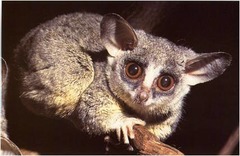
Galagos (Bush Babies)
- found in Africa
- leapers
- sympatric (define)-- occurring with the same or overlapping geographical ranges
- dispersed polygyny (define: ranges of females vs males)-- 1 male, multi-female; dispersed. females have multiple ranges, males overlap ranges due to limits of food and offspring, males reach maturity and leave
- vocalizations sound like baby crying-- territorial, scent marking, twins common
- eat fruits and insects
- hide in little spaces like empty bird nests, bee hives, and tree hollows
- forage alone, sleep together
Pottos (and relatives Perodicticus sp.)
- found in Africa
- quiet, slow and skunky
- cryptic. spinal shield
- power grip
- large vertibral spines, curl in protection
- eat insects, fruit, gum, poisonous insects
- "smelly"
- females may form smaller groups
- very low parental investment

Lorises ("clown")
- found in Asia
- slow and slender
- no tail.
- slow movements. slow hunters
- venemous-- poison with oil from upper arms mixed with saliva-- repelling predators and parasites by spreading it on their fur
- babies cling
- small

Lemurs
Strepsirrhini suborder
Lemurs Geographic Range
Madagascar (rafting)-- floating on vegetation, can shut down systems/hibernate (ability to travel)
Lemurs Activity Patterns
Diurnal, nocturnal, cathemeral -- Diversity!! Adaptive radiation: founding species, spread out to fill all available niches
Lemurs Dietary Types
Insectivore, frugivore, or folivore
Lemurs Social Groupings
Solitary, pairs, or small to large groups
Lemurs Locomotion
vertical clingers and leapers, quadrupedal
Five Major Lemur Groups
- Lemuridae (True Lemurs)-- Bamboo lemurs, ruffed lemurs, ring-tailed lemurs
- Megaladapids or Leptilemurs (Sportive Lemurs)
- Cheirogaleids (Dwarf Lemurs)
- Indrids-- Indris, sifakas, woolly lemurs
- Daubentoniidae (Aye-Ayes)
Lemuridae (True Lemurs) Focus: Ring Tailed Lemurs
- semi-terrestrial quadruped-- not normal, walk an dspend time on ground
- anatomy not best suited for ground
- derived diurnalism (has a tapetum lucidum)-- active during the day, evolutionary very recent (bad eyesight)
- rhinarium
- social group: MMMF (promiscuous), matrilocal, female dominance. Stable, longer male maturity length
- territories overlap; "stink fights", don't defend very physically
- seasons: wet-hot and cool-dry: diet changes over course of year (leaves, buds, flowers, fruit)
- strong predation

Megaladapids or Leptilemurs (Sportive Lemurs)
- agressive, territorial
- nocturnal
- vertical clingers and leapers
- dental formula: 0:1:3:3 / 2:1:3:3 -- missing front 2 teeth (possible mutation/genetic drift)
Sportive Lemurs Focus: white-footed sportive lemur
- dry cool season "lazy peasant"
- genitalia inactive when not mating-- reduced activity during cold time of year
- dispersed polygony
- "cache and carry"-- temporarily leave babies
- one offspring per year

Cheirogaleids (Dwarf Lemurs)
- smallest leamurs
- hibernate for six months
- fat storage in tail-- for hibernation
Dwarf Lemurs Focus: grey mouse lemur
- nocturnal
- mating pattern depends on resources-- up to 4x more females than males
- sexual dimorphism: females larger males
- hormonal competition: dominant male pheromones suppress other bodies/teste
- only procreate for a small period (days) and dormant rest of the year
- low parental investment, high mortality-- twins or triplets each year

Indrids-- indris, sifakas, woolly lemurs
- vertical clingers and leapers
- 2:1:2:3 / 2:0:2:3 -- variation
Indrids Focus: Indri
- larger bodies 13-16 lbs
- diurnal but no tapetum lucidum
- leaves and fruit
- pair bonded-- territorial through vocalizations, females dominate males especially regarding food
- higher parental investment

Daubentoniidae (Aye-Ayes)
- biggish, nocturnal, funky...
- 6 lbs, tiny eyes spread apart
- leaf nest, social, one offspring at a time
- 1:0:1:3 / 1:0:0:3, teeth continue to grow, rodent like
- specialized hands: large, spindly, tap foraging
- ears for echolocation, large
- large relative brain size
- one pair of breasts low on torso-- one offspring at a time, unusual
- low fear
- funky copulation style-- female runs and calls, upside down, she supports both of them
- "pseudo thumb", sixth finger, long and skinny, uses echolocation on wood and finger grabs grub

Haplorrihini
Three infraorders:
- Tarsiiformes: Tarsiers of Asia
- Platyrrhini: monkeys of central and south America
- Catarrhini: monkeys of Asia and Africa, apes, and humans
Haplorrhini Sensory Adaptations
- no rhinarium, short rostrum/snout
- eyes more convergent, postorbital plate
- no tapetum lucidum (even when nocturnal), many are trichromatic
- fovea
Haplorrhini Dietary Differences
mostly frugivores and folivores, few insectivores
Haplorrhini Activity Patterns/Ecology
- only two are nocturnal, the rest are diurnal
- many arboreal taxa, also many terrestrial taxa
Haplorrhini Social Groupings
only two are solitary, all others live in pairs, small to very large groups
Haplorrhini Sexual Dimorphism
few taxa have little/none, many taxa show moderate to high dimorphism
Happlorrhini additional traits
- mobile, single upper lip
- no dental comb
Tarsiers (Tarsiiformes)
- debate on classification in taxonomy
- derived traits: dry noses, eyes close together
- primitive traits: vertical leapers, nocturnal, grooming claws, small
- unique traits: large eyes and swiveling head, faunivorous-- owl-like
- SE Asia (Sumatra, Borneo, Java)
- name, tarsus (meaning)-- tarsal (ankle) bone very long, better for leaping
- vertical clingers and leapers
- teeth like 4 mya!-- very similar to ancestral bones
- only strict carnivorous primate (insects, spiders, small crustaceans, and small vertebrates [bats, lizards, birds])
Tarsiers (Tarsiiformes) Focus: spectral tarsier "general tarsier traits"
small
vert clingers, leapers
cache and carry
pair bond
tactile tails
