Symtoms and Risk Screening Tools
 Call Kai
 Learn
Learn Practice Test
 Spaced Repetition
 Match
Match Flashcards
 Knowt Play
1/18

There's no tags or description
Looks like no tags are added yet.
Name | Mastery | Learn | Test | Matching | Spaced | Call with Kai | Chat |
|---|
No analytics yet
Send a link to your students to track their progress
19 Terms
Description
Contributes to the analysis of occupational performance.
Brief standardized information about CLIENT FACTOR and safety conditions under which OT management may work.
They tell us WHAT may be interfering, while occupation-based assessment tells us HOW it is interfering with performance/participation.
Screening
Screening is deliberately brief and over-inclusive.
These tools are built to favor sensitivity over specificity
A positive result is a flag, NOT a diagnosis
A negative result does NOT rule out a problem if performance impairment is observed.
Tool: Cognition
BPRS - Brief Psychiatric Rating Scale
BPRS (Cognition)
Brief Psychiatric Rating Scale
Assesses: Severity of a Broad Range of Psychiatric Symptoms
Somatic concern, Anxiety, Emotional withdrawal, Conceptual disorganization, Guilt, Tension, Mannerisms/posturing, Grandiosity, Depressive mood, Hostility, Suspiciousness, Hallucinatory behavior, Motor retardation, Uncooperativeness, Unusual thought content, Blunted affect, Excitement, Disorientation
Score: 18 items (used to be 16 back in 1962)
Administration: 20-30 mins
Clinician-rated
Interview + observation
Scoring & Interpretation:
0 = not assessed
1 = bit present
7 = extremely severity
Higher total = greater severity
Important: There is no specified cutoff. Interpret the symptoms profile and changes across repeated rating.
Tool: Mood, Anxiety, Trauma, and Sleep (MATS)
BDI-II - Beck Depression Inventory-II
GAD-7 - Generalized Anxiety Disorder
PHQ-9 - Patient Health Questionnaire-9
PCL-5 - PTSD Checklist for DSM-5
PSQ1 - Pittsburgh Sleep Quality Index
BDI-II (mats)
Beck Depression Inventory-II
Assesses: Severity of depressive symptoms
Cognitive-Affective Symptoms
Somatic-Vegetative Symptoms
Score: 21 items
Administration: 5-10 minutes
Past 2 weeks
Self-report
Scoring & Interpretation:
Minimal = 0-13
Mild = 14-19
Moderate = 20-28
Severe = 29-63
Important: Any endorsement of the suicidal-ideation item requires immediate risk screening using C-SSRS and escalation, regardless of the total score.
GAD-7 (mats)
General Anxiety Disorder-7
Assesses: Frequency of generalized anxiety symptoms.
Nervousness, Uncontrollable worry, Worrying about different things, Difficulty relaxing, Restlessness, Irritability, Fear something awful might happen
Score: 7 items
Administration: 2-3 minutes
Past 2 weeks
Self-report
Final item about functional difficult is not scored.
Scoring & Interpretation:
Minimal = 0-4
Mild = 5-9
Moderate = 10-14
Severe - 15-21
≥10 = cut-point for probable GAD
Reported sensitivity: 89%
Reported specificity: 82%
PHQ-9 (mats)
Patient Health Questionnaire-9
Assesses: The 9 DSM criteria for a major depressive episode, rated according to frequency.
Also includes an unscored question about interference with":
Work, Home Life, and Relationships
Score: 9 items
Item 9: Asks about thoughts of self-arm or being better off dead.
Administration: 2-3 minutes
Past 2 weeks
Self-report
Scoring & Interpretation:
None to Minimal = 0-4
Mild = 5-9
Moderate = 10-14
Moderately Severe = 15-19
Severe = 20-27
≥10 = Sensitivity and Specificity for major depression were both reported as 88%
Any endorsement → C-SSR + Escalation
PCL-5 (mats)
PTSD Checklist for DSM-5
Assesses: PTSD symptoms clusters
Intrusion (memories, dreams, flashbacks, reactivity)
Avoidance
Negative Alterations in Cognition & Mood
Alterations in Arousal and Reactivity (hypervigilance, startle, concentration, sleep, irritability, reckless behavior)
Score: 20 items
Administration: 5-10 minutes
Past month
Self-report
Scoring & Interpretation
0 = Not at all → 4 = Extremely
Total: /80
A provisional PTSD cutoff of approximately 31-33 is commonly used, but it is setting-dependent
A 10-20 point change = clinically meaningful
PSQI (mats)
Pittsburgh Sleep Quality Index
Assesses: Sleep quality and disturbance
Subjective sleep quality
Sleep latency
Sleep duration
Habitual sleep efficiency
Sleep disturbances
Use of sleep medication
Daytime dysfunction
Score: 19 self-rated items + 5 bed-partner items
Administration: 5-10 minutes
Past month
Scoring & Interpretation
0 = No difficulty → 3 = Severe difficulty
Global Score: 0-21
Higher score = worse sleep quality
>5 = poor sleep quality
Note: Don't look only at the global score alone. Examine the component profile to determine where the sleep problem occurs.
Tool: Self-Harm and Safety
ISAS - Inventory of Statements About Self-Harm
C-SSRS - Columbia-Suicide Severity Rating Scale
ISAS (shs)
Inventory of Statement About Self-Harm
Assesses: Non-suicidal self injury (NSSI)
Section 1
Lifetime frequency of 12 NSSI behaviors
Descriptive features
Section 2
39 items
Measures 13 functions of NSSI
Functions:
Intrapersonal
Interpersonal
Score: 2 sections
Administration: 10-15 minutes
Self-report
Sensitive administration
Scoring & Interpretation
Each function = 0-6
Higher-scoring functions describe why the self-injury occurs
Positive ISAS ≠ suicide assessment (requires a separate suicide-risk screen)
C-SSRS (shs)
Columbia-Suicide Severity Rating Scale
Assesses Suicide Risk through:
Severity of Suicidal Ideation
Intensity of Ideation
Suicidal Behavior (NSSI is rated separately)
Administration: 2-5 minutes
Lifetime/recent time frames
Interview
Scoring & Interpretation
NO SUMMED SCORE
Risk is triaged using:
Highest ideation item endorsed
Suicidal behavior
Receny
Global Score: 0-21
Ideation items 3–5 OR any recent suicidal behavior → high risk requiring immediate escalation according to facility protocol.
Tool: Substance Use
DAST/DAST-10 - Drug Abuse Screening Test
MAST - Michigan Alcoholism Screening
FTDN - Fagerstrom Test for Nicotine Dependence
DAST/DAST-10 (su)
Drug Abuse Screening Test
Assesses: Problems and consequences related to drug use other than alcohol.
Score: 10 items
Administration: 2-5 minutes
Past 12 months
Self-report
Scoring & Interpretation
No problems reported = 0
Low = 1-2
Moderate = 3-5
Substantial = 6-8
Severe = 9-10
>3 = further assessment
Cutoff of 6 is generally used across versions for a probable drug-use problem requiring full assessment
MAST (su)
Michigan Alcoholism Screening Test
Assesses: Lifetime alcohol-related problems
Score: 25 items
Administration: 10-15 minutes
Lifetime
Self-report
Scoring & Interpretation
Non-alcoholic = 0-3
Suggestive of Alcoholism = 4
Alcoholism = ≥5
Note: Because the timeframe is lifetime, a high score does not establish that the problem is current.
FTND (su)
Fagerström Test for Nicotine Dependence
Assesses: Physical dependence on nicotine.
Score: 6 items
Administration: ~2 mins
Self-report
Scoring & Interpretation
Total: /10
Very Low = 0-2
Low = 3-4
Moderate = 5
High = 6-7
Very High = 8-10
Higher scores predict greater withdrawal severity and need for more intensive cessation support.
Tool: Medication Adherence
MMS - Modified Morisky Scale
MMS (ma)
Modified Morisky Scale
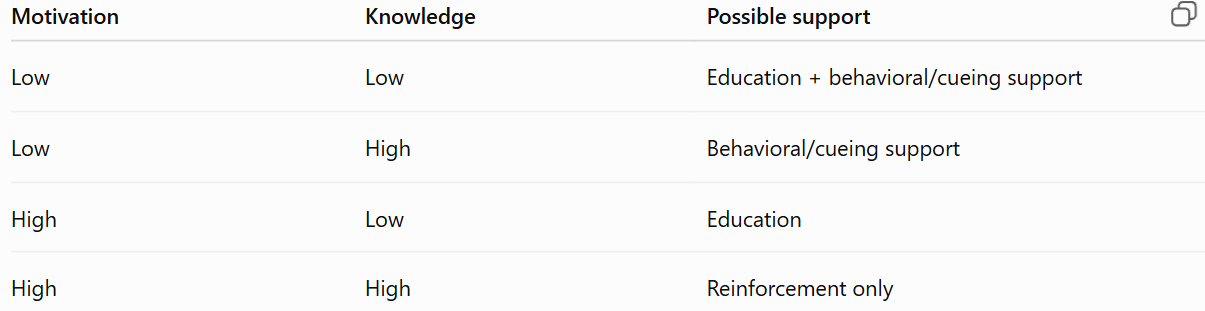
Assesses: Medication-taking behavior through two dimensions.
Motivation
Knowledge
Score: 6 yes/no items
Administration: <2 mins
Interview
Scoring & Interpretation
Two separate sub scores:
Motivation = 0-3
Knowledge = 0-3
For each:
Low = 0-1
High = 2-3