Crime - Lecture 1
 Call Kai
 Learn
Learn Practice Test
 Spaced Repetition
 Match
Match Flashcards
 Knowt Play
1/62

Earn XP
Description and Tags
introduction to the course and key concepts
Name | Mastery | Learn | Test | Matching | Spaced | Call with Kai | Chat |
|---|
No analytics yet
Send a link to your students to track their progress
63 Terms
farringdon & west - context
most violent crimes are committed by a small group of men who show an early onset and lifelong pattern of antisocial behaviour
around 5% of the population is responsible for around 70% of violent crimes committed in society
has been shown in many different countries, criminal justice systems, mental health systems, educational systems
antisocial personality disorder (moffitt, 1993)
one of 10 personality disorders in the DSM
only personality disorder with childhood antecedent in it’s diagnostic requirment
met diagnostic criteria by 15
antisocial behaviour
behaviour by a person which causes or is likely to cause harassment, alarm or distress to one or more persons not of the same household as the person
antisocial behaviour act
aggressive behaviour
aggressive behaviour is a multifaceted construct that may be expressed behaviourally in many ways
200 different definitions of aggression have been proposed (parrott & giancola, 2007)
‘any form of behaviour directed towards the goal of harming or injuring another living being who is motivated to avoid such treatment’ (baron & richardson, 1994)
forms of aggression
direct vs indirect (buss, 1961)
overt vs covert (buss, 1995)
physical vs verbal (buss, 1961)
overt vs relational (crick, casas & mosher, 1997)
functions of aggression
reactive vs proactive (also referred to as instrumental, predatory, premeditated, offensive)
evidence from neuroscience that different types of aggression are underpinned by different neural circuitry
different types of aggression map onto different subgroups
reactive aggression can be seen in:
psychopathy, antisocial personality disorder, PTSD, depression
can be motivated by different factors (e.g. frustration-based or threat-based)
psychopathy in adulthood
unique as a psychiatric disorder, as it is characterised by a high level of instrumental and proactive aggression in psychiatry
one of the only disorders where you can see a high level of instrumental or proactive aggression
instrumental aggression
purposeful and goal-directed
unprovoked and typically involves planning, forethought and is undertaken to achieve a particular desired goal
roots in social learning theory (bandura, 1973)
operant conditioning
aggression leads to reward which leads to re offence)
associated with traits of callousness, coldness, and a lack of empathy towards victims, and with a low level of autonomic arousal
reactive aggression
elicited in response to frustration or threatening event
frequently associated with anger
roots in the frustration-aggression model
emotionally charged
seen in several internalising (e.g. depression, PTSD) and externalising disorder (conduct disorder, ADHD)
aggressive behaviour vs violence
violence is:
according to Anderson & bushman (2002), ‘aggression that has extreme harm as its goal’
for blackburn (2003), ‘the forceful infliction of physical injury’
considered as a severe, life-threatening, physically aggressive behaviour
extreme end of spectrum of aggressive behaviour
violent offending
a subcategory of violence and refers to acts of violence that lead to convictions under criminal law
some studies have defined a violent offence/offender status based on:
the index offence alone (i.e. the offence for which the person was taken into custody)
the whole criminal history
self-report
idiosyncratic codes (own way of encoding violence - different to replicate)
crime and crime data
any form of human behaviour that is designated by the law as criminal and subject to a penal sanction
the ‘looking glass of crime’
defining:
actual crime
official crime
dark figure
dark figure of crime
the amount of crime that is unreported or unknown
the total amount of crime in a community consists of the crimes that are known or recorded and the dark figure of crime (e.g. partner violence)
official sources
‘reality is merely an appearance of something more real’ (darrell huff, 1954)
crime funnel
it is useful to consider the criminal justice system as a large funnel
at the wide mouth of the funnel are all the crimes committed in society, including every murder, rape, burglary, insurance fraud, shoplifting, and car theft

persistent offenders
a small group of males is responsible for the majority of (violent) crimes that are committed by men
early-onset conduct disorder
antisocial personality disorder in adulthood
referred to as ‘life-course’ persistent offenders
risk factors for the prevalence of persistent offending
findings from the HO 1998/99 youth lifestyle survey
male
living in an inner city
low social class
lone or step parents
criminal parents
poor parental supervision
delinquent friends
bullying
truancy
excluded from school
low achievement
regular drinking
cumulative effect of risk factors
relationship between the number of risk factors and the probability you were identified as a serious or persistent offender in the last 12 months

diagnosis of conduct disorder
characterised by “a repetitive and persistent pattern of behaviour in which the basic rights of others or major age-appropriate societal norms or rules are violated”, resulting in a clinically significant impairment in functioning
includes:
overt symptoms
aggression to people and animals
destruction of property
covert symptoms
deceitfulness and theft
violation of rules
dsm-5 diagnostic criteria for CD - aggression to people and animals
often bullies, threatens, or intimidates others
often initiates physical fights
has used a weapon that can cause serious physcial harm to others
has been physically cruel to people
has been physically cruel to animals
has stolen while confronting a victim
has forced someone into sexual activity
dsm-5 diagnostic criteria for CD - destruction of property
has deliberately engaged in fire setting with the intention of causing damage
has deliberately destroyed others’ property (other than by fire setting)
dsm-5 diagnostic criteria for CD - deceitfulness or theft
has broken into someone else’s house, building, or car
often lies to obtain goods or favours or to avoid obligations
has stolen items of nontrivial value without confronting a victim
dsm-5 diagnostic criteria for CD - serious violations of rules
often stays out at night despite parental prohibitions, beginning before age 13
has run away from home overnight at least twice
often truant from school, beginning before age 13
dsm-5 diagnostic criteria for CD
needs to fulfill 3 criteria in the last 12 months, and 1 present in the last 6
childhood-onset: at least one problem with conduct before age 10
adolescent-onset: no problems with conduct before age 10
dsm-5 diagnostic criteria for CD - new specifier
with limited prosocial emotions
lack of remorse or guilt
callousness/lack of empathy
lack of concern about performance in important activities
shallow or deficient affect
child needs to fulfil specific specifications for conduct disorder, and fulfil 2 out of the criteria in the last 12 months in different settings
offenders as a percentage of the population: the ‘age-crime’ curve
age of onset
% of the general popilation engaging in crime
during adolescence there’s a peak in crime
males outperform females

moffitt - the developmental taxonomic theory overview
childhood-onset/life-course persistent antisocial behaviour
a neurodevelopmental disorder
Adolescence-limited antisocial behaviour
due to social modelling of antisocial peers
no role for neuropsychology/individual characteristics
dsm-5 distinguishes between childhood-onset and adolescence-onset forms of CD
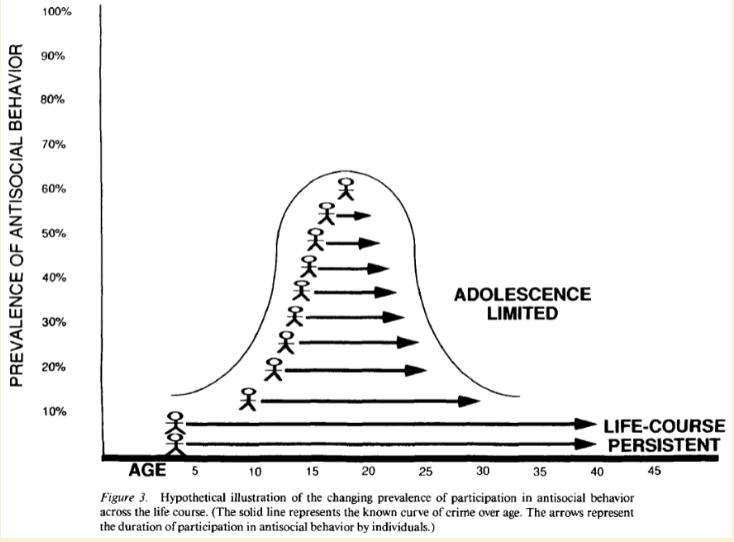
moffitt - the developmental taxonomic theory - childhood-onset/life-course persistent antisocial behaviour
individually-based risks
neurocognitive deficits (low verbal IQ, executive functions deficits)
under controlled temperament (volatile emotionally)
hyperactivity
moffitt - the developmental taxonomic theory - adolescence-limited antisocial behaviour
individually-based risks are less salient
exaggerated form of ‘normal’ rebelliousness
psychosocial factors are more salient
influence of deviant peers
adolescent ‘maturity gap’
dsm-5 distinguishes between childhood-onset and adolescence-onset forms of CD
frick & viding - three pathways to CD
adolescent onset
chilshood onset with high callous-unemotional traits
childhood onset associated with emotional and behavioural dysregulation (low CU traits)
frick & viding - two subgroups of childhood-onset CD
two subtypes based on levels of CU traits
lack of empathy and guilt
callous use of others
included as a specifier in dsm-5
there is evidence for distinct neurocognitive profiles and differing aetiologies
CP+CU = lack of emotional responsiveness to negative emotional stimuli
CP-CU traits = high emotional reactivity/poor emotion regulation
dsm-5 diagnostic criteria: antisocial personality disorder
Disregard for and violation of others' rights since age 15, as indicated
by 3 or more of the following features:
Failure to conform to social norms with respect to lawful behaviours as indicated by repeatedly performing acts that are grounds for arrest
Deceitfulness, as indicated by repeated lying, use of aliases, or conning others for personal profit or pleasure
Impulsivity or failure to plan ahead
Irritability and aggressiveness, as indicated by repeated physical fights or assaults
Reckless disregard for safety of self or others
Consistent irresponsibility, as indicated by repeated failure to sustain consistent work behaviour or honour financial obligations
Lack of remorse, as indicated by being indifferent to or rationalising having hurt, mistreated, or stolen from another
The person is at least 18 years of age
Conduct disorder was present by history before age 15 years
The antisocial behaviour does not occur in the context of schizophrenia or bipolar disorder
antisocial personality disorder and conduct disorder
label changes from CD to ASPD when the individual turns 18
CD is a specification required for the diagnosis of ASPD
needs to meet 3 traits of the specifications
if they do not meet for ASPD, but do for CD as an adult, they can be given the label CD as an adult
very rare
ASPD is the only personality disorder that has a childhood antecedent
hare - the relationship between ASPD, CD and psychopathy
50-80% of male prisoners have met diagnostic criteria for CD, and then for ASPD in adulthood
15-20% have diagnostic traits for psychopathy
the relationship between CD/ASPD and psychopathy is asymmetric
most/all individuals with psychopathy will have ASPD, but not the other way around
due to the diagnostic criteria for psychopathy being very similar, but also having very unique traits

psychopathy
greater number of crimes
more violent crimes
more likely to recidivate
key characteristics
lack empathy and remorse
manipulative
start offeding at young age
premeditated violence
persistent and versatile offenders
offenders at young age

gao et al. - is psychopathy a neurodevelopmental disorder?
some forms of CD and psychopathy could be neurodevelopmental in origin
has genetic underpinnings
abnormalities in brain structure and function
neurocognitive impairments
persistent through development
CD as risk factors for problems in adolescence and adulthood
Mental health
Legal
Educational
Social
Occupational
Physical health
psychiatric disorder associated with the most burden in ages 1-14
high chance of ADHD, PTSD
scott et al. - costs of conduct disorder
a large association with crime
children with CD are largely sent to groups dealing with crime, rather than to provide support

kim-cohen et al. - CD as a risk factor for psychiatric disorder in adulthood
CD is associated with many psychiatric outcomes in adulthood
presence of CD at age 15 increases the risk of other disorders
such as anxiety, depression, schizophrenia, etc.
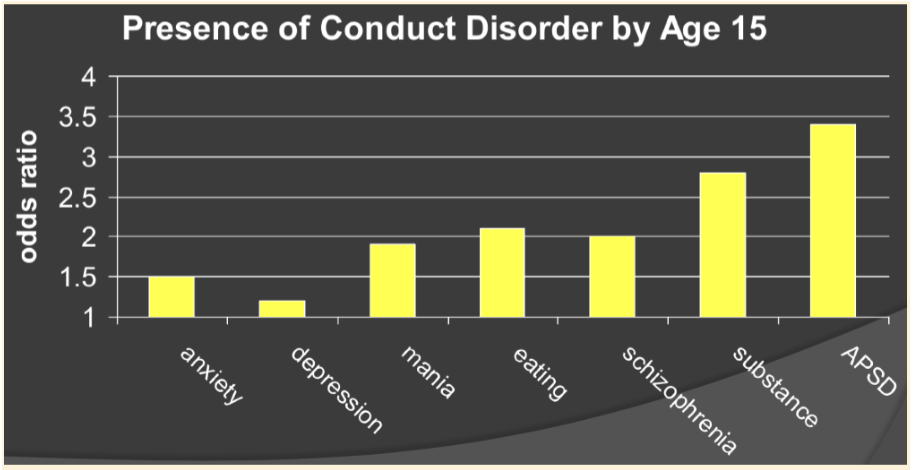
de brito & hodgins - disorders co-morbid with CD
children with CD frequently display other types of problems
between 8.7% and 45.4% of boys and between 1.2% and 61.4% of girls with CD also present ADHD
in community samples, the prevalence of comorbid anxiety disorders ranges from 22% to 33%, while among children with CD who have sought treatment, 60% to 75% present with anxiety disorders
comorbidity estimates ranging from 12-17.6% have been found for depressive disorders
moffitt et al. - prognosis of CD
In general, the literature suggests that
Children who develop conduct disordered behaviour later in childhood have a somewhat better prognosis
The severity and variety of early antisocial behaviour is a powerful predictor of serious antisocial behaviour in adulthood
The prognosis may be worse for those who also have co-morbid disorders.
frick - risk factors associated with CD - dispositional
Neurochemical (e.g., serotonin)
Autonomic irregularities (e.g., low resting heart rate),
Neurocognitive deficits (e.g., executive functioning)
Deficits in the processing of social information (e.g., a hostile attributional bias)
Temperamental vulnerabilities (e.g., poor emotional regulation)
Personality predispositions (e.g., impulsivity)
frick - risk factors associated with CD - contextual
child’s prenatal (e.g. exposure to toxins)
early child care (e.g. poor quality child care)
family (e.g. ineffective discipline)
peer (e.g. association with deviant peers)
neighbourhood (e.g. high levels of exposure to violence), environments
psychopathology
the field of psychology which aims to understand the aetiology, nature, and treatment of mental disorders
developmental psychopathology
aims to understand how psychopathology emerges over the lifespan
kerig et al.
‘developmental psychopathology is the study of developmental processes that contribute to, or protect against, psychopathology’
brofenbrenner - developmenal psychopathology approach

the developmental psychopathology approach
Multiple levels of analysis and theoretical perspectives: ‘from neurons to neighbourhoods’
our environment shapes our brain over time
we also influence our environment (peer groups, schooling, etc)
tracking development of mental illness over time
understanding contribution of different variables (risk & resilience factors)
understanding mental disorders & psychopathology better by characterising normative development
moving away from typical divisions of labour in psychology
the developmental psychopathology approach integrates across social, cognitive, emotional, and biological levels of analysis
it contends that mental disorders cannot be fully understoof by focusing on any of these levels in isolation
in addition, these levels are in constant interaction with each other (and time)
frick - characteristics of a comprehensive etiological model of CD from a developmental psychopathology perspective
Must consider the potential role of multiple risk factors
Must consider the possibility that subgroups of children with CD may have distinct causal mechanisms underlying their antisocial and aggressive behaviours
Needs to integrate research on the development of antisocial and aggressive behaviour with research on normally developing youth
Needs to integrate multiple levels of analyses (e.g., genetic, neurological, social, cognitive, behavioural)
frick & viding - developmental psychopathology perspective on CD
Provides a very useful way for integrating the diverse research litertaure into a coherent causal model
helps us to understand the developmental mechanisms that can lead to CD and to translate this research into implications for prevention and intervention
key developmental psychopathology concepts:
equifinality and multifinality
importance of integrating research on both normal and abnomal development
importance of integrating multiple levels of analysis for understanding CD
cicchetti and rogosch - developmental pathways
outcome - e.g. mental health condition/state
equifinality - to reach the outcome, there might be different causal pathways leading to the same outcome
multifinality - multiple endpoints (e.g. 4 siblings who grew up together all ending with different states)

canalisation
when processes become increasingly stable or set in motion down a particular trajectory (very unlikely to change pathway)
critical/sensitive periods
phases of heightened sensitivity to environmental factors such as adverse life events or abuse
e.g. 6-month threshold in early deprivation studies
gottlieb - different models of the operation of risk factors
unidirectional - too simplisitc
bidirectional
involves genes, enviornment, behaviour, etc.
certain genetic dispositions might influence how you develop
or certain environmental factors during youth
epigenetics
we are born with a certain genetic makeup that is fixed
however, the environment can influence genetic expression (nt fixed)

frick & viding - developmental psychopathology approach on CD
“a developmental psychopathology approach should emphasise potential differences in the developmental mechanims that may underlie these behavioural manifestations or personality features”
e.g. the same behavioural pattern can be the result of very different developmental mechanisms
criteria for inferring causality
A (proposed cause - child abuse) and B (outcome - ASPD) are related to one another (correlation or association)
A precedes B in time (i.e. ASPD symptoms do not emerge before the onset of childhood abuse)
level or intensity of A predicts severity of B
when accounting for extraneous variables (e.g. poverty) the relationship between A and B still holds
research designs in developmental psychopathology - longitudinal
characteristic of the developmental psychopathology approach
types of longitudinal designs:
retrospective - obtaining info about history (e.g. age of onset)
follow-back - using previously recorded data about a group of individuals (e.g. time when taken into care/abused)
prospective - info collected repeatedly on the same individuals over time
research designs in developmental psychopathology - cross-sectional
studying different age groups at a single point in time
problems of causal inference
susceptible to cohort effects
one age group might be more/less disturbed for reasons not directly related to chronological development
loeber & farrington - research designs in developmental psychopathology
accelerated longtidunial designs - prospective longitudinal study with shorter follow-up intervals
with multiple age groups
studies can be completed more rapidly, but still retain longitudinal component
again, potentially subject to cohort effects
selective loss of ppts across groups
clinical sample
ensures study ppts are likely to have disorder of interestt, but problems of recruitment bias
community sample
recruiting high-risk sample from schools or some other setting
unlikely to find people with certain conditions, such as CD
representative sample
sample matched with general population on key characteristics
critique of developmental psychopathology approach

ways around critiques of developmental psychopathology
