3.2.1 Business objectives
 Call Kai
 Learn
 Practice Test
 Spaced Repetition
 Match
 Flashcards
 Knowt Play
1/18

There's no tags or description
Looks like no tags are added yet.
19 Terms
What are the different business objectives?
The different business objectives:
profit maximisation
revenue maximisation
sales maximisation
satisficing
What is profit?
Profit is the difference between its TR and TC // or (AR-AC) X Q
When does profit maximisation occur?
Profit maximisation occurs when, MC=MR. In other words, each extra unit produced gives no extra loss or no extra revenue.
If MR> MC, producing more increases profit.
If MC> MR, profit falls.
What is the diagram for profit maximisation?
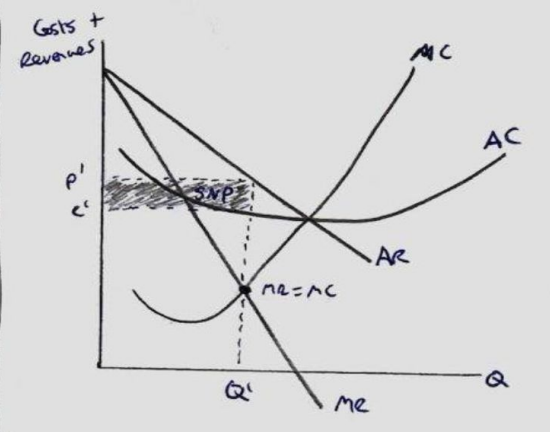
Why do firms profit-maximise?
Firms profit maximise:
to reward shareholders with dividends and a higher share price
to fund Investment from retained profit- the cheapest source of finance, which saves paying high interest rates on loans, linking to organic growth
In the short run, the interests of the owners or shareholders are most important, since they aim to maximise their gain from the company. (pmt)
to survive in the LR and build reserves against downturns
owner-managers (e.g sole traders) keep the profit themselves, so there is no principal-agent probleminvestment
Why may firms not profit-maximise?
Firms may not profit-maximise=
Information gaps: few firms actually know their MC and MR curves, so they cannot find MC = MR precisely. Many use cost-plus pricing instead.
Principal-agent problem: managers may pursue revenue, sales or growth (3.1.1).
Short run vs long run: a firm may sacrifice profit now to build market share and earn more later.
Stakeholder pressure: workers, customers and regulators may object to high prices or profits.
When does revenue maximisation occur?
Revenue maximisation occurs when MR=0, suggested by Baumol.
Why MR = 0? Each extra unit adds MR to total revenue. While MR is positive, TR rises; once MR is negative, TR falls. So TR peaks where MR = 0 — at the point where demand is unit elastic (PED = −1)
Beyond MR= 0, each additional unit reduces TR.

What is the diagram for revenue maximisation?

Why do firms revenue maximise?
Firms revenue maximise:
principal agent problem= managers’ pay and status are often linked to revenue or turnover rather than profit
market share and LR profit= higher sales now can build brand loyalty & EoS that increase profit later
credibility with lencers and investors= who often judge a firm’s success by revenue growth
tech and start up firms often prioritise revenue growth over profit in their early years to dominate a market
Why may firms not revenue maximise?
Firms may not revenue maximise=
Revenue maximisation means producing beyond MC = MR, so profit is lower than it could be — shareholders may push back, especially if dividends fall.
The firm still needs to cover its costs: revenue maximisation is only sustainable if AR ≥ AC at that output.
It may be a deliberate short-run strategy that leads to higher long-run profit, so it is not always in conflict with shareholders.
When does sales maximisation occur?
Sales maximisation occurs when AR=AC.// maximises sale volume. It is the highest output it can sell without making a loss. At this point the firm earns only normal profit.
Why AR = AC? Selling more requires cutting the price. The firm keeps expanding until price (AR) has fallen to equal average cost. Any further and AR < AC, so the firm would make a loss.
What is the diagram for sales maximisation?

Why do firms sale maximise?
Firms sale maximise:
Market share: gaining the largest share can make the firm the market leader and squeeze rivals.
Deterring entry (limit pricing): a low price that only covers average cost makes the market unattractive to new entrants.
Economies of scale: higher output moves the firm down its LRAC curve, lowering future costs (link to 3.1.2).
Managers' status grows with the size of the operation (principal-agent problem)
Why may firms not sale maximise?
Firms may not sale maximise:
Only normal profit is earned, so there is little retained profit for investment and shareholders get low returns.
Pricing below rivals' costs to drive them out can be predatory pricing, which the CMA can investigate.
Like revenue maximisation, it may be a short-run strategy for long-run profit: once rivals leave, prices can rise.
What is the difference between revenue and sales maximisation?
Revenue maximisation is about the money from those sales (value) whereas
sales maximisation is about the number of units sold (volume).
What is satisficing?
Satisificing is making enough profit to keep shareholders and other stakeholders content.
Why do firms satisfice?
Firms satisfice:
Principal-agent problem: managers make enough profit to keep shareholders from complaining, then pursue their own goals (perks, an easier life, status).
Many stakeholders: firms balance shareholders, workers, customers, suppliers and the community, so no single objective is maximised.
Imperfect information (bounded rationality): firms cannot calculate MC = MR, so they set achievable targets instead.
Owner objectives in small firms: an owner may prefer work–life balance and control to the extra effort and risk of maximising — the independent café from Lesson 1.
Social and ethical aims: social enterprises and firms such as employee-owned businesses may trade some profit for fair pay or sustainability.
Why may firms not satisfice?
Firms may not satisfice:
Satisficing can be rational: chasing the last pound of profit can cost more in effort, risk or staff morale than it earns.
But it may mean X-inefficiency (costs above the minimum) and leave the firm vulnerable to a takeover by a buyer who thinks it could earn more.
It is more likely where competition is weak; in very competitive markets, firms that don't push for profit may not survive.
What is the comparison table for all the business objectives?
