Cells, Tissues, Organs midterm (histology)
 Call Kai
 Learn
 Practice Test
 Spaced Repetition
 Match
 Flashcards
 Knowt Play
1/166

There's no tags or description
Looks like no tags are added yet.
167 Terms
What is an ulcer?
A break in the epithelium in the small intestine or gastrointestinal tract
Is epithelial tissue vascular or non-vascular?
Non-vascular
How do epithelial cells get nutrients?
Nutrients diffuse into the cell layer from blood vessels
What is the basal lamina?
A layer of extracellular matrix secreted by the epithelial cells
What is the basement membrane?
Layer that anchors epithelial tissue to underlying tissues
What are basal cells?
Stem cells for renewal of other cells (rapid mitosis)

What is the lamina propria?
Layer of loose connective tissue which contains blood vessels and lymph vessels
What is simple squamous epithelium?
Single layer of flattened cells

What is the function of simple squamous epithelium?
Absorption and filtration
Where would you find simple squamous epithelium?
Lining of tubes open to the exterior (at least at one end)
Where would you find simple squamous endothelium?
Lining of blood vessels
Where would you find simple squamous mesothelium?
Covering organs within body cavities

What is stratified squamous non-keratinized epithelium?
Multiple layers of flattened cells
What is the function of stratified squamous non-keratinized epithelium?
Protection in a moist environment, "wear and tear" epithelium
Where would you find stratified squamous non-keratinized epithelium?
The esophagus, the oral cavity, the cornea

What is stratified squamous keratinized epithelium?
Multiple layers of flattened cells with a tough, keratinized outermost layer
What is the function of stratified squamous keratinized epithelium?
Provides a tough waterproof barrier to protect underlying tissues
Where would you find stratified squamous keratinized epithelium (thin skin)?
The skin, the cheek, the tongue, esophagus (in dry environment)
Where would you find stratified squamous keratinized epithelium (thick skin)?
Bottom of paw pads
What is the function of the small intestine?
Digestion and absorption of food, production of gastrointestinal hormones
What lines the small intestine?
Simple columnar epithelial cells with villi and microvilli (enterocytes)

What is the function of villi/microvilli?
Increase surface area to increase absorption
What is found inside the villi?
Blood vessels and lymphatic capillaries

What is simple columnar epithelium?
Single layer of tall, column shaped cells
What is the function of simple columnar epithelium?
Absorption, secretion and protection

What is the striated border seen on the surface of epithelial cells?
Microvilli with glycoproteins and glycocalyx

What is the function of glycoproteins in the striated border?
Secrete a dense, enzymatic, gel-like protective coat of glycocalyx for adsorption

What are goblet cells?
Cells scattered throughout the epithelium that secrete mucus
Where would you find goblet cells?
Respiratory tract and intestines
What is the mucosa?
The innermost tissue layer in direct contact with the lumen of the digestive tube

What is the function of the mucosa?
Protection, secretion, absorption
What is the submucosa?
Thick layer of connective tissue that sits below the mucosa

What is the function of the submucosa?
Anchors the mucosa and provides nourishment through blood vessels and nerves
Why don't lymph vessels stain well?
They have a high fat content

What is pseudostratified columnar epithelium?
A single layer of irregularly shaped cells that appears to have multiple layers
What makes pseudostratified look like it has multiple layers?
The nuclei sit at different levels due to the irregular shape and compactness of the cells
What is the function of pseudostratified columnar ciliated epithelium?
Clean (purify) and moisten the air within, trapping and moving foreign particles out of respiratory tract
How does the mucociliary escalator work?
Cilia move the mucus produced by the goblet cells over the surface of the epithelium which traps foreign material to either be coughed out or swallowed

What glands lubricate the tracheal lining?
Seromucus glands

What is the muscularis?
A layer of smooth muscle below the submucosa

Where are seromucus glands found?
Within the wall of the trachea
What are basal bodies?
The roots of the cilia on the cell surface

What is the function of the ureter?
Transports urine from kidneys to bladder
What is the function of the urethra?
Transports urine out of body

What is transitional epithelium?
Cells can change shape depending on the amount of distention of the organs
What shape does the transitional epithelium represent when the lumen of the ureter is full vs when it is empty?
Full = stratified squamous epithelium
Empty = stratified cuboidal epithelium
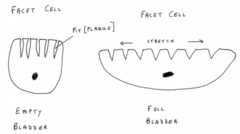
What are facet cells?
"Umbrella cells" which have a high stretching capacity found on the outermost layer of the urinary tract

What is the function of facet cells?
Prevent urine from leaking down past the epithelium into the underlying tissue
Why are facet cells able to stretch so much?
They have pits (plaques) on their cell surface as well as a large amount of cytoplasm so they can be morphed as the urine fills the urinary tract
What is the function of a glandular epithelial cell?
Specialize in the synthesis and secretion of a product
What are the two primary functional categories of glands in the body?
Endocrine and exocrine
What is an endocrine gland?
A ductless gland that secretes hormones into the bloodstream
What is an exocrine gland?
Glands secrete products through ducts that connect to the epithelial surface
What is the structure of an exocrine gland?
A secretory unit and a duct system

What is an adenomere?
The secretory unit of a gland (cluster of secretory cells)

What is an intercalated duct?
The first part of the exocrine gland that connects directly to the adenomere (very narrow)

What is the pathway saliva takes in the exocrine gland?
1. Intralobular duct (running within lobule)
2. Interlobular duct (running between lobules)
3. Lobar duct (draining a lobe of gland)
4. Main duct (draining entire gland)

What is a striated duct?
Connected to the intercalated ducts in the lobules of the gland, drains into interlobular duct
What is the capsule of a gland?
Thin outer layer of dense connective tissue that encases and protects the gland
What is the stroma of a gland?
Connective tissue that extends into the gland and allows access for blood vessels and nerves
Where are the nuclei found in mucus adenomeres?
Pushed onto the basal surface because the cells are full of mucus and don't leave much room

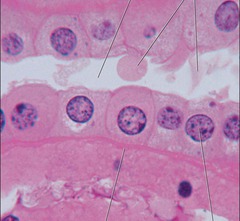
What is simple cuboidal epithelium?
Single layer of cube shaped cells

Why is the outer layer of the striated duct folded?
To increase surface area for more active transport of ions in and out of the cell
What does a serous adenomere secete?
Protein-rich fluid
Why do serous adenomeres appear darker on a slide?
They hold onto stain better due to the secretions of proteins, endoplasmic reticulum, ribosomes, etc.
Why do mucus adenomeres appear lighter on a slide?
The carbohydrate-rich mucin washes out

What are secretory granules?
Storage organelles within the basal cytoplasm that hold proteins, hormones, enzymes, etc.
What is a mixed adenomere?
One portion of the adenomere secretes protein and the other secretes mucus
What are the two parts of a mixed adenomere?
Mucus demilune and serous demilune

What is striated muscle?
Skeletal muscle with cross striations
What is epimysium?
Dense irregular connective tissue that surrounds the entire muscle
What is endomysium?
Delicate loose connective tissue between muscle fibers
What is perimysium?
Dense irregular connective tissue that creates fascicles and allows blood vessels/nerves to flow through
What are fascicles?
Bundles of muscle fibers
Where are nuclei located in striated muscle?
On the periphery of the fiber

What gives skeletal muscle the striated appearance?
Actin (light areas) and myosin (dark areas) proteins lined up "in register"
What is the function of actin and myosin proteins?
Help with muscle contraction and relaxation
What is the structure of smooth muscle cells?
Interlocking arrangement, cells surrounded by basal lamina to help with adhesion

What is a gap junction/nexus in smooth muscle?
Cell-to-cell protein channel that allows impulse to travel from one nerve to another in a different cell
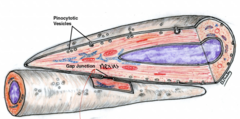
Where are nuclei located in smooth muscle?
Centrally located
Why does smooth muscle not appear striated but still have actin and myosin present?
They are not lined up in register
What does the nuclei look like in a contracted muscle cell?
Spiral/corkscrew shape
How is smooth muscle arranged in the small intestine?
One layer runs in longitudinal direction and the other runs in the circular direction (perpendicular)

What holds cardiac muscle cells together to make a fiber?
Intercalated discs

What allows cardiac muscle to have very strong cohesion with intercalated discs?
Each end of the muscle cell has a jagged edge which increases surface area for fusion
Why is there branching of cardiac fibers?
To increase the strength and adhesion of the cardiac muscles so they don't break or fall apart

What are purkinje fibers?
Specialized cardiac muscle cells that rapidly transmit nerve impulses to cardiac muscle
What is the function of purkinje fibers?
Cause ventricles to contract and ensures the heart squeezes evenly and pumps blood efficiently
What is the function myosin and actin proteins (striations) in cardiac muscle?
To pass nerve impulses quickly through the cells/fibers NOT contraction
Why are purkinje fiber binucleate?
Fibers have a high metabolic demand so they need 2x the amount of DNA in order to transcript more mRNA
What is blood?
Liquid connective tissue with cells in an extracellular fluid (plasma)
What are the main functions of blood?
Transport of gases
Transport of white blood cells (leukocytes)
Transport of proteins
What are blood platelets?
Cytoplasmic fragments derived from cells in bone marrow (megakaryocytes)
What is the function of platelets?
Controls bleeding/clotting
What is blood plasma?
Liquid portion of blood
What are the main types of proteins found in plasma?
Albumin, fibrinogen, globulin
What is the function of albumin?
Most abundant protein, transports hormones, metabolites and drugs
What is the function of fibrinogen?
Creates fibers at the site of damage to stop bleeding/initiate clotting
What is the function of globulin?
Maintains osmotic pressure and function as antibodies (immunoglobulins)
What is a liver fluke?
A parasitic flat worm that causes tissue damage as it travels to the liver