Extra Metalang (missing + mnemonics + extra notes)
 Call Kai
 Learn
 Practice Test
 Spaced Repetition
 Match
 Flashcards
 Knowt Play
1/43

There's no tags or description
Looks like no tags are added yet.
44 Terms
Paralinguistic features - mnemonic
VNB
Paralinguistic features
Vocal effect (including whispers & laughter)
Non-verbal features (including gestures, facial expressions, eye contact)
Breathiness, creakiness
Semantic patterning - mnemonic
PALM OF SHIP
Semantic patterning
Pun
Animation
Lexical ambiguity
Metaphor
Oxymoron
Figurative language
Simile
Hyperbole
Irony
Personification
Semantic change processes - mnemonic
BENDS
Semantic change processes
Broadening
Elevation
Narrowing
Deterioration
Shift
Overt norm
Correct ‘rules’ as per society (extra notes)
Covert prestige
Status/value to the ingroup (extra notes), non-standard English
Descriptivism
d → dynamic + evolving (extra notes)
Standardisation
→ codifying, codified set of rules (extra notes)
Connected speech processes - mnemonic
AVEI
Connected speech processes
Assimilation
Vowel reduction
Elision
Insertion
Prosodic features - mnemonic
VTIPS
Prosodic features
Volume
Tempo
Intonation
Pitch
Stress
Phonological patterning - mnemonic
RACORA
Phonological patterning
Rhyme
Assonance
Consonance
Onomatopoeia
Rhythm
Alliteration
Syntactic patterning - mnemonic
PAL
Syntactic patterning
Parallelism
Antithesis
Listing (tripartite, extensive)
Cohesion - mnemonic
ECLAIR
Cohesion
Ellipsis, repetition, substitution
Collocation
Lexical choice (synonymy, antonymy, hyponymy)
Adverbials and conjunctions
Information flow (front focus, clefting, end focus)
Reference (anaphoric, cataphoric, deictic)
Coherence - mnemonic
CLIF-C
Coherence
Consistency and conventions
Logical ordering'
Inference
Formatting
Cohesion
Features of spoken discourse - mnemonic
BANDOO
Features of spoken discourse
Backchanneling/minimal responses
Adjacency pairs
Non-fluency features
Discourse particles
Openings and closings
Overlapping speech
Strategies of spoken discourse - mnemonic
TTMC
Strategies of spoken discourse
Turn taking
Topic management
Management of repair sequences
Code switching
Morphological patterning - mnemonic
BACCA BASIC
Morphological patterning
Blending
Affixation
Conversion of word class
Contraction
Acronym,
Backformation
Abbreviation
Shortening
Initiation
Compounding
Word formation processes - mnemonic
BNCN
Word formation processes
Borrowings
Neologisms
Commonisation
Nominalisation
Hypocoristic suffixation
The process of shortening, modifying or altering words from their original form by adding a suffix such as ‘o’, and ‘ie’ (e.g. ‘servo’ for ‘service station’ or ‘sunnies’ for ‘sunglasses’). I'm doing so, a more colloquial expression is created.
Extra notes: creates a friendly/affectionate tenor, informal;colloquial in nature, reduction of social distance
Word loss
Obsolescence
Archaism
Word loss - Obsolescence definition
A term or phrase becoming obsolete: no longer used as part of the language.
Word loss - Archaism definition
Aterm or phrase that exists within specific contexts (e.g. idioms) but has otherwise dropped out of the language.
Politeness
Refers to the language choices that show consideration, respect and sensitivity towards others, and an awareness of social communication expectations and norms.
Politeness markers such as 'thanks', 'please' and 'sorry' are commonly used in everyday conversations.
The politeness strategies that people employ may vary depending on contextual or social factors, such as the degree of social distance between the participants (the closeness of their relationship); however, they are most commonly used to build rapport.
In English Language, we focus on positive and negative politeness.
Positive politeness
Refers to the strategies we use to create and maintain social harmony by demonstrating empathy and building rapport. Rapport can be reflected through language that shows friendliness, solidarity, interest and inclusiveness.
Key features of positive politeness

Negative politeness
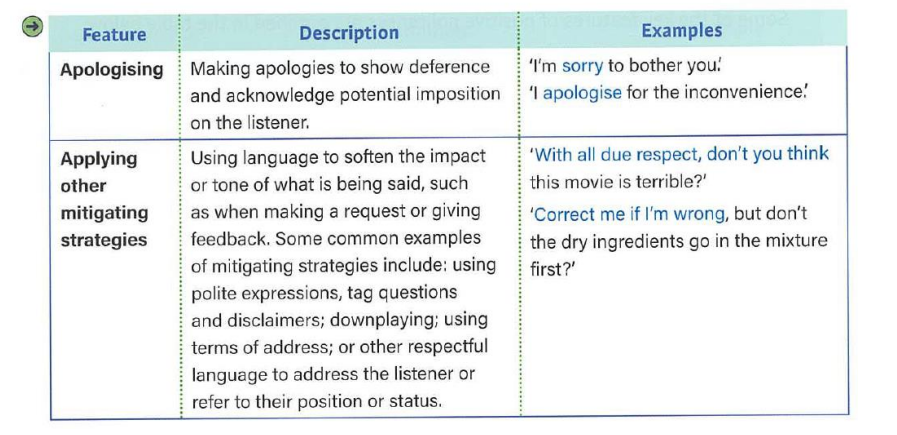
Focuses on reducing the imposition placed on the listener. This is achieved by indirectness, showing deference and demonstrating respect for the listener's autonomy.
Negative politeness is used when the intent is to maintain social harmony or when there is a perceived social distance between participants.
Key mitigating strategies of negative politeness

Face
The term 'face' is used to describe the aspect of the listener that is being acknowledged through the use of politeness strategies. It can be divided into positive face and negative face.
Positive face
The desire to be seen as competent and liked by others. It reflects an individual's need for social recognition, appreciation and inclusion. Concerns the desire for favourable social interactions and maintaining a positive self-image.
Negative face
The desire to be free from imposition and constraints on autonomy. It reflects an individual's need for independence, privacy and freedom to act. Concerns the desire to maintain one's sense of individuality and personal space.
Face threatening acts
Communication that may pose a threat (potential harm) to an individual's positive or negative face, leading to consequences such as embarrassment, loss of face, offence or conflict.
Examples of face-threatening acts include making requests, giving directives, complaining, disagreeing, interrupting and delivering bad news.
