L41-purification techniques
 Call Kai
 Learn
 Practice Test
 Spaced Repetition
 Match
 Flashcards
 Knowt Play
1/13

There's no tags or description
Looks like no tags are added yet.
Name | Mastery | Learn | Test | Matching | Spaced | Call with Kai | Chat |
|---|
No analytics yet
Send a link to your students to track their progress
14 Terms
what are the 4 main sources of drugs
nature
semi-synthetic
fully synthetic
biochemically engineered
describe nature as a source of drugs
compounds found in nature are called natural products
e.g. morphine from opium poppy
Taxol, penicillin, insulin
NP have a purpose or function so every natural product is biochemically active
describe semi-synthetic products as a source of drugs
natural products that are modified to improve physiochemical properties
e.g. heroin( diamorphine ), aspirin, Taxol
NP aren’t designed for human use
describe fully synthetic products as a source of drugs
theses are drugs that are entirely made in the lab from basic building blocks
these are designed as drugs and the majority of modern drugs.
e.g. paracetamol, Viagra, aspirin
describe bioengineered products as a drug source
these include proteins, monoclonal antibodies, gene therapies
list 5 purification methods
recrystallisation
filtration
distillation
separating funnels techniques
chromatography
describe recrystallisation
a mixture is all dissolved in hot solvent
the mixture is allowed to cool down- this causes the impurities to stay in the solution and the desired compounds crystallise
then the need to be separated
describe filtration as a separation techniques
after doing recrystallisation to obtain the desired compounds as crystals and the impurities that remain in the solution the mixture is filtered to obtain the crytals
describe distillation as a purification technique
its based on compounds having different boiling points
its good for volatile compounds
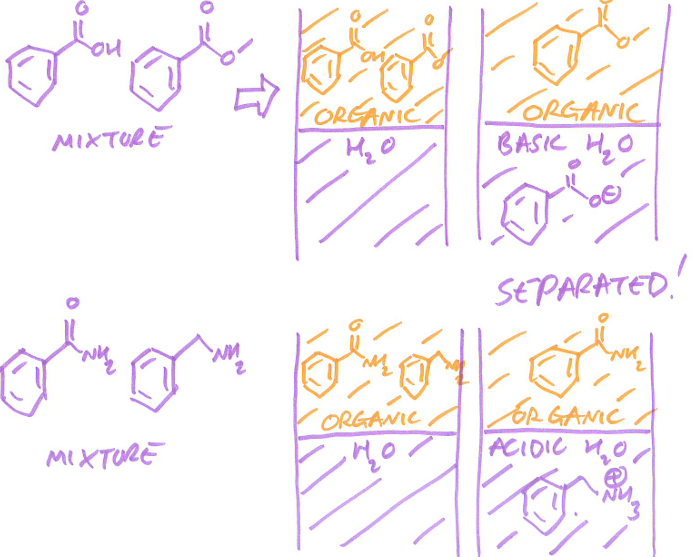
describe separating funnel techniques as a purification method
organic solvents are either non-halogenated or halogenated- depends on density
non halogenated < aqueous < halogenated
non halogenated solvent are the least dense whilst halogenated are most dense
describe chromatography as a purification technique
the separation of a mixture by passing through a medium where the components move at different rates
in a mixture of different compounds different compounds will move across the stationary phase at different rates due to different interactions
what is TLC, HPLC,
TLC- thin layer chromatography
HPLC- high performance liquid chromatography
explain the prcess of TLC
its mostly used to follow reactions
then uv light is used to visualise the plate
you can also chemically stain the plate
explain HPLC
high performance liquid chromatography
used to analyse and purify compounds
enantiomers can be separated by using a chiral stationary phase as the different enantiomers will react differently with the plate