Anatomy of Speech & Hearing Exam 3
 Call Kai
 Learn
 Practice Test
 Spaced Repetition
 Match
 Flashcards
 Knowt Play
1/86

Earn XP
Description and Tags
Anatomy of Speech & Hearing Exam 3
87 Terms
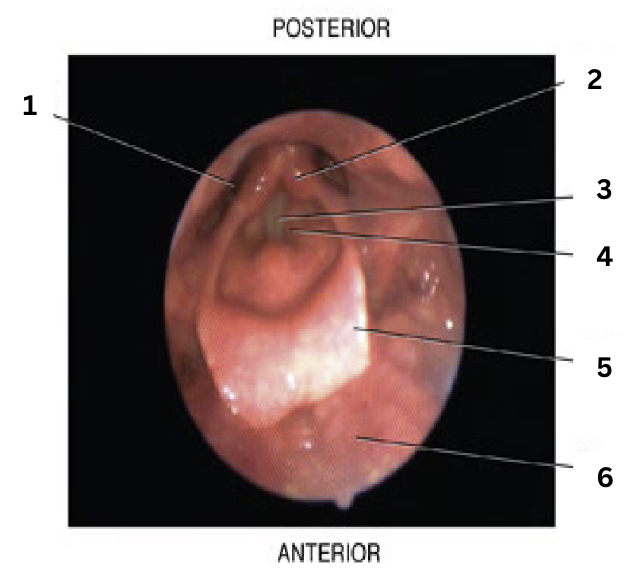
what is number 1?
piriform sinus

what is number 2?
arytenoid prominence within aryepiglottic fold

what is number 3?
vocal folds

what is number 4?
false vocal folds

what is number 5?
epiglottis

what is number 6?
tongue base

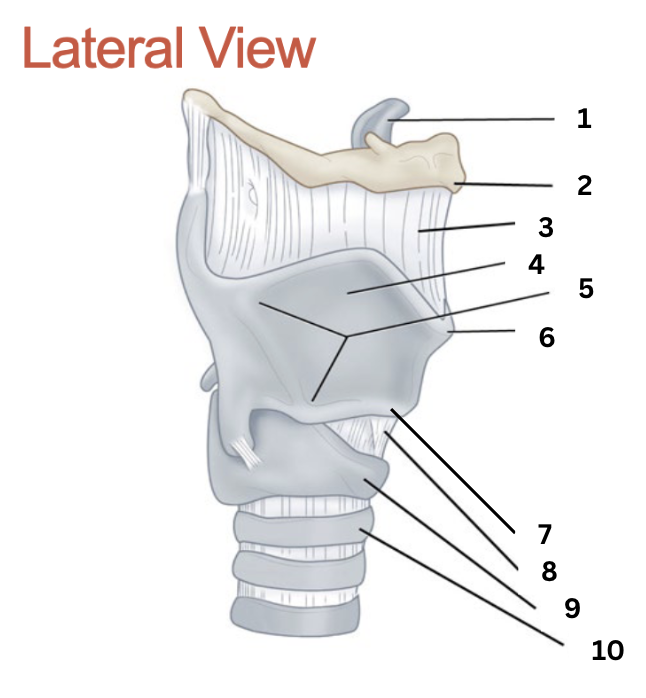
what is number 1?
epiglottis

what is number 2?
hyoid bone
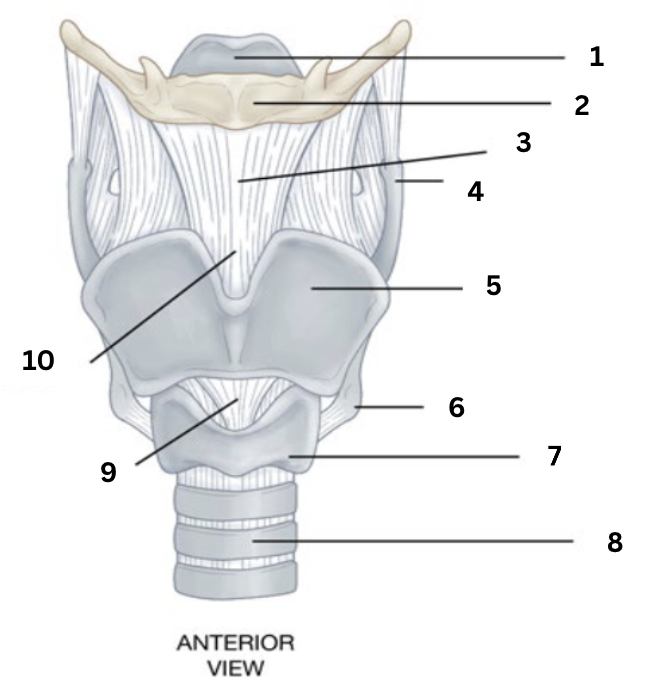
what is number 3?
thyrohyoid membrane
what is number 4?
superior horn of thyroid cartilage

what is number 5?
thyroid cartilage lamina

what is number 6?
inferior horn of thyroid cartilage

what is number 7?
cricoid cartilage

what is number 8?
trachea

what is number 9?
circothyroid ligament

what is number 10?
thyroid notch

what is number 1?
epiglottis

what is number 2?
hyoid bone

what is number 3?
thyrohoid membrane
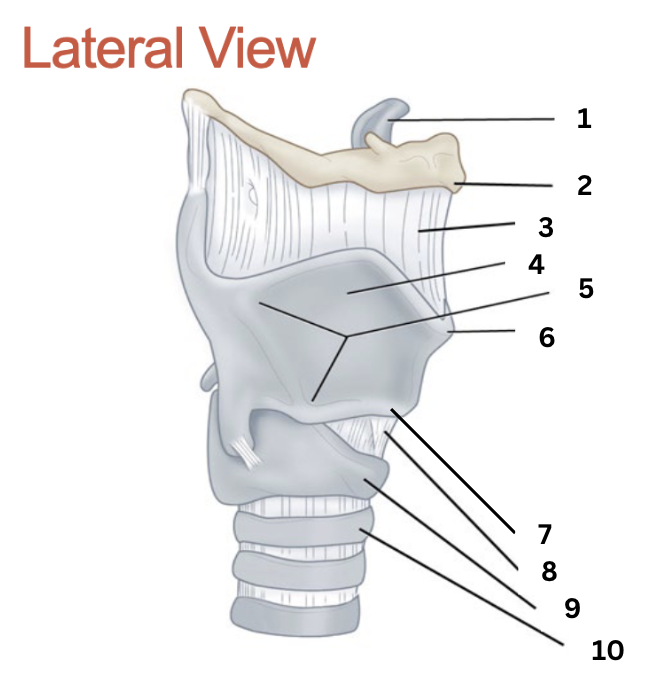
what is number 4?
thyroid cartilage lamina

what is number 5?
oblique line

what is number 6?
laryngeal prominence (adam’s apple)

what is number 7?
thyroepiglottis ligament

what is number 8?
cricothyroid ligament
what is number 9?
cricoid cartilage

what is number 10?
trachea

what is number 1?
epiglottis

what is number 2?
hyoid bone

what is number 3?
thyrohoid membrane

what is number 4?
superior horn of thyroid cartilage

what is number 5?
thyroid cartilage lamina

what is number 6?
arytenoid cartilage

what is number 7?
vocal ligament

what is number 8?
inferior horn of thyroid cartilage

what is number 9?
cricoid cartilage
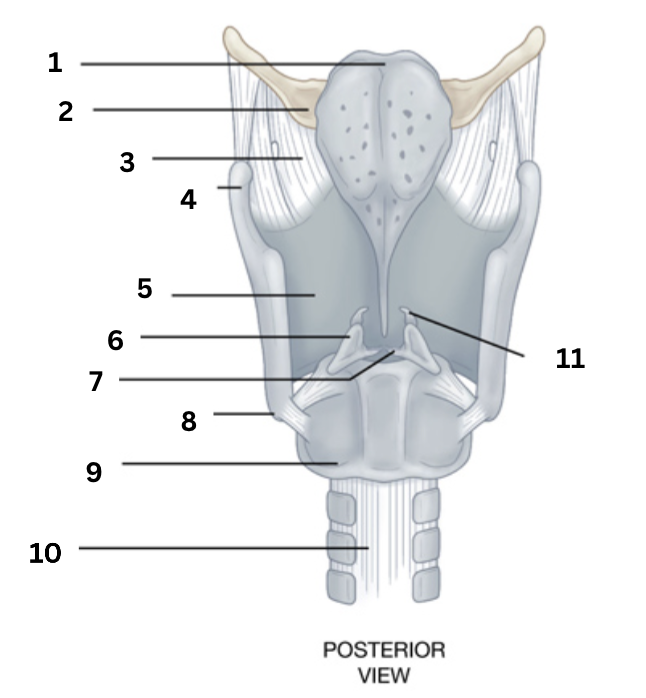
what is number 10?
trachea
what is number 11?
corniculate cartilage

what is number 1?
epiglottis

what is number 2?
hypoepiglottic ligament

what is number 3?
hyoid bone

what is number 4?
thyrohyoid membrane

what is number 5?
thyroid cartilage lamina

what is number 6?
corniculate cartilage
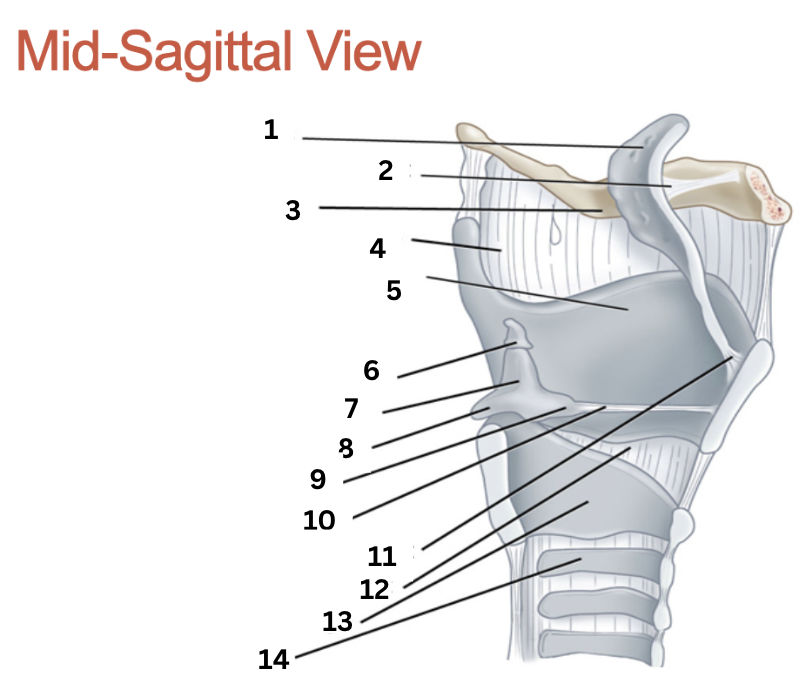
what is number 7?
arytenoid cartilage

what is number 8?
muscular process
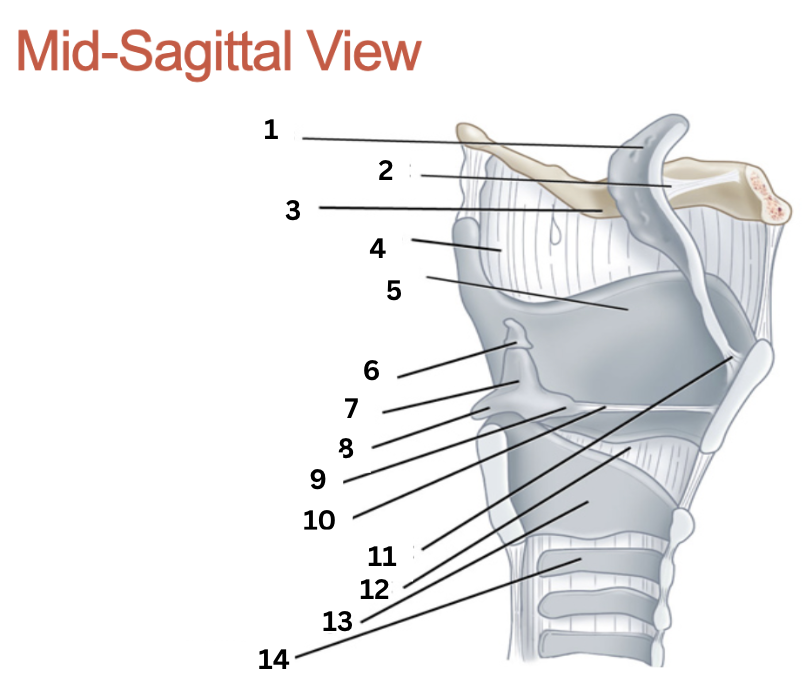
what is number 9?
vocal process
what is number 10?
vocal ligament

what is number 11?
thyroepiglottic ligament

what is number 12?
circothyroid ligament

what is number 13?
circoid cartilage

what is number 14?
trachea
three categories of intrinsic laryngeal muscles
adductors, abductors, cricothyroid muscles
adductor intrinsic laryngeal muscles
lateral cricoarytenoids (LCAs), thyroarytenoids (TAs), interarytenoids (IAs)
abductor intrinsic laryngeal muscles
posterior cricoarytenoids (PCAs)
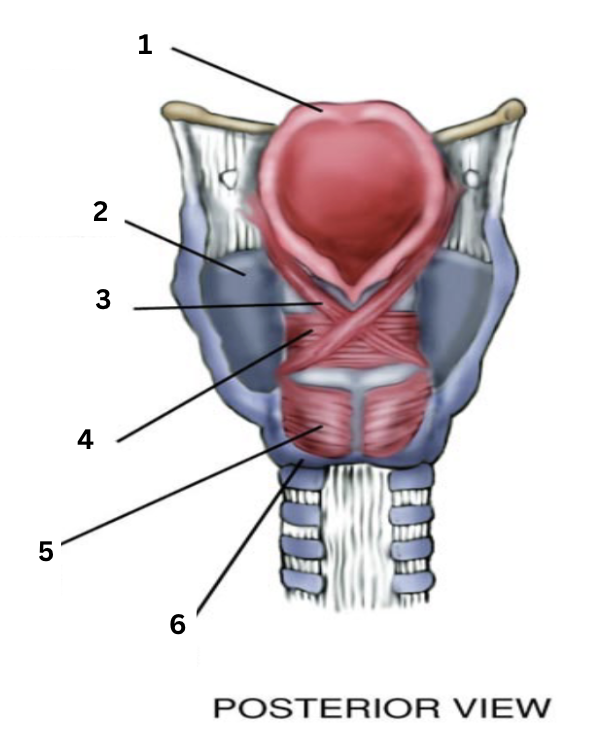
what is number 1?
epiglottis

what is number 2?
thyroid cartilage

what is number 3?
oblique arytenoid muscle

what is number 4?
transverse arytenoid muscle superior

what is number 5?
posterior cricoarytenoid muscle

what is number 6?
cricoid cartilage

what is number 1?
arytenoid cartilage
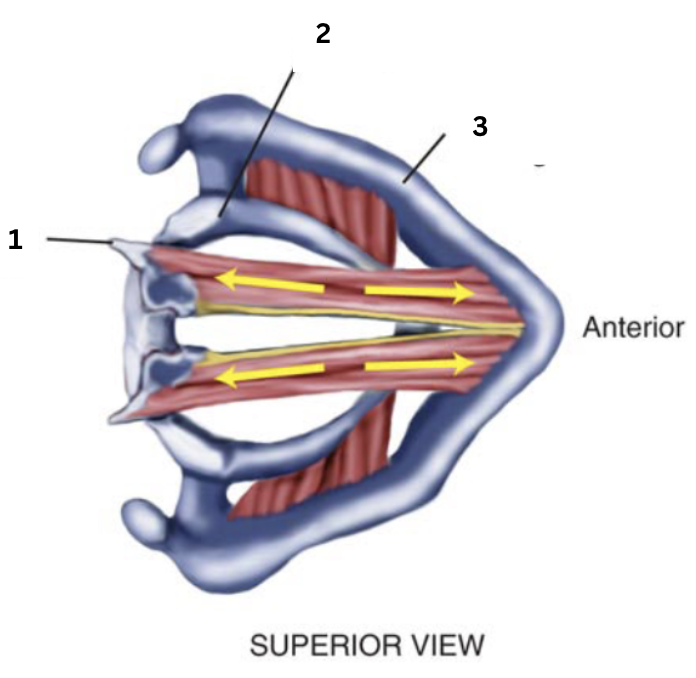
what is number 2?
cricoid cartilage

what is number 3?
thyroid cartilage
two kinds of extrinsic laryngeal muscles
suprahyoids, infrahyoids
suprahyoid muscles
mylohyoid muscle, geniohyoid muscle, anterior digastric muscle, posterior digastric muscle, stylohyoid muscle
infrahyoid muscles
sternohyoid muscles, thyrohoid muscle, omohyoid muscle
what nerve innervates to the larynx?
cranial nerve X - vagus nerve
biological functions of the larynx
coughing, throat clearing, abdominal fixation, forced inspiraion, swallowing
aerodynamic myoelastic theory of vocal fold vibration
muscles close the vocal folds, and air pressure builds beneath them until it forces them apart. airflow then rushes through the opening, and the bernoulli effect, along with the fold’s elasticity, pulls them back together. Because of vertical and longitudinal phase differences, the folds open and close in a rippling motion rather than all at once, and the cycle repeats.
air pressure
force from air in the lungs pushing up against the closed vocal folds
airflow
movement of air from the lungs up through the glottis
Bernoulli effect
as air speeds through a narrow space, its pressure drops, which pulls the vocal folds back together
muscle and elasticity
laryngeal muscles bring the folds together, and their elastic tissue snaps them back toward the midline after being pushed apart
vertical phase difference
the bottom of the folds opens and closes before the top, creating a wave-like motion from bottom to top
longitudinal phase difference
different points along the fold’s length (front to back) open and close at slightly different times
three types of phonatory attack
simultaneous, breathy, glottal
simultaneous phonatory attack
adduction of the vocal folds and experation happening at the same time airflow is released, vocal folds meet in the middle “hygenic”
breathy phonatory attack
release airflow before adducting the vocal folds
glottal phonatory attack
adduction of vocal folds before airflow is released
phonatory attack
how airstream is released
how many glottal phase cycles happen every second
230 for women, 120 for men
three vocal registers
modal, falsetto, fry
pitch and vocal fold mass have an inverse relationship
true
categories for wilson voice profile
laryngeal opening, severity, pitch
laryngeal opening dimension for wilson voice profile
-4 (no audible voice), -3 (aphonia, whispered), -2 (breathy), 1 (normal), +2 (pressed), +3 (extreme tension) — patients can be scored on both breathiness and tension
severity for wilson voice profile
1-2 is mild, 3-5 is moderate, 6-7 is severe
pitch for wilson voice profile
-2 (lower than expected), 1 (normal), +2 (higher than expected) — “expected” is relative to age and sex of the patient