Topic 4 - Mapping Mutations
 Call Kai
 Learn
Learn Practice Test
 Spaced Repetition
 Match
Match Flashcards
 Knowt Play
1/38

There's no tags or description
Looks like no tags are added yet.
Name | Mastery | Learn | Test | Matching | Spaced | Call with Kai | Chat |
|---|
No analytics yet
Send a link to your students to track their progress
39 Terms
Complementation Testing
Determines if two mutants are mutated in the same gene
-Requires getting the two mutant alleles into the same individual, then assessing the phenotype
Only works for recessive mutations
Complementation - Complementation Testing
Complementation = mutation are in different genes
-Shown in WT progeny, mutations are non-allelic
No-Complementation - Complementation Testing
No Complementation = mutations are in the same gene
-Mutant progeny, mutations are allelic
Intragenic Complementation
Two mutations that complement each other, but are alleles of the same gene due to unusual properties of the protein
-Seen with genes that encode multifunctional proteins
-We’d expect a mutant phenotype, but instead observe a wildtype phenotype
Two-Point Linkage Mapping
New mutations can be mapped by linkage analysis to existing loci on the linkage map of the organism in question
-Uses a previous known gene (mapping marker), should be centrally located along length of chromosome of interest
Unlinked vs Linked
If two loci are unlinked (assort independently), gamete phenotype will be equal proportion
-Independent assortment shown in semicolon (exl m/m ; b/b)
If two loci are linked, gamete phenotype will not be equal proportion, instead dependent on distance between loci
-Shown with / (ex; mb/mb)
If unknown, use dot between (m/m . b/b)
Test-Cross
Involves crossing F1 individual to a homozygous recessive individual
Recombinants and Parentals
Recombinants - Have phenotypes different from ORIGINAL parents, will always be LESS abundant
Parental - Have phenotypes of the parents (P generation) will always be MORE abundant
Recombinant Frequency
RF = Recombinant/total progeny
-Map distance (mu) = RF x 100
Problem with Visible Markers
Visible markers are not well distributed throughout the chromosomes
How do we determine visible marker to use
-But molecular markers (SNP - Single Nucleotide Polymorphism) are far greater in number and more distributed
Two-Point Linkage Mapping Example
Suppose we developed a mutant with purple eyes (m/m), wish to know location on the chromosome
-We select the Black Body to be our visible marker (b/b)
Cross True-Breed Parents
Cross parents homozygous for our mutation (p/p . +/+) and homozygous for black body (+/+ . b/b) to achieve F1 generation which will be heterozygous

Test-Cross
Cross heterozygous F1 with tester (homozygous for recessive alleles)

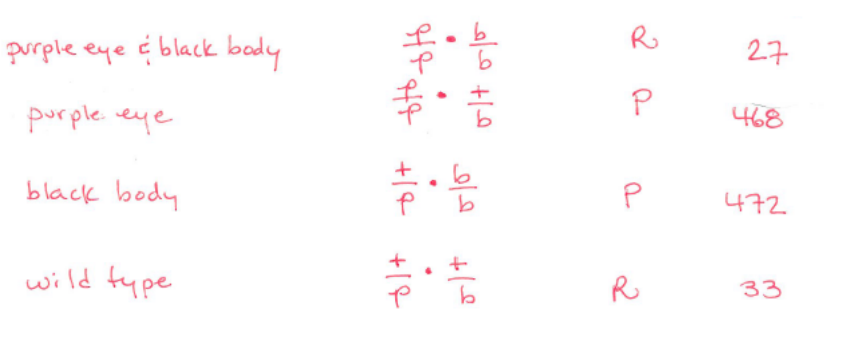
Determine Proportion of Progeny and RF
Since they are not equal proportion, the mutation is LINKED to visible marker (black body), therefore they do not independently assort
-RF = Recombinant / Total Progeny
Map Distance = RF x 100
Single Nucleotide Polymorphism
Molecular marker used in mapping
-Polymorphic (Locus with two or more alleles)
-Tend to be bi-allelic (only two alleles)
Very abundant/well distributed throughout the genome
Genotyping SNPs
Small proportion are located within context of restriction enzyme cleave site (Snip SNPs)
-These can be genotyped using PCR and restriction digestion of the product
Snip SNP Detection
Isolate genomic DNA from individual to genotype
Subject genomic DNA to PCR using primers that flank the SNP
Primers will anneal regardless of SNP alleles as sequences in flanking region are identical
Treat PCR product with appropriate restriction enzyme, run on a gel
Analyze

Allele Specific Oligonucleotide Hybridization
Each ASO is specific to one of the SNP alleles
-Ex; ASO 1 probe only hybridizes target DNA containing SNP allele 1 sequence

ASO Hybridization - Process
Isolate genomic DNA from individuals of interest
Denature DNA (via high temps)
Spot in duplicate (pipette) onto solid supports (membrane/glass slide)
Hybridize targets with respective ASO (ASO hybridization signal tends to be radioactive)
Allow probe to bind to complementary sequence
Wash off unhybridized probe, expose to films
Hybridization signal indicates the presence of the SNP allele within a target DNA sample

Fluorescent ASOs
Uses a single solid support with target and differentially labelled ASO probes that are fluorescent
-Ex; ASO probe 1 using Cy3 (green) and Probe 2 using Cy5 (red)
Microarray Genotyping
Extract genomic DNA
Break genomic DNA into pieces
Label genomic DNA (fluorescently)
-Silicone chip contains SNP alleles in different locations of the chip
-Genomic DNA finds complementary sequence (SNP allele), resulting in fluorescent signal
Microsatellites
Type of molecular marker, polymorphic loci (repeating units of 2-5 bases)
-Different alleles generated by strand slippage during replication (repeats expand or contract)
-Also called Short Tandem Repeats (STRs) or Simply Sequence Repeats (SSRs)
Detecting Microsatellites
isolate DNA from individuals, genomic DNA used as template in PCR
DNA that flanks a microsatellite in a specific location of the genome is conserved in all individuals, singe pair of PCR primers will amplify that locus in all individuals
Different sized PCR products generated depending on number of repeating units in microsatellite
Resolved by gel, differences are small and capillary electrophoresis is required
Mapping with SNPs
Suppose you’ve identified a new mutation on mouse chromosome 18
-You have the mutant and mutant-balancer stocks
We can use high through-put genotyping on microarray with molecular markers to narrow down a “critical region” on Chromosome 18
Genetic Background of Mutant
Mutant generated in a C57BL/6 background has a distinct complement of SNP alleles compared to other mouse strains (BALB/c mouse strain)

F1 Generation
Mutant mouse and BALB/C WT mouse crossed
-All will be heterozygotes; one chromosome 18 from mutant and other from WT

F2 Generation
F1s crossed together, select for F2 with mutant phenotypes
-Select F2 are homozygous for mutation
-DNA flanking mutation locus can be from either genetic background (due to crossing-over)
-SNPs can therefore be from either parent throughout chromosomes

Genotyping F2 Individuals
Genotype F2 individuals with mutant phenotype to determine minimal region from the C57 that has been retained
-Closer SNP is from a mutation, lower the chance of recombination
-Farther an SNP locus is from the mutation, more likely it is to have had a recombination event (introducing a Balbe SNP allele)

Microarray Genotyping of F2 Mutants
Smallest region from C57 background retained is between SNP762 and SNP545
-This is our “Critical Region”
-Gene of interest is located somewhere in the interval between the two SNP markers
We then select an SNP within the critical region (SNP 705)
Distance between our mutation and the DM1 SNP is mapped via 2-point linkage

Alleles for DM1
Two alleles for DM1 (DM1^T and DM1^C)
Two-Point Mapping - Step 1
Generate doulbe heterozygote by crossing true-breeding parents:
-F1 is double heterozygous, able to make 4 possible gametes
-But proportion is based on linkage that we need to determine

Two-Point Mapping - Step 2
Testcross consists of double homozygous recessive for loci of interest (goi and DM1)
-Cross with our doubly heterozygous F1 individual

Two-Point Mapping - Step 3
Score the progeny and interpret results
-Unequal proportion of gametes, therefore our genes (goi and SNP) are linked
-Using the RF and total progeny, we determine distance between the genes is 20mu apart, but we don’t know if it’s 20mu north/south
Therefore, we’d have to use another molecular marker within the critical region to narrow down the position

Mapping with SNPs - C.Elegans
Several WT strains in Bristol and Hawaii are separated geographically/genetically
-SNP every 1000bp with known locations, allowing us to map new mutations with respect to these SNPs via a high-throughput method
Step 1 - Cross Parents
Cross the true breeding WT Hawaiian males with Bristol hermaphrodites that are homozygous for the mutation
-Trying to determine a linkage between SNP and mutation, we assume the SNP is cleaved in CB4 but not N2 (aka, it’s a snip SNP)

Step 2 - Selfing
C. Elegans can be selfed, so instead of testcrossing we self
-From the F2, we only select those with the mutant phenotype
Step 3 - Analyze Linkage
If Mutation and SNP are Not Linked:
-A 1:2:1 genotypic ratio is observed among MUTANT F2s (those homozygous for mutation)
-25% SNPn2/SNPn2 ; 50% SNPn2/SNPcb ; 25% SNPcb/SNPcb
If Mutation and SNP are Linked:
-Parental and recombinant GAMETES are not made in equal proportion (parental gametes make up >50% o the gametes)
-There is not a 1:2:1 genotypic ratio among mutant F2s
SNP and Mutation Relation
Closer mutation is to the SNP being tested, less likely a homozygous mutant will harbor the CB allele of the SNP (ie, be recombinant)
-More likely that there will be significant over-representation of N2 homozygous SNP (parental) mutants compared to 1:2:1 expected for Independent Assortment
Counting Chromosomes
Middle/Right are recombinants → but they aren’t equal
-In terms of Chromosomes, middle has one recombinant and one parental, whereas the right has two recombinant chromosomes
