Topic 4: Bioenergetics
 Call Kai
 Learn
 Practice Test
 Spaced Repetition
 Match
 Flashcards
 Knowt Play
1/9

There's no tags or description
Looks like no tags are added yet.
10 Terms
Photosynthesis produces oxygen.
Complete the word equation for photosynthesis (3)
______ + ______ → ______
Carbon dioxide + water → glucose
(3 marks, 1 for each correct answer)
Explain how oxygen is used in cells. (2)
(Used in aerobic) respiration (1)
( do not accept anaerobic)
To release / transfer energy (1)
Allow for energy
Allow (respiration) by mitochondria
(Do not accept energy created / made / produced)
A student investigated the effect of light from different coloured light bulbs on photosynthesis.
The student:
used pondweed in a beaker of water
used different coloured light bulbs in a lamp
counted the number of bubbles of oxygen the pondweed produced in two minutes for each colour of light bulb.
Give one hazard the student would need to consider when using the apparatus in this investigation.
Give the risk the hazard would cause. (2)
any one pair from:
• bulb / lamp is hot
(so) may burn you / skin
• glassware is breakable
(so) may cut skin
• electricity in close proximity to water
allow named example of electrical item in close proximity to water
(so) may get electric shock
• scissors / scalpel (to cut pondweed) are sharp
may cut skin
mark in pairs, each pair for 2 marks, must include both hazard and reason for any marks
A student investigated the effect of light from different coloured light bulbs on photosynthesis.
The student:
used pondweed in a beaker of water
used different coloured light bulbs in a lamp
counted the number of bubbles of oxygen the pondweed produced in 2 minutes for each colour of light bulb.
The student needed to keep the temperature of the water in the beaker the same throughout the investigation.
Describe how the student could keep the temperature of the water the same. (1)
(use a) water bath (1)
allow put beaker into (another) beaker of water
allow other correct methods, eg heat shield
allow use an LED
A student investigated the effect of light from different coloured light bulbs on photosynthesis.
The student:
used pondweed in a beaker of water
used different coloured light bulbs in a lamp
counted the number of bubbles of oxygen the pondweed produced in 2 minutes for each colour of light bulb.
The beaker of water contained the pondweed.
Explain why the temperature of the water in the beaker needed to be kept the same throughout the investigation. (2)
(change in) temperature affects / changes (the rate of)
photosynthesis (1)
allow temperature is a limiting factor (of photosynthesis)
allow temperature affects enzyme (activity)
allow temperature affects rate of reaction
(so) will affect / change the number of bubbles (produced) (1)
allow (so) will affect results
allow (so) will affect validity
ignore to make it fair
ignore so the results will be the same

A student investigated the effect of light from different coloured light bulbs on photosynthesis.
The student:
used pondweed in a beaker of water
used different coloured light bulbs in a lamp
counted the number of bubbles of oxygen the pondweed produced in 2 minutes for each colour of light bulb.
The table shows the results.
Which colour of light caused the highest rate of photosynthesis in the pondweed?
Tick (✓) one box. (1)
Blue
Green
Red
Yellow
Blue (1)

A student investigated the effect of light from different coloured light bulbs on photosynthesis.
The student:
used pondweed in a beaker of water
used different coloured light bulbs in a lamp
counted the number of bubbles of oxygen the pondweed produced in 2 minutes for each colour of light bulb.
The table shows the results.
What is the best way to display the data in the table above?
Tick (✓) one box. (1)
Bar graph
Line graph
Scatter graph
Bar graph (1)
A student investigated the effect of light from different coloured light bulbs on photosynthesis.
The student:
used pondweed in a beaker of water
used different coloured light bulbs in a lamp
counted the number of bubbles of oxygen the pondweed produced in 2 minutes for each colour of light bulb.
The student wanted to measure the volume of oxygen the pondweed produced in 2 minutes.
Name one piece of apparatus the student could use to measure the volume of oxygen. (1)
any one from:
• measuring cylinder
• (gas) syringe
• burette
A student investigated the effect of light from different coloured light bulbs on photosynthesis.
The student:
used pondweed in a beaker of water
used different coloured light bulbs in a lamp
counted the number of bubbles of oxygen the pondweed produced in 2 minutes for each colour of light bulb.
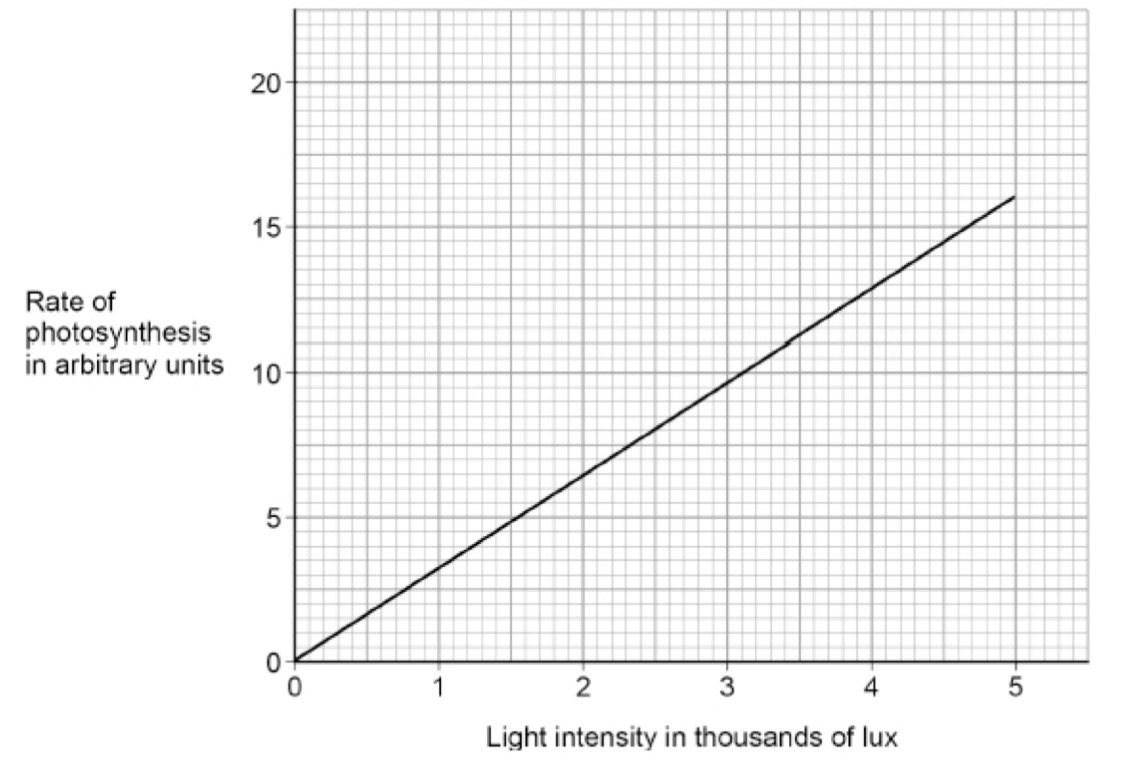
Another student investigated the effect of light intensity on the rate of photosynthesis.
The figure below shows the results.
Describe what the figure shows about the relationship between light intensity and the rate of photosynthesis. (2)
as light (intensity) increases, rate / photosynthesis increases (1)
allow positive correlation
(rate / photosynthesis increases) at the same rate as light (intensity) (1)
allow rate / photosynthesis increases linearly / evenly
allow description of shape of line eg straight / linear
allow rate is (directly) proportional to light (intensity) for 2 marks

A scientist investigated the rate of photosynthesis of one type of tomato plant.
The tomato plants were grown in a greenhouse.
The table below shows the results.
Give two control variables the scientist should have used in the investigation. (2)
Any two from:
• temperature
• size of tomato plants or size / number of leaves
allow age of plant
• light
• (volume of) water
allow (amount of) water
• (amount / type of) fertiliser / minerals / ions / nutrients (given to plants)
allow (type of) compost / soil
allow named example of mineral ion such as nitrate
/ magnesium
• time before rate readings are taken
ignore time unqualified
ignore type of tomato plant
ignore type of greenhouse