Polymers of Life
 Call Kai
 Learn
 Practice Test
 Spaced Repetition
 Match
 Flashcards
 Knowt Play
1/20

There's no tags or description
Looks like no tags are added yet.
21 Terms
alcohols, diols, and phenols
contains a hydroxyl group -OH
primary- the OH is bonded to a carbon bonded to one other carbon atom
secondary: the OH is bonded to a carbon bonded to 2 other carbon atoms
tertiary: the OH is bonded to a carbon bonded to 3 other carbon atoms
e.g butan-2-ol
diols
contain 2 hydroxil groups, e.g ethane-1,2-diol
phenols
aromatic alcohols, weak acids as the H can disocciate from the OH group, the carbon 1 is always the one bonded to the OH
carboxyllic acids, aromatic carboxylic cids dicarboxyllic acids
contain a carboxyl group -COOH e.g ethanoic accid
called acids bc they dissociate to relase a hydrogen ion, becoming an ion e.g sodium ethanoate. they are weak acids bc they partially dissociate(use a reversible reaction sign to show ionisation in water is partial)
carboxyllic acid⇌carboxyllic ion -(e.g ethanoate) + H+
or carboxyllic acid +water ⇌ carboxyl ion (e.g CH3COO-) +H3O-
aromatic carboxylic acids coan contain benzene rings. If they contain another group, the carbon bonded to COOH is carbon one, e.g in 2-methyl benzoic acid
dicarboxylic acids:
dicarboxlic acids have 2 carboxyl groups. each carboxyl group has to be at the ends of the carbon chain
both carboxyl groups react

aldehydes and ketones
contain a carbonyl group C=O
aldehyde e.g ethanal
ketone- e.g propanone, only give number if there are more than 4 carbons

acyl chlorides and acid anhydrides
acyl chlorides:
acid chlorides, a derivative of carboxylic acid, OH is replaced with a clorine so -COCl
replace the e in alkane name with -oly chloride e.g ethanoyl chloride
acid anhydrides:
formed by a condensation reaction betweeen 2 carboxylic acids, eliminating a small molecule e.g water
only need to know name of ethanoic anhydride and that it is (CH3CO)2O

esters
formed from condensation reactions
carboxylic acid +alcohol ⇌ ester+ water (needs acid catalyst)
first part comes from alcohol and second part comes from carboxylic acid e.g ethyl butanoate
can also be formed by acyl chlorides or acid anhydride +alcohol→ester + small molecule
polyesters are formed by a condesation reaction between a diol and dicarboxylic acid
amines
deriviteives of ammonia but 1 or more hydrogen is replaced with an R group
primary amine- one hydrogen replaced with an R group, secondary- 2hydrogens replaced, tertiary, 3 huydrogens
only need to know how to name primary amines- start w name of R group e.g methylamine, ethylamine or 1-aminopropane(name is different if 3 or more bc u need to say position of amine group)
‘diamino’ if 2 amine groups e.g 1,6-diaminohexane
primary amine group is always NH2

amine properties
water solube bc they form hydrogen bonds in water as N has a lone pair
weak pd-id attractions to water ,
more energy is required to break hydrogen bonds between water molecules than is released by forming pd-od bonds, so solubility decreases the longer the chain is
they are weak bases bc the N has lone pairs, so acts as a proton receptor to accept a hydrogen ion from water and form a dative covalent bond forming OH- ions making the solution acidic. this is an equilibrium and there are still some undissociated amine so the smell remains in solution
if acid is added H, the amine is neutralised but this is not an equilibrum there is no freee amine so smell disapperars
if an alkali is added to an amine salt the amine smell returns, ph is above 7 bc hydroxide ions act as a base acceptingn protons from amine salt so free amine is regenerated
amine salt naming is using ‘alkylammonium ion’ e.g ethylammonium chloride

amides and nylons
derivatives of carboxyllic acids, but has an NHx insread of OH
primary, only one hydrogen is relaced with a carbon chain, secondary- 2 hydrogens are replaced with carbons, tertiary- 3 carbons are replaced with carbons
formed by acyl chloride + ammonia or an amine→amide + small molecule, condensation reaction, don’t call the bond a peptide bond this is onyl for bio
amide formation is very exothermic and steamy white fumes are produced
nylons;
polyamides aka nylons, are fromed by diamines+diacylchloride or a dicarboxylic acid
first number is number of carbons in the diamine, second number is number of carbons in the dicarboxylic acid or diacychloride e. nylon-6,6

hydrolysis of esters and amides in neutral, acidic and alkaline conditions

proteins
condensation polymers of amino acids, 2-dipeptide, 3-tripeptide 4+polypetide, over 40 protein
amino acids are the monomers and they are known as residues when part of a polymer
the order in which the residues are joined-primary structure of protien
say peptide bond isntead of amide bond between COOH and NH2
zwitterions
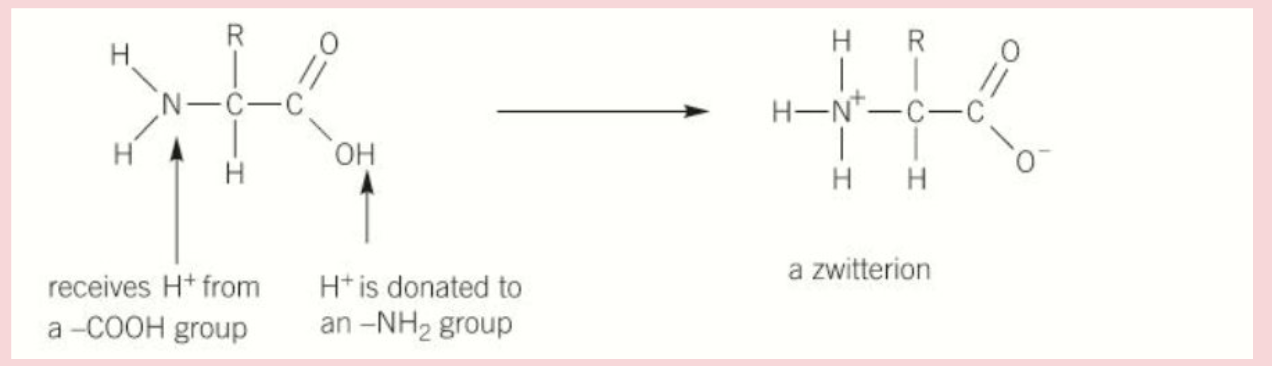
proteins are bifunctional bc they have an acidic group that donates a proton (amine group) and a basic group that accepts a protein
this forms zwitterions which have a positive charged group and a engative charged group with no overal charge but lots of ionic attractions between zwitterions
this can happen with amino acids, they are solunble in qater bc zwitter ions form ion dipole attractiosn w polar water molecules
amino acids can react with OH- or H+ ions to buffer solutions
hydrolysis of peptides and chromatography
amide bond can be hydrolysed using enzymes in roganisms or heating under reflux with moderated conc HCL in a lab
then you can do chromatography and compare Rf values with known amino acids to identify an unknown one
amino acids ened to know: functional group,
the carbon bonded to R is the alpha carbon
glycine R group is just H
alanine functional group is CH3

secondary and tertiary bonding in proteins
secondary structure:
coil into helix or fold into a sheet due to hydrogen bonds between the NH and CO of neighboruing parts of the same chain
tertiary structure:
3d strucute held together by bonds and attractions between r groups of amino acid residues e.g ionic, covalent(disulfide bridges), hydrogen bonding, id-id forces
structural proteins e.g collagen are fibrous whilst chemical proteins are globular
enzymes and competitive inhibtors
globular tertiary structure proteins.
a substrate fits the active site and forms attractions to the R groups of the protein structre to be broken down or joined into new products
R groups on the residues of the enzymes interact with substrate froming weak bonds, forcing other bonds within the substrate to weaken or change shape forcing the areas to come close enough to react
weak bonds are broken when reaction is complete leaving active site unchanged and free for another substrate molecule to enter
often only one enantiomer of an optical isomer will fit into the active site
competitiev inhibitors(4)
competitive inhibitors similar shape to the substrate so can fit into the same active sites and
form same interactions/bonds w active sites.
however it does not form any new products
remains bonded to the active site preventing anuy more substrates from entering and being catalysed. (model answer)
define pharmacophore, molecular recognition
molecular recognition- how molecules interact in terms of intermolecular and covalent bonds
pharmacophore- the part of a drug molecule that gives the medicine its particular pharmocological properties
they can fit into receptor sites, interact w receptor sites to form weak intermolecular attractions, be modifided to reduce side effects by changing side groups
optical isomerism
all molecules have a mirror image
non-superimposable mirror image- mirror image is a different molecule (left hand is a nonsuperimposable mirrr image of right hand bc if you pick up the mirror image and put it over it wont fit the original
this happens when a molecule has a chiral centre- carbon with 4 different groups bonded 2 it. So molecules with a chiral carbon have optical isomerism
enantiomers- non-superimposable mirror images
they usuallly have the same physical and chemical properties, but react differently with other chiral molecules e.g left hand doesnt fit a right handed glove. most amino acids are chiral so most enzymes only interact wirtha. specific enantiomer of a chiral molecule
DNA structure and bonding
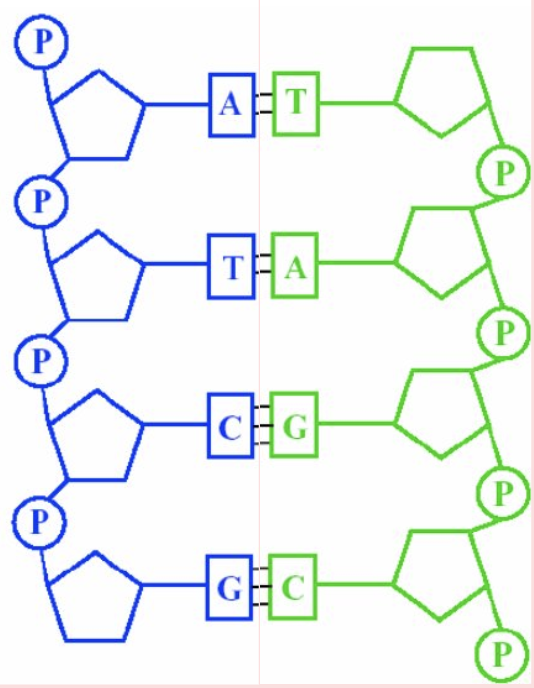
each side of the sugar phosphate backbone is anti-parrallel
condensation reactions to form phosphodiester bonds betweeen phosphates and sugars insugar phosphate backbone
hydrogen bonds between A and T (2) and C and G(3)complementary nitrogenous base pairing
transcription and translation
transcriptipon- the DNA is unzipped by DNA helicase and RNA neuclotides organise to form a complementary mRNA strand, small enough to enter ribosomes
translation- trna runs along mrna strand and has anticodons that complement mRNA codons
in RNA there is U instead T
NMR spectrocoscopy
nuclear magentic resonance
if some nuclei are exc ited they emit radiation as radio frequency to drop down to grown state
nuclei needs to have an odd number of nucleons(protons and neurons) to do this
each enviornment what surrounds carbon/hydrogen gives one peak
position of peak tells us what the environment is but not how many there are for carbon, only hydrogen
‘we will find x peaks with a chemicl shift between a and b ppm’
for hydrogen nmr there is a splitting pattern which is the number of H on the neighbouring carbons +1. = singlet(1), doublet(2), triplet(3) quartet, or mulitiplet
this can be combined with infrared spectroscopy to identify molecules
if recap: OH for alcohol produces a smooth broad peak betwen(3200-2600 given), if jagged then the OH is likely of a carboxyllic acid