Biotechnology Exam Two
 Call Kai
 Learn
 Practice Test
 Spaced Repetition
 Match
 Flashcards
 Knowt Play
1/34

Earn XP
Description and Tags
Slides from Chapter 3, 4, and 5.
35 Terms
Plasmid DNA: small circular pieces of DNA fiund primarily ion bacteria
small circular pieces of DNA found primarily in bacteria
Plasmid DNA facts:
considered extrachromosomal DNA because they are in the cytoplasm in addition to bacteria chromosome
are small, approx. 1 to 4 kb
can replicate independently of chromosome
used as vectors: pieces of DNA that can accept, carry, and replicate other pieces of DNA

Calcium Chloride Transformation of Bacterial Cells
a process for inserting foreign DNA into bacteria
very inefficient process
Calcium Chloride Transformation of Bacterial Cells steps:
Treat bacterial cells with calcium chloride, while chilled on ice for 30 minutes
Add plasmid DNA to cells chilled on ice
Heat the cell and DNA mixture (30 sec @42 degrees C)
Plasmid DNA enters bacterial cells and is replicated and express their genes
Electroporation
apply brief pulse of high voltage electricity to create tiny holes in the bacteria cell wall that allow the DNA to enter the cell
Advantages of Electroporation:
rapid
requires fewer cells
can be used to introduce DNA into other cell types
more efficient process


Selection
is a process designed to facilitate the identification of recombinant bacteria from bacteria that contain plasmid without foreign DNA, while preventing the growth of non-transformed bacteria
Antibiotic selection:
transformed cells are cultured on plates containing antibiotic to identify transformed bacteria from non-transformed bacteria
Ex.: Ampicillin if your plasmid has Amp. resistant gene
does not select for plasmid containing foreign DNA (recombinant plasmid) vs. recircularized plasmid with no DNA insert
What is involved in the selection of recombinant bacteria after transformation:
selection
antibiotic selection
Blue-white selection with X-gal (artificial lactose) in media:
DNA is cloned into plasmid restriction site within lacZ gene
When lacZ gene is interrupted by an inserted gene, it cannot produce functional Beta galactosidase enzyme
With X-gal added to media in Petri plate
-Non-functional lacZ = white colony = clone = genetically identical bacterial cells each containing copies of the recombinant plasmid
With X-gal added to media in Petri plate
-Functional lacZ = blue colony


B. 1, 3, and 6
Introduction to human gene cloning:
first recombinant human protein marketed was insulin in 1982, and next was growth hormone in 1985
cloned human insulin cDNA sequence inserted into a plasmid and the bacteria cells were then used to synthesize the protein product of the cloned gene
can generate lots of pure protein via this technique
What was the source of growth hormone prior to recombinant technology?
Cows (bovine) or pigs (porcine) provided insulin to treat human diabetes, then human growth hormone was extracted from the pituitary glands of human cadavers.
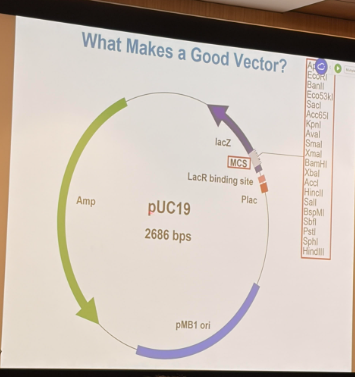
Practical Features of DNA Cloning Vector (Plasmid)
Size
Origin of replication (ori)
Copy number
Multiple cloning site (MS)
Selectable marker genes
RNA polymerase promoter sequences
DNA sequence primers
Size
small enough to be separated from chromosomal DNA
Origin of replication
site for DNA replication that allow plasmids to replicate independently from host chromosome
Copy Number
number of plasmids in the cell, normally small (recombinant plasmids have high copy numbers)
Multiple cloning site (MCS)
recognition sites for several restriction enzymes in which DNA insert is cloned into
Selectable marker genes
enables selection of transformed colonies
RNA polymerase promoter sequences
used for transcription (for Protein Expression Vector (up arrow)) in vitro and in vivo
DNA sequence primers
seq flank ends of multiple cloning site
Assume you want to make lots of human insulin using a bacteria expression vector.
Why wouldn’t using human insulin genomic DNA for this cloning project be advantageous?
Because bacterial cells cannot remove introns, which are non-coding regions found within eukaryotic genes.
Creating DNA Libraries
Collections of cloned DNA fragments from a particular organism contained in plasmid vectors within host bacteria (ex. E. coli), or can be flanked by ligated adapters/linkers (w/NGS) without use of host cells
Screened to pick out different genes of interest
Two Types of Libraries:
Genomic DNA libraries (Ex. DNA sequencing entire genome (NGS))
Complementary DNA libraries (cDNA libraries) (Ex. Sequencing transcriptome)
What prevents restriction enzymes produced by a bacterium from digesting its own genome?
Methylated DNA
Genomic Libraries
Chromosomal DNA from the tissue of interest is isolated & digested with a restriction enzyme (RE) which produces many fragments that are part of the entire genome
DNA ligase is used to ligate genomic DNA fragments and vector (plasmids) digested with the same RE or adapters/linkers (w/NGS)
Recombinant vectors (plasmids) are used to transform bacteria, and theoretically each bacteria will contain a single recombinant plasmid with a single fragment of genomic DNA from the organism of interest
Disadvantages of Genomic Libraries
Introns are clones in addition to exons:
- Majority of genomic DNA is introns in eukaryotes so majority of the library will contain non-coding pieces of DNA
Many organisms have very large genome, so searching for gene of interest is difficult, unless using NGS.
Time consuming!
cDNA Libraries
mRNA from tissue of interest is isolated
Need to make double stranded DNA from mRNA; How?
Adapters/linkers (w/NGS): double stranded cDNA sequences, which contain restriction enzyme recognition sites, are ligated to the ends of the cDNA
Cut with restriction enzyme, cut vector with same RE, ligate fragments to make recombinant vectors
Then transform bacteria with recombinant vectors, or perform NGS of cDNA with Adapters/linkers
cDNA Libraries
Advantage over genomic libraries
- Collection of actively expressed genes in the cells or tissues from which the mRNA was isolated
-Introns are NOT cloned
-Can be created and screened using colony hybridization to isolate genes that are primarily expressed only under certain conditions in a tissue
Disadvantage
-Can be difficult to make the cDNA library if a source tissue with an abundant amount of mRNA for the gene is not available
Identify and Clone a Gene of Interest