Plant Diversity I
 Call Kai
 Learn
 Practice Test
 Spaced Repetition
 Match
 Flashcards
 Knowt Play
1/56

There's no tags or description
Looks like no tags are added yet.
57 Terms
Cyanobacteria and protists likely existed on land by
1.2 billion years ago
Small plants, fungi, and animals emerged on land only within the last
500 million years
Since colonizing land, plants have diversified into more than ___ living species
290,000
Most present-day plants live on
land
Green algae called ___ are the closest relatives of plants
charophytes
Plants share the following traits with charophytes
Rings of cellulose-synthesizing proteins
Structure of flagellated sperm
Formation of a phragmoplast – scaffold for cell plate assembly
Plants are separated from algae because plants form
embryos
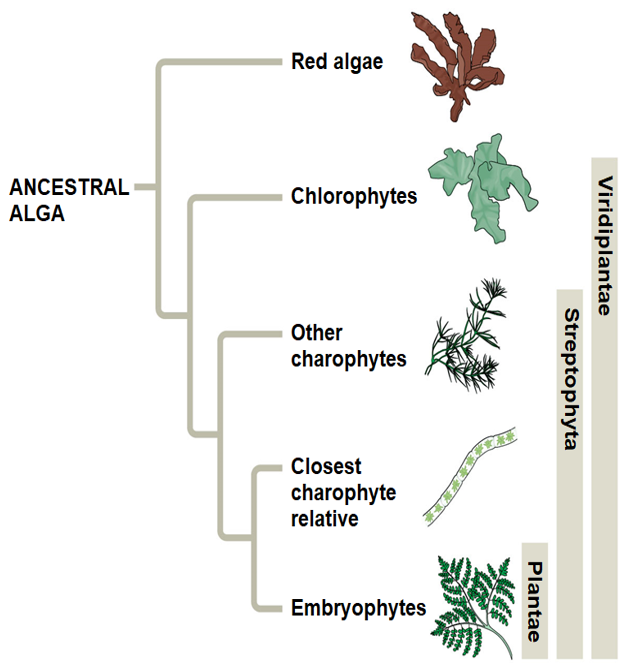
Five key traits appear in nearly all plants but are absent in the charophytes
1) Alternation of generations
2) Multicellular, dependent embryos
3) Walled spores produced in sporangia
4) Multicellular gametangia
5) Apical meristems
1) Alternation of Generations
Plants alternate between two multicellular generations, a reproductive cycle called alternation of generations
gametophyte generation
haploid and produces haploid gametes by mitosis
Fusion of a sperm and egg gives rise to the ___
diploid sporophyte which produces haploid spores by meiosis that develop into gametophytes
2) Multicellular, Dependent Embryos
The diploid embryo is retained within the tissue of the female gametophyte
Nutrients are transferred from parent to embryo through
placental transfer cells
Plants are called ___ because of the dependency of the embryo on the parent
embryophytes
The sporophyte produces spores in organs called
sporangia
sporangia
called sporocytes undergo meiosis to generate haploid spores
Spore walls contain ___, a complex polymer which makes them resistant to harsh environments
sporopollenin
Gametes are produced within organs called
gametangia
Male gametangia, called ___
antheridia, produce and release sperm
Female gametangia, called
archegonia, produce a single nonmotile egg
Each egg is fertilized within an
archegonium
Plants sustain continual growth in length by repeated cell division within the
apical meristems
Fossilized spores and plant tissues have been extracted from
450-million-year-old rocks
Fossils of larger structures, such as a sporangium, date to
425 million years ago

Bryophytes and seedless vascular plants are each a grade organisms that are grouped based
on shared key biological features
Nonvascular plants are commonly called ___
bryophytes
Seedless vascular plants can be divided into clades
Lycophytes (club mosses and their relatives)
Monilophytes (ferns and their relatives)
Gymnosperms
produce seeds that are not enclosed in chambers
Angiosperms
produce seeds that develop inside chambers that originate within flowers
Bryophytes are represented today by three phyla of small, herbaceous (nonwoody) plants
Liverworts, phylum Hepatophyta
Mosses, phylum Bryophyta
Hornworts, phylum Anthocerophyta
Mosses and other nonvascular plants have life cycles dominated by
gametophytes
A spore germinates into a gametophyte composed of a
protonema
protonema
one or more gamete-producing gametophores, and rhizoids anchoring gametophytes to the substrate
Bryophyte sporophytes never live independently of the __
gametophyte; they are the smallest and simplest sporophytes of all extant plant groups
sporophyte
consists of a foot, a seta (stalk), and a sporangium, also called a capsule, which discharges spores through a peristome

The earliest fossils of vascular plants date to
425 million years ago
In ferns, the familiar leafy plants are the __; the gametophytes are tiny plants that grow on or below the soil surface
sporophytes, gametophytes

Vascular plants have two types of vascular tissue:
xylem and phloem
Xylem conducts most of the water and minerals and includes tube-shaped cells called ___
tracheids

§Water-conducting cells are strengthened by ___ and provide structural support
lignin

Phloem
has cells arranged into tubes that distribute sugars, amino acids, and other organic products

Roots
Are organs that anchor vascular plants
They enable vascular plants to absorb water and nutrients from the soil
Roots may have evolved from subterranean stems

Leaves
organs that increase the surface area of vascular plants, thereby capturing more solar energy that is used for photosynthesis
Leaves are categorized by two types:
Microphylls, small, often spine-shaped leaves with a single vein
Megaphylls, larger leaves with a highly branched vascular system

Lycophytes have
microphylls, monilophytes, gymnosperms
angiosperms have
megaphylls
Sporophylls
modified leaves with sporangia
Sori
clusters of sporangia on the undersides of sporophylls

Strobili
cone-like structures formed from groups of sporophylls

§Most seedless vascular plants are __, producing one type of spore that develops into a bisexual gametophyte
homosporous
All seed plants and some seedless vascular plants are
heterosporous
Heterosporous species produce
megaspores, which give rise to female gametophytes and microspores, which give rise to male gametophytes


There are two clades of seedless vascular plants
Phylum Lycophyta includes club mosses, spike mosses, and quillworts
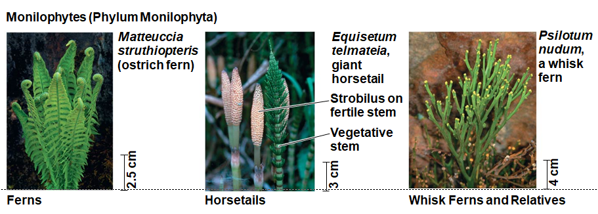
Phylum Monilophyta includes ferns, horsetails, and whisk ferns and their relatives
Phylum Monilophyta
Ferns are the most widespread seedless vascular plants, with more than 12,000 species which are most diverse in the tropics but also thrive in temperate forests
Horsetails were diverse during the Carboniferous period, but are now restricted to the genus Equisetum
Whisk ferns resemble ancestral vascular plants but are closely related to modern ferns