ess paper 2
 Call Kai
 Learn
 Practice Test
 Spaced Repetition
 Match
 Flashcards
 Knowt Play
1/717

There's no tags or description
Looks like no tags are added yet.
718 Terms
Environmental value system (EVS)
A worldview or set of beliefs that influences how someone perceives and responds to environmental issues.
Ecocentric
Nature has intrinsic value; prioritises ecological integrity, biodiversity and living within environmental limits.
Anthropocentric
Human needs and interests are central; nature is valued largely for its benefits to people.
Technocentric
Technology, innovation and scientific management can solve environmental problems and allow continued development.
Intrinsic value
The value something has simply because it exists, independent of its usefulness to humans.
Instrumental value
The value something has because it provides a benefit or service.
Worldview
A person's fundamental beliefs and assumptions about the world.
Environmental movement
Collective social and political action intended to protect the environment.
Stakeholder
An individual or group affected by, or able to influence, an environmental decision.
Conflict of interest
A situation in which different groups have competing priorities or desired outcomes.
System
A collection of interacting components that function together as a whole.
Open system
Exchanges both energy and matter with its surroundings
Closed system
Exchanges energy but not matter with its surroundings.
Isolated system
Exchanges neither matter nor energy
Boundary
The defined limit separating a system from its surroundings.
Input
Matter or energy entering a system
Output
Matter or energy leaving a system.
Storage
Matter or energy held within a system
Flow
Movement of matter or energy between components.
Transfer
Movement of matter or energy without changing its form
Transformation
A change in the chemical or physical nature of matter or energy.
Equilibrium
A condition in which opposing processes balance, so the system remains relatively stable.
Steady-state equilibrium
A dynamic condition in which inputs and outputs balance despite continuous movement through a system.
Static equilibrium
A condition in which there is no movement or change.
Feedback loop
A process in which the output of a system influences its future behaviour.
Negative feedback
Reduces or counteracts an initial change, helping stabilise the system.
Positive feedback
Amplifies an initial change, potentially destabilising the system.
Tipping point
A threshold beyond which a relatively small additional change can trigger a major shift in the system.
Regime shift
A transition from one relatively stable state to another
Resilience
The ability of a system to absorb disturbance and recover while retaining its essential functions.
Resistance
The ability of a system to withstand disturbance without changing significantly.
Carrying capacity
The maximum population size an environment can sustainably support.
Model
A simplified representation of reality used to understand, explain or predict a system.
Threshold
the point at which a system changes behaviour.
System complexity
interactions between components can produce unpredictable outcomes.
Sustainability
Maintaining environmental, social and economic systems over time without undermining their future functioning.
Sustainable development
Meeting present needs without compromising the ability of future generations to meet their own needs.
Intergenerational equity
Fairness between present and future generations.
Intragenerational equity
Fairness between people and groups within the same generation.
Environmental justice
Fair access to environmental benefits and protection from environmental harm, regardless of social or economic status.
Ecological footprint
The biologically productive land and water area needed to supply a population's resource consumption and absorb its waste.
Biocapacity
The capacity of an area to regenerate renewable resources and absorb waste.
Ecological overshoot
When humanity's ecological footprint exceeds Earth's available biocapacity.
Carbon footprint
Total greenhouse gas emissions associated with an activity, individual, organisation or population, usually measured in CO₂-equivalent
Water footprint
The volume of freshwater used to produce goods and services.
Environmental indicator
A measurable variable used to assess environmental conditions or sustainability.
Sustainable development goals (SDGs)
The 17 UN goals addressing social, economic and environmental development.
Planetary boundaries
Scientific limits within which humanity can operate without destabilising Earth's major systems.

Safe operating space
The range of conditions within which humanity can operate while reducing the risk of major environmental disruption.
Precautionary principle
Where there is a risk of serious or irreversible environmental harm, lack of complete scientific certainty should not be used to delay preventative action.
Polluter pays principle
Those responsible for pollution should bear the costs of managing or preventing it.
Environmental stewardship
Responsible management and protection of natural environments.
Three pillars of sustainability
a sustainable decision should all three dimensions (environmental, social and economic)

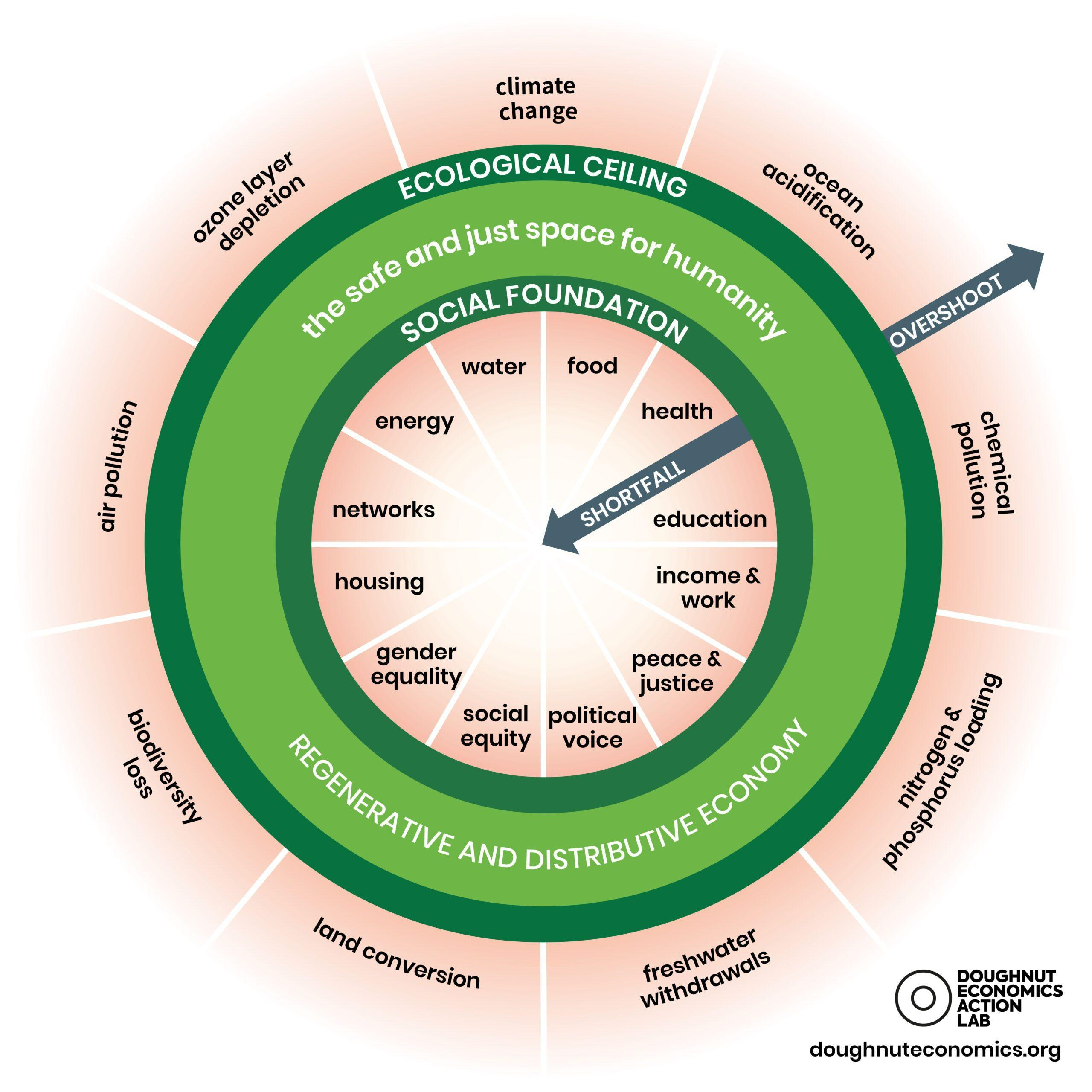
Doughnut economics model
inner boundary is the social foundation, the outer is the ecological ceiling. space between is safe space for humanity
Social foundation
minimum social conditions needed for human wellbeing.
Ecological ceiling
planetary boundaries that should not be exceeded
Regenerative economy
restores and works with natural cycles rather than depleting them.
Distributive economy
distributes wealth, opportunity and resources more equitably.
Linear economy
take–make–dispose model.
Circular economy
aims to minimise waste through reuse, repair, recycling and regeneration.
Species
Organisms capable of interbreeding and producing fertile offspring.
Population
Individuals of the same species living in a defined area at a given time.
Community
All populations of different species interacting in an area.
Ecosystem
A community of organisms and their abiotic environment interacting together.
Habitat
The place where an organism lives.
Ecological niche
The role of a species in its ecosystem, including its resource use and interactions.
Abiotic factors
Non-living environmental factors such as temperature, light, pH, salinity and water availability
Biotic factors
Living components and biological interactions, such as predation, competition and disease.
Limiting factor
A factor that restricts population growth, distribution or productivity.
Carrying capacity (K)
The maximum population an environment can support sustainably.
Population density
Number of individuals per unit area or volume.
Natality
birth rate
Mortality
death rate
Immigration
Movement of individuals into a population
Emigration
Movement of individuals out of a population.
Exponential growth
Population growth that accelerates under ideal conditions.
Logistic growth
Population growth that slows as it approaches carrying capacity.
Biotic potential
The maximum reproductive capacity of a population under ideal conditions.
Density-dependent factor
A factor whose effect increases with population density, e.g. competition or disease.
Density-independent factor
A factor affecting populations regardless of density, e.g. drought or fire.
Competition
Organisms competing for limited resources.
Predation
One organism hunts and consumes another.
Mutualism
both species benefit
Commensalism
One species benefits, while the other is largely unaffected.
Parasitism
One organism benefits at the expense of another
Intraspecific competition
Competition between members of the same species
Interspecific competition
Competition between different species
Sampling
Collecting data from a representative part of a population or ecosystem
Quadrat
A square sampling frame used to estimate abundance or distribution
Transect
A line along which organisms or environmental conditions are recorded
Random sampling
Sampling locations selected randomly to reduce bias
Systematic sampling
Samples taken at regular intervals
Capture-mark-release-recapture
A method for estimating mobile animal population size
Exponential growth shape
J curve

Logistic growth shape
S curve

Carrying capacity on graph
the population stabilises around K

Overshoot
the population temporarily exceed carrying capacity
dieback
population declines after overshooting available resources
Autotroph
Organism that produces organic compounds from inorganic substances.
Heterotroph
Organism that obtains organic matter by consuming other organisms or organic material.