Lesson 1: Pathfit Dumptruck
 Call Kai
 Learn
Learn Practice Test
 Spaced Repetition
 Match
Match Flashcards
 Knowt Play
1/56

Earn XP
Description and Tags
na para bang basurahan
Name | Mastery | Learn | Test | Matching | Spaced | Call with Kai | Chat |
|---|
No analytics yet
Send a link to your students to track their progress
57 Terms
Superior
Top
Inferior
Bottom
Anterior
Front
Posterior
Back
Medial
Closer to the midline
Lateral
Farther from the midline
Proximal
Closer to a joint
Distal
Farther from a joint
Cephalic
Toward the head
Caudal
Towards the tail
Sagittal Plane
Division of left to right
Coronal Plane
Division of front and back
Transverse Plane
Division of top and bottom
Core Area
Represents the body’s center of gravity and ensures the stability of movement
Flexion
Decreases angle of the joint
Extension
Increases angle of the joint
Dorsiflexion
Move foot up
Plantar flexion
Move foot down
Abduction
Away from the midline
Adduction
Toward the midline
Circumduction
Involves flexion abduction extension and adduction in succession
Rotation
Turning a bone along its axis (like
Supination
Parallel radius and ulna
Pronation
Radius over ulna
Protraction
Move forward
Retraction
Move back
Elevation
Moving body part up
Depression
Moving body part down
Opposition
Thumb to all fingers consecutively
Cervical Spine
Stability
Thoracic Spine
Mobility
Lumbar Spine
Stability
Hip
Mobility
Knee
Stability
Ankle
Mobility
Rectus Abdominis
Abs - the six pack muscle that flexes the spin and helps with forward bending
External Obliques
Sides of the abdomen. Rotate and side bend the trunk
Internal Obliques
Beneath the external obliques. Help with trunk rotation and stability
Erector Spinae
Along the spine. Extends and stabilizes the back.
Multifidous
Underneath the spine muscles. Help support and improve posture and balance
Other Back Core Muscles

Joint Movement
Describes how bones move relate to each other
Groups of Joint Movement
Angulr, Gliding, Rotational, Special Actions
Kinetic Chain
System where joints, muscles and nerves work together as connected links to produce and transfer source during movement
Posture
Relative position of the body and/or the arrangement of its body parts at any moment.
Good Posture
Exists when there is minimal stress acting on multipule joints, and minimal muscle activity needed to retain the postiion.
Sway Back
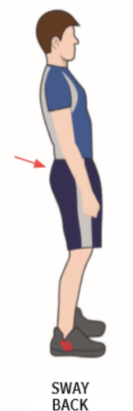
Lumbar Lordosis
baddie

Thoracic Kyphosis

Forward Head

Good Posture!

Proper Body Alignment
Your toes and your knees are pointing forward.
Relax your hips, relax your waist
Chest out, shoulder back
Lengthen your supine and make yourself long.
Core Training
strengthening and conditioning of the core muscles surrounding the middle of the body.
Also Core Stabilization or Balance Training.
Purpose
Strong core muscles…
that contract properly are important for good posture, balance, stabliity, and mobility
can also define trunk muscles and prevents back pain and injuries.
Who would benefit from Core Training?
Everyone, improving performance and helping in daily work
Training Your Core
Dynamic and Isometric Exercises
best done with own Body Weight
Core Exercises
Yoga Poses, Crunches, Planks, Cobra, Side Plank, Back Extension, Standing Wood Chop, etc.