GEOG 3900 Weeks 3-4
 Call Kai
 Learn
 Practice Test
 Spaced Repetition
 Match
 Flashcards
 Knowt Play
1/56

There's no tags or description
Looks like no tags are added yet.
57 Terms
Northern hemisphere landmass
Which region has experienced the most warming since the industrial revolution?
A, B, and D
Which of the following are paleoproxy archives?
A. tree rings
B. ice cores
C. volcanic rocks
D. ocean sediments
15 degrees C
Since the age of dinosaurs, Earth has cooled more than ___
hotter
shorter wavelengths
cooler
longer wavelengths
longer
Earth emits ____ wavelengths
joule
fundamental energy unit
Power =
Energy/Time
Watt =
Joules/Seconds
Temperature
A measure of the avg KE molecules in a body
kelvin → celsius
subtract 273.15
celsius → kelvin
add 273.15
radiation, convection, conduction
A
B
C

conduction
molecule to molecule transfer
heat flow: warm to cold
convection
transferred by vertical movement
physical mixing
radiation
directional energy transfer
propagated w/o medium at speed of light
Albedo
Relative amount of light that a surface reflects compared to the total sunlight that falls on it
Earth - 30%
386 billion billion megawatts
sun energy output
photosphere
surface of the sun
sunspots
cooler regions (~1500 K cooler)
look dark
can be as large as 50,000 km in diameter
indicate solar activity, 11 yr cycle
electromagnetic radiation
How does the energy from Sun reach Earth?
-273 C (absolute zero)
everything above … emits radiation
0.4-0.7 micrometers
visible wavelength spectrum
Insolation
Amount of sunlight shining on earth (incoming solar radiation)
basic laws of radiation
all bodies emit radiant energy
hotter objects emit more energy than cooler objects
P/a = σT^4
Stefan-Boltzmann equation
σ
Stefan-Boltzmann constant
(5.67 × 10^-8 W m^-2 K^-4)
Wien’s law
The hotter the object, the shorter the wavelength of max emitted radiation
λ( max) = 3000 micrometers K/ T (K)
6000 K
Sun temp
Blackbody
An object that is a perfect absorber and perfect emitter
We assume Earth and Sun are
GHGs
…absorb long-wave radiation from Earth, re-emit also… both up + downwards
longer
Atmosphere efficient at absorbing in the ____ wave spectrum
Climate control
Earth’s energy balance =
radiation
More GHG → more ____ at surface → temp increases
stratospheric cooling
As we increase concentrations of CO2 in the troposphere, the equilibrium temp of earth happens at higher elevation where temp is colder. Out of equilibrium
False
T/F: Bc the Earth’s atmosphere has mass, it is a good conductor of heat
True (due to GHGs)
T/F: The atmosphere is mostly heated from below
Convection
What is the method of heat transfer associated w/ the dev of thunderstorms?
less kinetic energy + sink
When air parcels are cooled, they have….
stratospheric O3
The atmosphere is not an efficient absorber of SWL, visible radiation EXCEPT for…
1360 W
The top of Earth’s atmosphere receives about… (from oversimplified model)
NOT constant
Solar constant is…
Sunspots, 11 yr cycle
Why is the solar constant not constant?
All directions
Earth’s radiation direction
Radiative equilibrium temp
Achieved when rate of absorption of solar radiation (SW) = rate of Earth’s emission (LW)
Greenhouse effect
The atmosphere gains temp from surface, AND then warms the surface temp by making it harder to loose E to space
number of layers in the atmosphere, the solar constant, and albedo
Surface temp determined by 3 parameters:
45%
By 2019, how much (%) had the level of warming (greenhouse gas index) from additional gases like carbon dioxide risen since 1990?
16.9
On June 9 2020, the daily high (maximum temperature) reached 96.0 degrees F. Calculate the anomaly value for this daily maximum temperature by using the appropriate value from the table containing various average values computed over the climate normal period 1981-2010 from the OSU airport station:

14.5
According to the graph (a) below that has two y-axes, what was the global mean temperature (in degrees C) for the normal period used to compute the anomalies that are graphed? Enter a number to closest tenth of a degree (one decimal place).
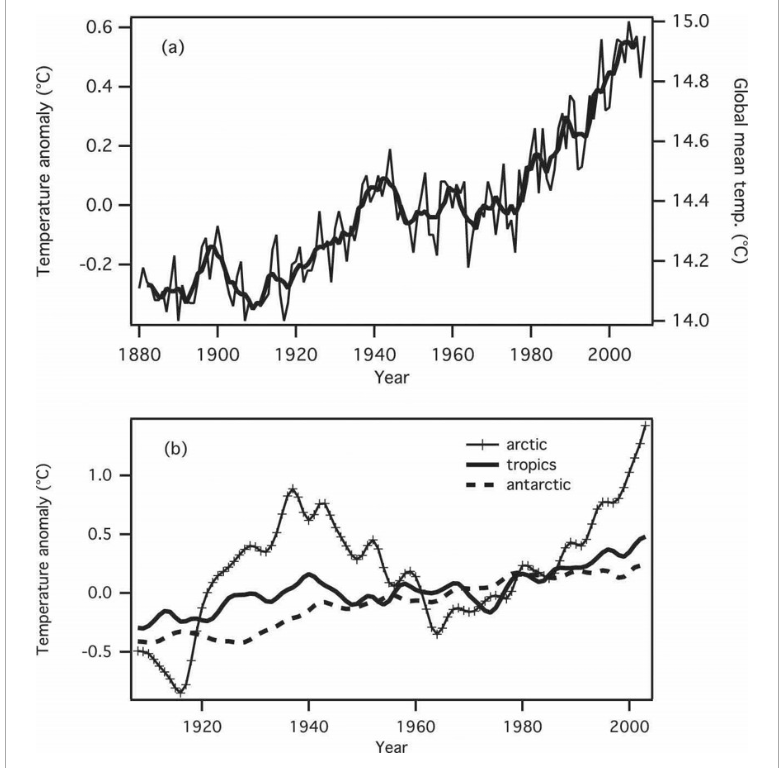
Arctic (24N-90N)
Referring to graph (b), what latitude range on Earth has had the most variability in temperatures over the range of measurements depicted?

FALSE
T/F: Sea levels have been rising steadily over the last 50 years only due to rapidly melting sea ice.
Coarser
For paleoproxies archives, there is a trade-off between the resolution (level of detail or precision) and total span of time in the archive. Longer archives that span greater time ranges typically have _______ (coarser or finer) resolution.
True
T/F: For most of Earth's history, there has been comparatively less glacier ice cover compared to today.
precipitation
besides temperature, the variable of climate that is most important for humans is:
60
latitude degree limit (N and S) that conventionally bound the tropics
30
upper latitude degree limit of mid-latitudes