Comparing Risks and Identifying Opportunities for Prevention
 Call Kai
 Learn
 Practice Test
 Spaced Repetition
 Match
 Flashcards
 Knowt Play
1/31

There's no tags or description
Looks like no tags are added yet.
32 Terms

pallegra from niacin deficiency
What is the goal of many epidemiologic studies?
determine whether there is an excess risk (or reduced risk) of disease in association with certain characteristics, exposures, or treatments
What are six different measures of risk?
absolute risk (incidence)
risk difference
relative risk
odds ratio
attributable risk %
population attributable risk %
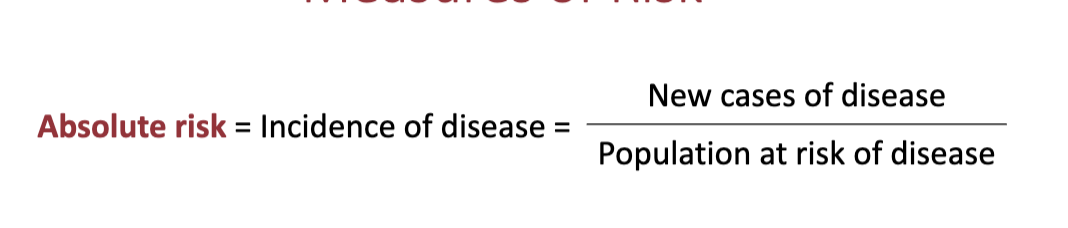
What is absolute risk (incidence)?
most directly comparable to the incidence of disease
a population with low incidence of disease would be considered to have a low absolute risk of disease
question it answers: How frequently did disease develop in each group?
Absolute risk equation.
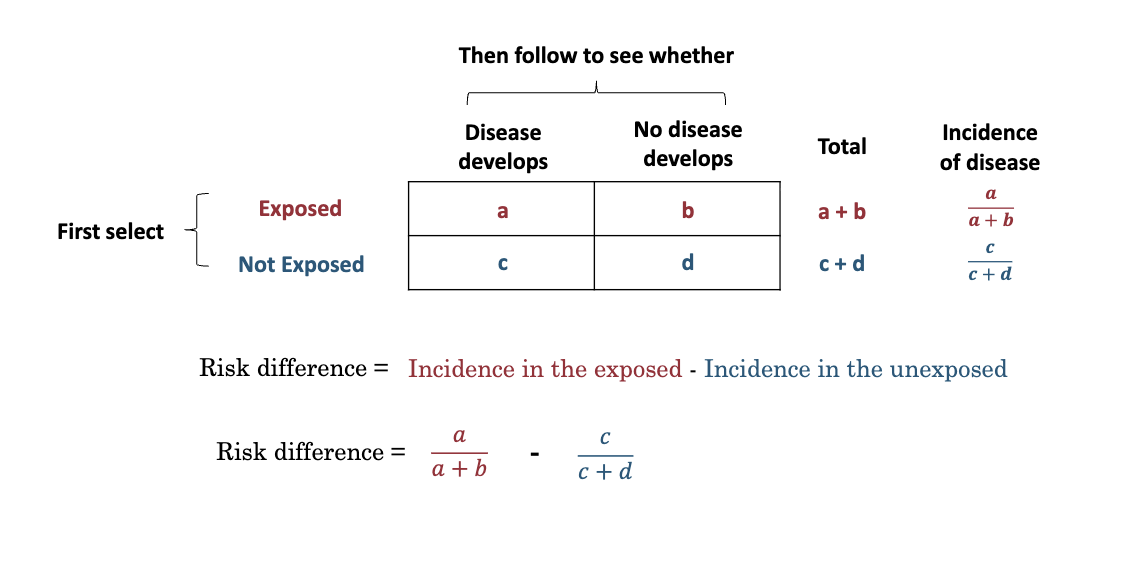
What is risk difference (RD)?
compares the difference between the absolute risk in one group to the absolute risk in another group
aka attributable risk (AR)
question it answers: how much higher or lower was the risk?
Risk difference (RD) equation.

How do you interpret a risk difference = 0?
risk in the exposed is equal to the risk in the unexposed
How do you interpret a risk difference > 0 ?
risk in the exposed in greater than the risk in the unexposed
factor = risk factor for disease
How do you interpret a risk difference < 0 ?
risk in the exposed is less than the risk in the unexposed
factor = protective

Examples of interpreting risk difference values.


What is relative risk (RR)?
compares the absolute risk in one group as a ratio to the absolute risk in another group
question it answers: How many times the risk?
Relative risk (RR) equation.


How do you interpret relative risk = 1 ?
risk in the exposed is equal to the risk in the unexposed
How do you interpret relative risk > 1.0 ?
risk in the exposed is greater than the risk in the unexposed
factors = risk factor for disease
How do you interpret relative risk < 1.0 ?
risk in the exposed is less than the risk in the unexposed
factor is protective
Examples of interpreting relative risk.


Can we calculate the relative risk in a case control study? Why or why not?
no
we cannot measure incidence in a case control study bc participants are purposefully selected on the basis of their disease status
since we can’t measure incidence, we cannot calculate relative risk
Can we calculate the relative risk in a cross sectional study? Why or why not?
no
we cannot measure incidence in a cross sectional study bc we only measure people at one point in time, therefore we cannot record new cases of disease
since we can’t measure incidence, we cannot calculate relative risk
How can you calculate a measure of association when the incidence is unknown (case control or cross sectional studies)?
calculate an odds ratio
How do you calculate odds ratio?


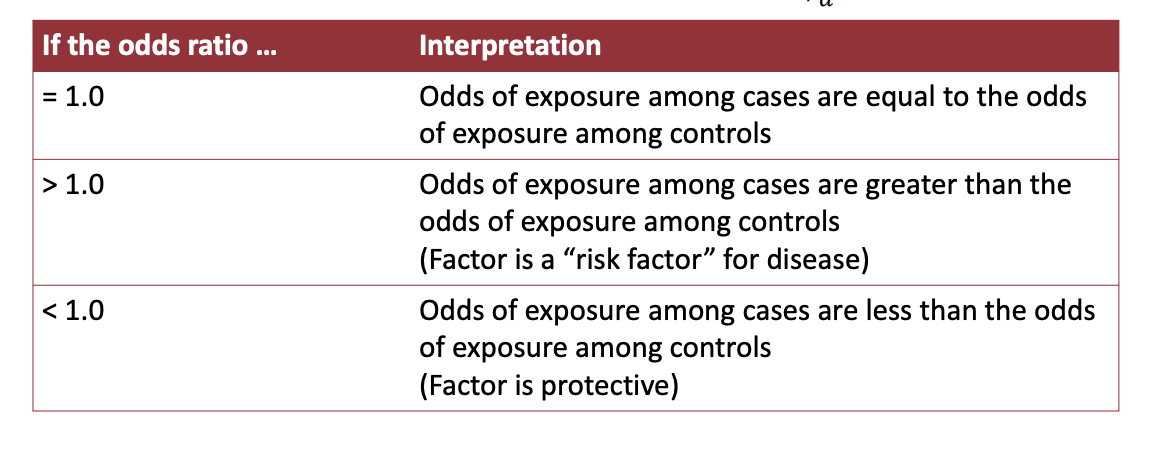
How do you interpret different odds ratio values?
What is the relationship between OR and RR?
tend to be approximately equal to each other, especially when the disease is rare
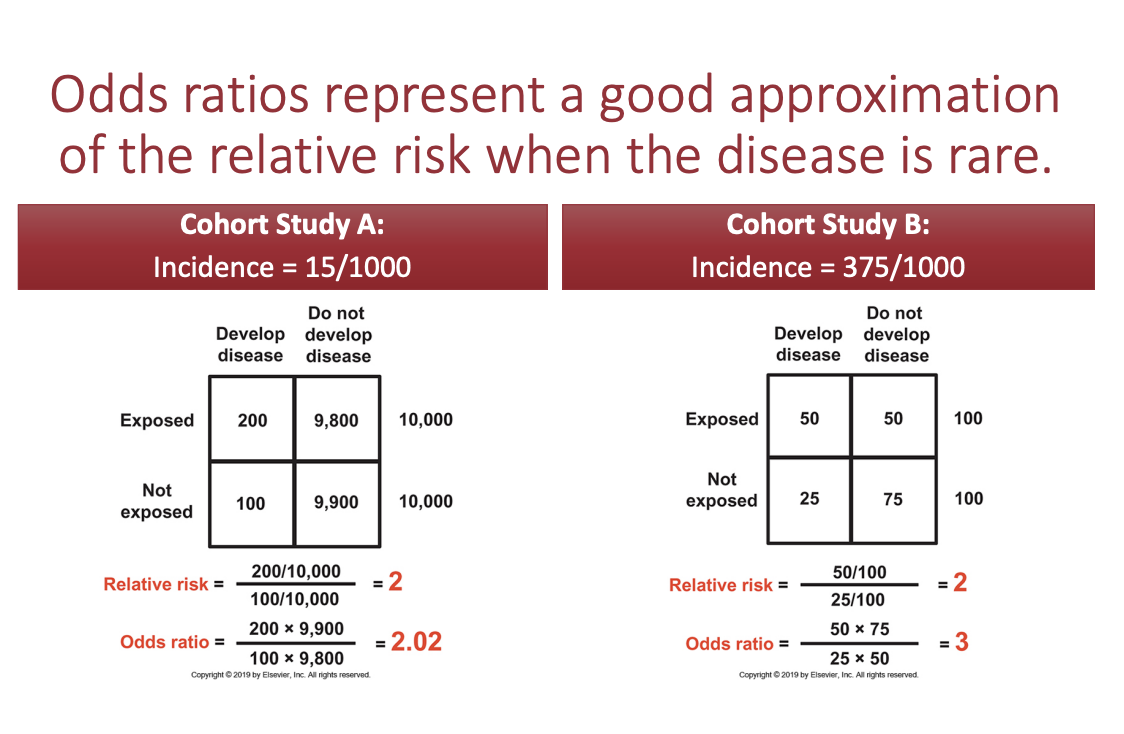
hence why they are interpreted basically the same way
What is attributable risk?
answers how much of the disease occurrence can be attributed to a given risk factor
can be estimated for a specific risk group or the population as a whole
How do you calculate attributable risk percent (AR%)?


interpretation: approximately 60% of the risk of IDA among non-supplement users could potentially be prevented if they took supplements
What is population attributable risk% (PAR%)?
answers the question: what is the proportion of the risk IN the ENTIRE population that can be attributed to a certain risk factor
“How much of the risk of lung cancer in the populations as a whole could be attributed to smoking?”
more relevant to public health planners compared to AR% or RR
How do you calculate population attributable risk % (PAR%)?


interpretation: approximately 31% of IDA cases in the whole population could potentially be prevented if all pregnant women took iron supplements
What is the difference b/w attributable risk and relative risk?
attributable risk is more relevant to a clinician than the relative risk, and suggest the possibility for prevention (ex: if you stop, you can stop lung cancer by x%”)
relative risk is a measure of the strength of an association and helps to determine if an observed association is causal
What is the difference b/w AR% and PAR%?

What happens to PAR% when prevalence of risk factor is large or small?
if prevalence is large
AR% and PAR% are similar values
if prevalence is small
AR% and PAR% are going to be different values

What is the Global Burden of Disease Study?
an attempt to quantify the population attributable fraction of deaths, years of life lost, and disability-adjusted years of life lost due to various risk factors
What was discovered as a result of the Global Burden of Disease Study?
more deaths can be attributed to suboptimal diet than any other risk factor globally
non-optimal intake of sodium, whole grain, fruits, vegetables, and nuts were the leading risk factors
