ASLP 3040: Immittance Testing, Acoustic Reflexes & OAEs
 Call Kai
 Learn
 Practice Test
 Spaced Repetition
 Match
 Flashcards
 Knowt Play
1/34

There's no tags or description
Looks like no tags are added yet.
35 Terms
What does the term 'immittance' combine?
Impedance and admittance.
What is impedance?
The extent to which the system resists the flow of energy.
What is admittance?
The ease with which energy flows through a system.
How are impedance and admittance related?
They are reciprocal terms; if one is high, the other is low.
What is the primary function of immittance testing in audiological assessment?
To detect middle ear disorders. Is useful in differentiating cochlear from retrocochlear disorders
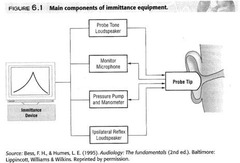
Immittance bridge
Signal generator #1: loudspeaker for probe tone
Microphone: measures sound pressure reflected eardrum
Pressure pump/manometer: varies air pressure in ear canal
Signal generator #2: loudspeaker for ipsilateral or contralateral signal

What is tympanometry?
Measurement of acoustic admittance of the middle ear as a function of air pressure variations.

Peak Pressure
(daPa) measured by varying the pressure in the ear canal using the manometer. Determines the point at which the pressure in the ear canal is equal to the pressure in the middle ear. Normal atmospheric pressure is 0daPa
What does static admittance describe?
The height of the tympanogram is measured at the plane of the eardrum. Measured in millimhos (mmho) and is interpreted based on normative data.
What does a Type A tympanogram indicate?
Normal middle ear function.

What does a Type As tympanogram suggest?
A stiff middle ear system.

What does a Type Ad tympanogram indicate?
A flaccid middle ear system.

What does a Type B tympanogram suggest?
Flat. No mobility of the middle ear system, possibly due to fluid or blockage.

What does a Type C tympanogram indicate?
Negative pressure buildup in the middle ear system.

What is the significance of ear canal volume measurements?
They can detect small perforations of the tympanic membrane.
What is an acoustic reflex?
An involuntary response of the stapedius muscle to sound.

What is the acoustic reflex threshold (ART)?
The lowest intensity level at which the acoustic reflex can be elicited.
What is acoustic reflex decay testing?
Present a tone contralaterally for 10 seconds at a level that is 10 dB above the reflex threshold at that frequency.
The test is looking for a continuous reduction in amplitude that does not change during the 10s presentation

What is positive decay in Acoustic reflex decay testing?
Positive decay is when a reduction in amplitude of more than 50% is noted during presentation
Positive decay indicates a retrocochlear disorder

How will a cochlear disorder look on a tympanogram, static immittance, and reflex threshold?
Normal tympanogram (peak pressure)
Normal static immittance
Normal reflex thresholds (up to a 50 dB HL loss)
How will a retrocochlear disorder look on a tympanogram, static immittance, and reflex threshold?
Normal tympanogram (peak pressure)
Normal static immittance
Absent or elevated reflex thresholds
Positive reflex decay
How will a conductive hearing loss look on a tympanogram, static immittance, and reflex threshold?
•Abnormal (flat) tympanogram
•Abnormal static immittance (no peak)
•Absent or elevated reflex thresholds
How will a sensorineural hearing loss look on a tympanogram, static immittance, and reflex threshold?
•Normal tympanogram
•Normal static immittance
•Normal reflex thresholds (up to ~50 dB HL hearing loss)
What are otoacoustic emissions (OAEs)?
Sounds generated in the cochlea that can be measured in the ear canal. Only generated by the outer hair cells.

What types of OAEs are there?
Spontaneous OAEs and evoked OAEs (TEOAEs and DPOAEs).

What is the significance of a signal-to-noise ratio (SNR) in OAEs?
OAEs are present if the SNR is greater than or equal to +6 dB SPL.
Spontaneous OAEs
Sounds generated by the cochlea and recorded in the ear canal without the introduction of a stimulus
Recorded with a sensitive low-noise microphone housed in a probe that is placed in the ear canal
Often absent in ears with normal hearing (50/50), so not clinically useful
Evoked OAEs
Sounds generated by the cochlea in response to the presentation of a stimulus
Can be consistently recorded in patients with normal hearing, so a clinically useful tool
Transient Evoked Otoacoustic Emissions (TEOAEs)
Elicited with a brief stimulus, such as a click
Somewhat frequency-specific up to 4000 Hz
Typically quicker to run
Distortion Product Otoacoustic Emissions (DPOAEs)
Two different tones presented to the ear simultaneously
Cochlear response (OAE) is a third tone - the "distortion product" of the two stimuli
Frequency-specific up to 12000 Hz
What is the clinical application of OAEs in newborn hearing screening?
They provide an indicator of normal or abnormal cochlear function.
What is the role of OAEs in pediatric assessment?
To help identify children with normal hearing and confirm behavioral test results.
What is the clinical significance of present OAEs in conjunction with demonstrated severe hearing loss?
It indicates a mismatch in behavioral and objective results.
What can affect the OAE response?
Compromised outer and/or middle ear function.
What does the presence of OAEs indicate about outer hair cells?
They are healthy when OAEs are present.