Animalology Lect1&2 Animals
 Call Kai
 Learn
Learn Practice Test
 Spaced Repetition
 Match
Match Flashcards
 Knowt Play
1/43

There's no tags or description
Looks like no tags are added yet.
Name | Mastery | Learn | Test | Matching | Spaced | Call with Kai | Chat |
|---|
No analytics yet
Send a link to your students to track their progress
44 Terms
Rules for binomial nomeclature of species
Genus first letter capitalized
Species/epithet always lowercase
Both names italicized in print
When written on paper, underline instead but separately uline genus and species
describe the grades of organization of animals/animal-likes
A. Unicellular level (Protozoa)
B. Multicellular level (Mesozoans & Parazoans)
C. Cell-tissue level (Eumetazoans)
D. Tissue-organ level (Eumetazoans)
E. Organ-system level (Eumetazoans)
Protozoans
Level A (“first” “animals”) Unicellular eukaryotes that are animal-like. Must be fully autonomous (can eat, reprodu, has nucleus, etc)
Metazoans
Level B (“after” “animals”) Multicellular organisms without “true tissues.” Splits into Mesozoans and Parazoans
Properties of Metazoans that Protozoans don’t have
multiple cells/units, ingestive (eating?), heterotrophic, sexual, undergoes embryonic tissue formation
Eumetazoans
Level C-E (“true” “after animal”) Animals with true tissues
Parenchyma vs stroma
Parenchyma is functional tissue of the organ, stroma is supportive tissue (unnecessary for organ except building shape)
4 fundamental tissue types
Epithelial, muscular, nervous, connective

Types of epithelial tissue
Simple squamous, Simple cuboidal, Simple columnar, Stratified squamous, Pseudostratified, Transitional
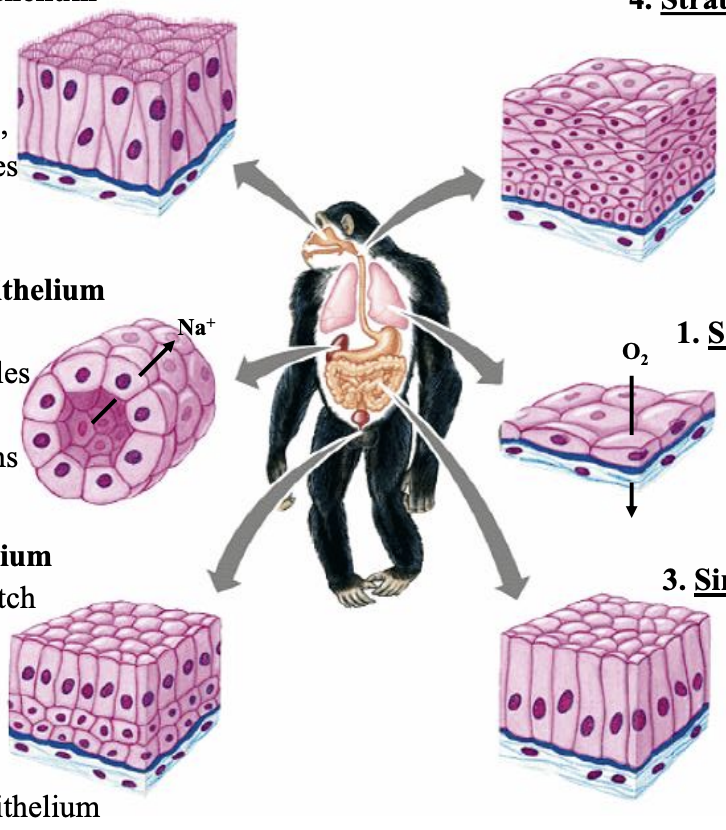
Explain the uses of every simple epithelial tissue
Squamous (diffusion of gases & molecules eg lungs)
Cuboidal (secretion of large fluids/molecules eg glands)
Columnar (highly absorptive surface eg intestines)
Pseudostratified vs stratified epithelium
Pseudostratified tissues appear to have multiple cell layers because of their randomly located nuclei. In reality they are Simple columnar and one cell layer.
Which epithelial tissue can stretch and compress, found in your bladder?

Transitional
Intracellular space
The (bodily) fluid inside cells
Extracellular space
The (bodily) fluid outside cells. Can be split into interstitial fluid and blood plasma if animal has blood
Examples of extracellular structural elements
Bone, cartilage, cuticle (exoskeleton), loose connective “tissue”
Categories of external architecture (ie symmetry)
Asymmetric, Spherical symmetry, Radial symmetry, Bilateral symmetry (+ secondary radial symmetry)
Polarity (in a body plan)
Specialization of body regions (eg having a head/bum, back/belly)

Rarest forms of body symmetry
Spherical symmetry (ball-like unicellular)
TRUE radial symmetry (usually organs make you biradial, quadriradial, etc)
Midsaggital plane
the axis connecting the mouth to the bum

Cephalization
having a head w/ sensory structures, common in bilateral symmetry
Secondary radial symmetry
When the animal is born with bilateral symmetry (larva) but gains radial symmetry as adult (starfish= pentaradial)

Diploblastic
when an organism contains two real layers: ectoderm and endoderm
Triploblastic
when an organism contains three real layers: ectoderm, endoderm, and mesoderm
Which animals are diploblastic and which are triploblastic?
Cnidarians are diploblastic and everything past that is triploblastic (worms, molluscs, men)

Gastrula
primitive GI tract; considered an endoderm; like a pit in the animal with no anus

Coelom
fluid filled cavity inside mesoderm; mesoderm must fully surround it to be a true coelom
Why should animals have coeloms?
Having fluid between your outside and GI tract is a good cushion and hydrostatic skeleton. Useful organs can be placed there instead of just pure useless tissue.
Kinds of coelums that are not actually true coelums

Acoelomate (fully made of solid cells and no fluid), Pseudocoelomate (fluid is technically outside mesoderm, so not a coelom)
Two ways animals can create coeloms
Schizocoelus (came from its own blob)
Enterocoelus (ripped apart from the endoderm) Hint: it entered from the anus

3 modes of unicellular locomotion
Ciliary, flagellar, amoeboid
Cytostome
The mouth of the cell
Metachronal beating
The coordinated beating of cilia to move in one direction; consists of power stroke and recovery stroke
Ciliates beat in a(n) _____ fashion
oblique (spiral)

tractellum
flagellum in the front of cell, pulling the cell toward it
pulsellum
flagellum in the back of cell, pushing the cell away from it
mastigonemes
cilia-like hairs on a flagellum, unable to stroke like actual cilia
cytoplasmic streaming
using a jet of cell fluid (endoplasm) to move in amoeboid locomotion
Explain how amoeboid locomotion works.
hyaline cap is formed
Endoplasm streams into the pseudopod like a pipe
Endoplasm becomes ectoplasm when it reaches the walls

Filopodia
Much slimmer lobopodia, used for amoeboid motion without a hyaline cap

Reticulopodia
extremely thin filaments/lobopodia for complex amoeboid motion

How to classify eukaryotes based on nutrition
Autotroph: make their own food (photoautotroph = using light)
Heterotroph: eat their food (phagotroph = using pseudopods, osmotroph = basically drinking/diffusing)
Phagosome
vacuole containing food captured by pseudopod
Lysosome
organelle? that digest foods in phagosomes
4 ways you can phagocytosis
Classic amoeboid phagocytosis (pseudopods)
A flagellate forming a pseudopodium
Free-living ciliophoran
Sessile ciliophorn/suctorian