Exam 2: Motor Learning --> Lecture 07 and 08: Motor Programs and dynamical systems
 Call Kai
 Learn
 Practice Test
 Spaced Repetition
 Match
 Flashcards
 Knowt Play
1/32

There's no tags or description
Looks like no tags are added yet.
33 Terms
COORDINATION
Patterns of body and /or limb movements
Motor control theory:
How the nervous system solves the degrees-of-freedom problem

Open or Closed Loop?
Open Loop Control System

Open or Closed Loop?
Closed Loop Control System
Advantages of Open Loop Control
the production of very fast movements in the absence of feedback
feedback does not have to be processed during movement
Disadvantages of Open Loop Control
not effective when environmental conditions are constantly changing
not good for very precise movements
Closed loop
Feedback
continuous, slow, and unpracticed movements
What is Open control for?
discrete, well-learned, and rapid movements
Generalized Motor Program is…
Repetitive!
GMP: Parameters or Surface Features
Movement Time
How long/short do you have to do the movement?
Movement Amplitude
How big/small is the movement?
Variations in muscles and limbs
What speed are you going?
GMP: Invariant Features
Sequence of actions or components
Relative timing
Relative force
Schema:
A set of rules stored in CNS that provides basis of decisions
Generalized motor program controls the…?
general characteristics of classes of actions
Motor response schema provides…
information governing an action in a given situation
Dynamic Systems Theory
Movement patterns emerge, or self- organize, as a function of interactions
Dynamic Systems Theory Constraints:
Factors (limiting and enabling) within the environment that influence skill acquisition and performance
Types:
Individual (internal)
Environmental (external)
Task (external)
Individual Constraints (organismic constraints)
A person’s biological and functional characteristics
Examples
Body attributes
Personality characteristics
Fitness variables
Perceptual and decision-making skills
Injury and disease
Environmental Constraints:
Gravity
Temperature
Natural light
Wind direction
Social environmental constraints:
Societal expectations
cultural norms,
spectators
family and peer networks
Task Constraints: Goals
All tasks are governed by goals that relate to the product or outcome of the action.
Task Constraints: Rules
Sport skills typically have rules that dictate specific coordination pattern that must be produced
Task Constraints: Implements or machines
Results from the interaction of the individual with an implement or machine
Movement:
function of a system self-organizing degrees of freedom into a single unit designed to carry out a specific task
Movement pattern:
result of the ever-changing constraints imposed by a given situation
Attractor:
Preferred state of stability in a system
Control parameter
Variable that, when changed, leads to corresponding changes
Direction, force, speed, perceptual info
Rate limiter
An individual constraint that holds back or slows the emergence of a motor skill
injury
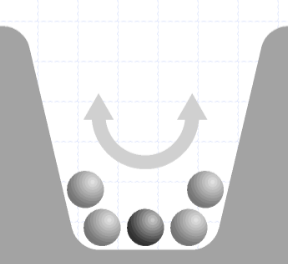
Deep attractor basins:
Stable systems, difficult to change
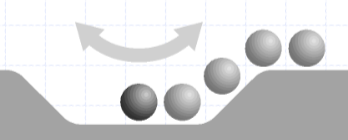
Shallow basins:
Less stable, more susceptible to change
Shallow attractor state
phase shift can occur abruptly
Deep attractor state:
instability, which leads to an increase in movement variability
Non-linear pedagogy
The learner searches through a range of potential movement solutions for the optimum strategy
Perceptual-motor workspace
Constraints-led approach
Purposeful manipulation of key constraints in an effort to acquire movement skills and decision-making behaviors
Hands-off practitioner