Feeding and trophic polymorphisms
 Call Kai
 Learn
 Practice Test
 Spaced Repetition
 Match
 Flashcards
 Knowt Play
1/19

There's no tags or description
Looks like no tags are added yet.
20 Terms
What determines how a fish feeds and its trophic position?
the morphology of mouth parts
the length and anatomy of the digestive tract
their behavior (swimming)
Describe suction feeding
the buccal cavity expands and creates a vacuum to engulf the prey
common in wrasses
Describe ram feeding
the buccal cavity expands, no vacuum is created, they just swim foward to cover area (typically very large areas as many are large fishes)
they are common in planktivorous fishes
what is an example of a shredder/tearer?
the cookie cutter shark
Describe manipulation feeding
It is nipping scraping rasping and gripping (parrot fish). They play important roles in coral reef ecosystems by maintaining reef integrity and functionality.
An inferior mouth describes…
bottom feeding
A subterminal mouth describes…
bottom feeding
A terminal mouth describes…
Generalist feeding
A superior mouth describes…
surface or upwards feeding
Fish can have teeth in their mouth or they can be toothless. T/F
True, some fishes have pharyngeal mouth parts or teeth on the roof of the mouth and tongue
Describe the adaptations of the shark intestine to its diet
spiral valve intestine slows down progression of large swallowed chunks to maximize digestion
Describe the intestine to body length ratio relationship
The more plant like material you eat the longer your intestine to body length ratio
What is the difference of the pyloric caeca in mammals & birds to fish?
mammals and birds
plays a role in hind gut fermentation
fishes
increase the SA of the intestine for absorption of sugars and amino acids
Explain how diet affects the presence of gill rakers
Gill rakers are likely to appear in plankton eaters as a way to help filter their food
What species has undergone disruptive selection?
Twaite shad and allis shad (different species used to be the same)
gill rakers fine in the allis shad but quick thicker and less amount in the twaite shad
3 spine stickle back
limnetic form vs benthic form → they are morphologically different as well as having different numbers of gill rakers
Why does disruptive selection occur?
to minimize competition
What kind of character displacement is there in cichlids?
Their pharyngeal jaw and tooth morphology
What character displacements are present in arctic char?
foraging niche
body size
mouth morphology
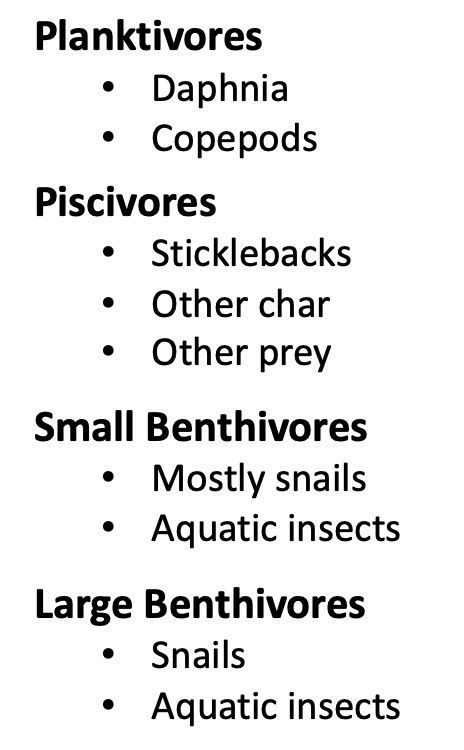
4 sympatric morphs

Describe the diet of planktivores, piscivores, small benthivores and large benthivores