Physiology of the Peripheral Circulation
 Call Kai
 Learn
 Practice Test
 Spaced Repetition
 Match
 Flashcards
 Knowt Play
1/106

There's no tags or description
Looks like no tags are added yet.
107 Terms
__ pressure is the measure between the 2 ends of a blood vessel
axial
__ pressure is the measure across the wall of a blood vessel
transmural
general resistance equation is
dP = QR
systemic circulation resistance equation is
BP - RAP = CO x SVR
organ circulation resistance equation is
BP - RAP = Organ Q x Organ VR
v = ___
Q / A
Poiseuille’s law shows ___ changes in r results in ___ changes in vascular R
small, large
resistances in series is
R total = R1 + R2 + R3
resistances in parallel is
1/Rtotal = 1/R1 + 1/R2 + 1/R3
large arteries are ___ vessels
elastic
large arteries ___ when blood pumped into aorta to accommodate SV
stretch
large arteries ___ when aortic valve is closed, to maintain P for perfusion of organs
recoil
what blood vessel has many elastic fibers in media, facilitating expansion and recoil
large arteries (aka elastic vessels)
__ are resistance vessels
arterioles
major site of vascular resistance
arterioles
__ are important in regulation of BP and control distribution of CO
arterioles
__ are made of prominent media and do ocntraction/relaxation of smooth muscle to change vascular resistance
arterioles
__ are exchange vessels
capillaries
__ are where O2 and nutrients are exchanged for CO2 and other metabolic waste products
capillaries
__ wall only has intima layer, facilitating diffusion of gases and solutes
capillaries
__ are capacitance vessels
venules and veins
__ hold a large capacity (60-70% of blood volume at rest)
venules and veins
__ are important in regulating return of blood to heart
venules and veins
__ control contraction/relaxation of smooth muscle for changes in storage capacity
venules and veins
pulse pressure =
SP - DP
compliance =
dV / dP
arterial compliance =
SV / PP
if increase SV, PP ___
increases
if decrease arterial compliance, PP ___
increases
if increase inotropic state, PP ___
increases (because faster, more forceful ejection)
__ is the main site of SVR and organ VR
arterioles
vascular resistance is innervates by the ___ division of the ANS
sympathetic
if arteriole resistance (Ra) increased, what happens to BP and capillary hydraulic pressure?
increases BP, decreases Pc (because if you increase arteriole resistance, more energy dissipated as it goes through resistance vessels → less pressure in capillaries)

if increase sympathetic tone to veins (alpha-1) → ___ venous capacitance → ___ volume of blood in veins → ___ venous return → ___ preload
decrease, decrease, increase, increase
SKM contraction → ___ venous return → ___ preload
increase, increase
inspiration → ___ intrathoracic P → ___ RAP → ___ venous return → ___ preload
decrease, decrease, increase, increase
expiration → ___ intrathoracic P → ___ RAP → ___ venous return → ___ preload
increase, increase, decrease, decrease
if increase sympathetic tone to heart → ___ PP
increase
___, ___, and ___ are the different types of capillaries
continuous, fenestrated, discontinuous
__ capillaries are the most common, least leaky
continuous
__ capillaries are much more permeable to water, small solutes than continuous
fenestrated
__ capillaries are most leaky
discontinuous
transcapillary exchange is ___
passive
solutes and gases ___ across capillary wall while water ___ across capillary wall
solutes and gases diffuse across capillary wall while water flow across capillary wall
diffusion of solutes is driven by a ___
concentration gradient
diffusion of gases is driven by a ___
partial pressure gradient
water flow is driven by ___
filtration pressure gradient
lipophilic solutes/gases diffusion vs lipophobic solutes diffusion
lipophilic solutes/gases can readily diffuse across a capillary wall while lipophobic solutes need pores to diffuse across capillary wall (much slower)
pores for small lipophobic solutes in continuous capillaries are ___
water-filled channels in ICCs
pores for small lipophobic solutes in fenestrated capillaries are ___
water-filled channels in ICCs and fenestrae
__ prevents large lipophilic solutes from accessing ICCs and fenestrae
Glycocalyx
endothelial cells have ___ for carrier-mediated solute transport
membrane proteins
brain capillaries need ___ to transport essential lipophobic solutes across endothelial cells
specific carrier proteins
Fick’s law is the ___
rate of solute diffusion at a specific point along a capillary

Fick principle is the ___
rate of total solute exchange between a and v ends of capillary network perfusing an organ

how to calculate solute exchange
Vs = Q x (Cas - Cvs)

to increase transcapillary exchange, ___ Q
increase
to increase transcapillary exchange, ___ metabolic rate
increase (increase Δc)
to increase transcapillary exchange, ___ A and ___ T
increase, decrease
__ recruitment can be used to increase transcapillary exchange
capillary
during exercise, ___ are dilated by metabolites and by circulating ___ (NT) acting at ___ receptors → ___ number of well-perfused capillaries
arterioles, EPI, beta-2, increasing
flow of water across the capillary wall is driven by a ___ → ___
filtration pressure gradient, net filtration pressure
what contributes to the net filtration pressure
capillary hydraulic pressure, interstitial fluid pressure, plasma oncotic pressure, interstitial oncotic pressure
net filtration pressure =
(Pc - Pi) - (πp - πi)
Pc → capillary hydraulic pressure (pushes fluid out of capillary)
Pi → interstitial fluid pressure (pushes fluid into capillary)
πp → plasma oncotic pressure (holds fluid in capillary)
πi → interstitial oncotic pressure (pulls fluid out of capillary)
fluid movement from capillary → interstitium = ___
filtration
fluid movement from interstitium → capillary = ___
absorption
for a perfect barrier, σ = ___
1
for an imperfect barrier, σ = ___
< 1
to calculate net filtration pressure for an imperfect barrier =
(Pc - Pi) - σ(πp - πi)
if increase Ra → ___ Pc
decrease

If increase Rv → ___ Pc
increase

net filtration pressure ___ along capillary
decreases
concentration gradient is defined by Fick’s law of diffusion which is ___
Js = (DA/T) ΔC
filtered fluid is returned to circulation via ___
lymphatics
lymphatics main function is to collect fluid filtered from ___ to ___
capillaries, interstitium
regulation of SVR and venous capacitance impacts regulation of ___
BP
regulation of organ VR impacts regulation of ___
organ Q
by blocking sympathetic tone to resting SKM → ___ in blood flow
increase
describe what happens to arterioles when loss of blood volume
volume loss → decreased BP → BRR → increased sympathetic tone to arterioles (vasoconstriction) → increased SVR → restores BP
describe what happens to veins and venules when loss of blood volume
volume loss → decreased BP → BRR → decreased venous capacitance → increased venous return → increased preload → increased CO → restores BP
if have increased core temperature → ___ sympathetic tone to cutaneous blood vessels → vaso___ → decreased body heat
decreased, vasodilation
systemic neural control of SVR and venous capacitance includes ___
NE (alpha 1 vasoconstriction) and EPI (alpha 1 vasoconstriction, beta 2 vasodilation)
systemic hormonal control of SVR and venous capacitance includes ___
RAS (Ang II), Nartriuretic peptides, vasopressin (antidiuretic hormone)
local regulation of organ VR includes ___ and ___ response
myogenic, metabolic
myogenic response is an active response of vascular SM to changes in ___
vascular P
for myogenic response, if P ___ then ___
increases, contraction
for myogenic response, if P ___ then ___
decreases, relaxation
myogenic response of vascular control requires ___
Ca++
myogenic response is ___ by Ca++ channel blockers
blocked

metabolic vasoactive factors include:
[K+]ISF, acidosis, hypoxia, adenosine
vasoactive effect of increased [K+]ISF
vasodilation (because increased interstitial K+, hyperpolarizes the SM cell → relaxation)
vasoactive effect of acidosis
vasodilation
vasoactive effect of hypoxia
vasodilation
vasoactive effect of adenosine
vasodilation
autoregulation = change in BP causes ___ in organ Q if organ’s metabolic activity (organ Vo2) remains constant
no change
how does BP relate to CBF?
BP = CBR x CVR
kidneys have a ___ blood flow at rest
high (due to excreting wastes and regulating body fluids)
if flow (Q) below typical resting values, what happens?
BRR response to low BP → increases sympathetic tone → increases organ VR
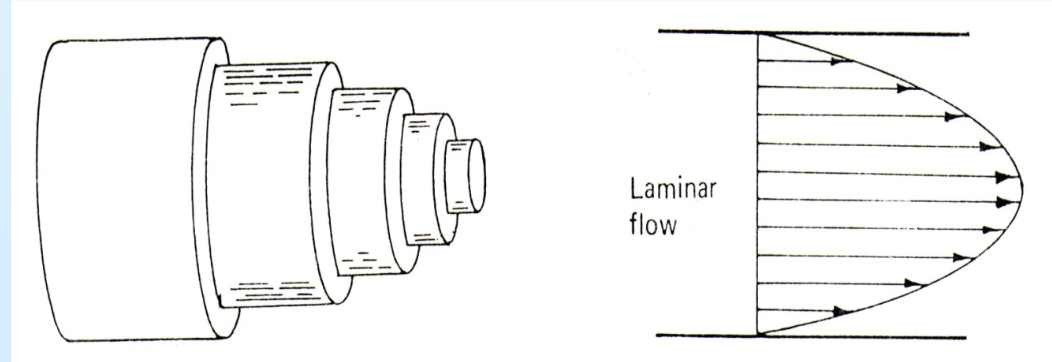
__ flow is the most common pattern of flow in circulation
laminar (arteries, arterioles, venules, veins)