ENS 306 Exam 2
 Call Kai
 Learn
 Practice Test
 Spaced Repetition
 Match
 Flashcards
 Knowt Play
1/37

There's no tags or description
Looks like no tags are added yet.
38 Terms
center of gravity (COG)
imaginary point around which body’s weight is equally balanced in all directions; same as center of mass (COM); where force of gravity (weight) vector acts; point serves as index of total body motion
linear motion
translation of a system’s COG along an axis
angular motion
rotational movement of a system about an axis

angular motion case 1
system restricted by linear joint forces at joint center

angular motion case 2
system not restricted by linear forces
with no net forces to restrict motion, an object will:
rotate about COG
anthropometry
science that defines physical measures of a person’s size, form, and functional capacities; interested in the normal anthropometric measurements and variation of these measurers; important for biomechanics, ergonomics
anthropometry helps us answer:
where is the COG? how is mass distributed relative to the COG? anthropometry lookup table lists these values for whole body and each body segment
whole body PCOG depends on:
the distribution of weight among and within body segments
PCOG can be located:
outside the body
during angular motion, all points on object:
move in a circle about an axis of rotation; move through the same angle in the same time
angular kinematics
kinematics of objects or systems undergoing angular motion; described similarly as linear kinematic values
direction of angular motion
specify both axis and sign (CW/CCW)

right hand rule
point thumb in positive direction along axis of rotation; direction of curled fingers is positive rotation
counterclockwise (CCW) (right hand rule)
positive rotation
clockwise (CW) (right hand rule)
negative rotation

absolute angular position
fixed reference; reference lines usually vertical or horizontal

relative angular position
moving reference; joint angle
vector of angular position
magnitude - units of degrees or radians; direction - specify axis and sign
angular displacement
change in angular position of a segment or any point on the rotating segment
angular displacement formula
∆𝜃 = change in position, 𝜃f = final position, 𝜃i = initial position

vector of angular displacement
magnitude - units of degrees or radians; direction - specify axis and sign
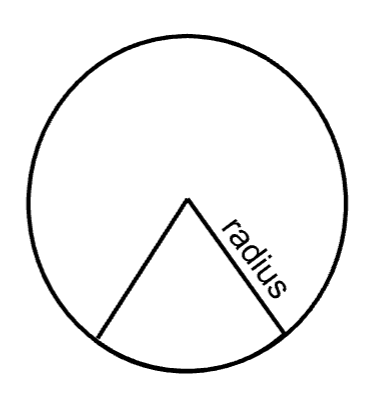
radian
angular unit; 1 radian = angle subtended at the center of a circle by an arc equal in length to the radius; 𝜋 radians per 180°
1 radian in degrees
57.29°
angular velocity
the rate of change in angular position
angular velocity formula
𝜔 = angular velocity, 𝜃f = final position, 𝜃i = initial position, ∆t = change in time
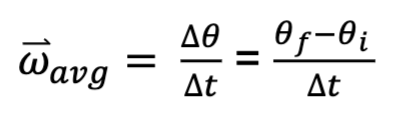
vector of angular velocity
magnitude - units of rad/s or °/s; direction - specify axis and sign (𝜔 + if 𝜃 increasing, 𝜔 - if 𝜃 decreasing)
angular acceleration
the rate of change in angular velocity
angular acceleration formula
𝛼 = angular acceleration, 𝜔f = final velocity, 𝜔i = initial velocity, ∆t = change in time
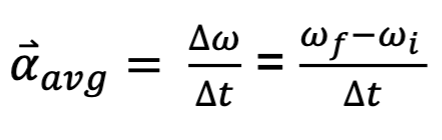
vector of angular acceleration
magnitude - units of rad/s2 or °/s2; direction - specify axis and sign (𝛼 + if 𝜔 increasing, 𝛼 - if 𝜔 decreasing)
slope of 𝜃 →
value of 𝜔
slope of 𝜔 →
value of 𝛼