Shoulder Examination and Evaluation
 Call Kai
 Learn
 Practice Test
 Spaced Repetition
 Match
 Flashcards
 Knowt Play
1/55

There's no tags or description
Looks like no tags are added yet.
56 Terms
what history questions should be asked when doing the shoulder examination?
consider age
ask about specific motions/activities that cause symptoms
Hx of subluxation/giving way
numbness/tingling
functional limitations
duration of symptoms
weakness/heaviness/spasms
comorbidities
Hx of shoulder pain/neck pain or surgeries
medication review
hand dominance
what about pain needs to be assessed in the subjective?
number
quality
nature
duration
location
travels (referred vs radicular)
what might you need to consider when making/ascertaining goals during the interview?
should ask directly the pt what their goals are
can ascertain some goals from the self-reported outcomes
consider using a scale such as the patient specific functional scale
where might the myocardium refer pain to?
the left arm
where might the diaphragm/pleura refer pain to?
shoulder/upper back
where might the ureters refer pain to?
iliopsoas/anterior to the midline groin
where might the bladder refer pain to?
suprapubic region
where might the gallbladder refer pain to?
shoulder, posterior/lateral t-spine
where might the pancreas refer pain to?
shoulder, T6-9 region (lateral flank)
what are the sources of R scapular pain?
gallstones/gallbladder pathology
liver
what are the risk factors of gallstones?
8Fs
fertile (3rd trimester)
female
BMI > 30
fourty
family Hx
what are the red flags of pericarditis?
sharp anterior chest/shoulder pain
increased temp, HR, RR
what are the red flags of ischemia?
neck, jaw, L arm and chest pain
SOB/palpitations
increased BP
syncope
what do you need to assess with posture of the shoulder?
position of the head on the neck, and the neck on the trunk
position of the shoulders
position of the scapula
position of the thoracic spine
influence of handedness or other activities that may create a normal variation
what do we need to look at with the anterior posture?
AC position and shape
sulcus deformity
clavicle alignment
atrophy
rounding of shoulders
symmetry of trapezius and scalenes
head carriage
what is upper cross syndrome?
A musculoskeletal condition characterized by a specific pattern of muscle imbalances, including tightness in the upper trapezius and pectorals along with weakness in the deep neck flexors and lower scapular stabilizers. This leads to poor postural alignment of the shoulders and head. See forward head, rounded shoulders, can see kyphosis
what is the SICK scapula?
Scapular malposition
Inferior medial border prominent
Coracoid pain/malposition
scapular dysKinesia
should we still do a neuro screen during the shoulder exam?
need to screen ROM of cervical and assess for possible spinal contributions to the issues, neurogenic source or upper trunk C5 radiculopathy vs impingement
all aspects need to be included
myotomes, dermatomes, DTR/MSR, and UMN reflexes
what is the closed pack position of the GHJ?
Max ABD and ER
what is the resting position of the GHJ?
55 ABD and 30 degrees horizontal adduction
what is the resting position of the SC and AC joints?
arm at side
what is the closed position SC joint?
max elevation and protraction
what is the closed position of the AC joint?
90 ABD
what is the resting position of the scapulothoracic joint?
30-60 flexion, and 30-60 degrees horizontal adduction
what is the closed pack position of the ST joint?
max ABD and ER
what is the capsular pattern at the GHJ?
ER > ABD > IR (flexion)
what are the capsular patterns of the SC and AC joints?
restriction at end range
what are the normal values of ROM for horizontal adduction?
130 degrees
what is the normal ROM for ER and IR?
ER: 80-90
IR: 60-100
what is apley’s scratch test?
A assessment method used to evaluate shoulder mobility and range of motion (functional ER and IR) by having the patient reach over their shoulder to scratch their back and touch the opposite scapula or reach the hand behind the low back up towards the middle of the back
what are some causes of scapular imbalance patterns?
increased protraction caused by tight pectoralis minor, weak/lengthened LT, serratus anterior; increased depression by the weak upper traps, loss of scapular stabilization
what are the associated effects of inadequate serratus anterior activation?
lesser scapular upward rotation and posterior tilt
what are the associated effects of excess upper trapezius activation?
greater clavicular elevation
what are the associated effects of pectoralis minor tightness?
greater scapular medial rotation and anterior tilt
what are the associated effects of posterior glenohumeral joint soft tissue tightness?
greater scapular anterior tilt
what are the associated effects of thoracic kyphosis or flexed posture?
greater scapular medial rotation and anterior tilt, lesser scapular upward rotation
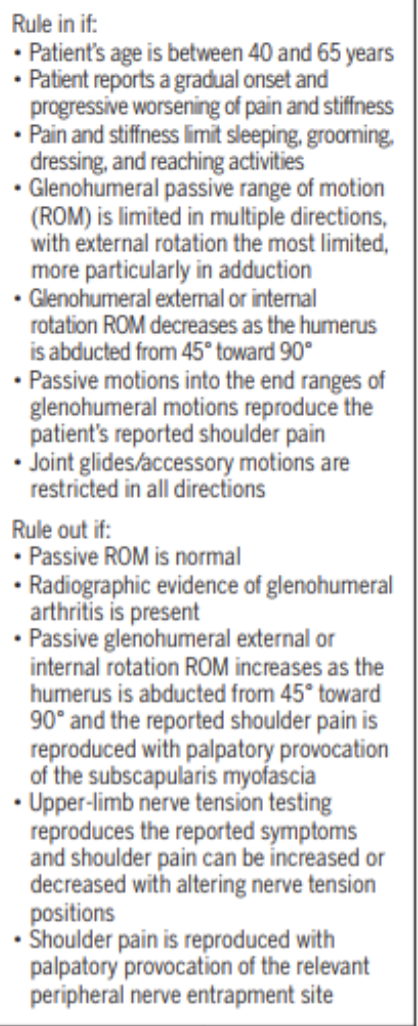
how do you rule in adhesive capsulitis based on the CPG?
see image
how would you rule in/out shoulder stability and movement coordination impairments/dislocation of shoulder joint, or sprain and strain of shoulder joint?
see image

how would you rule in/out shoulder pain and muscle power deficits/rotator cuff syndrome?
see image

what interventions should be used for high irritability in the shoulder?
see image

what interventions should be used for moderate irritability in the shoulder?
see image

what interventions should be used for low irritability?
see image

what might subacromial edema signify?
might indicate bursitis, biceps tendon involvement, or rotator cuff (blood from tears) pathology. look for distal bruising which might indicate a rotator cuff tear as the fluid migrates distally
which tests can be used for muscle power deficits?
speed’s test
drop arm test
lift off test/IR lag
resisted ER
what special tests can be used to assess movement coordination deficits?
sulcus sign
jerk test
apprehension/relocation test
crank test
o’brien’s test
scapular assist test
scapular reposition test
biceps load II
what tests can be used to assess impingement?
hawkin’s kennedy test
neer’s test
full vs empty can
what test can be used to assess the AC joint?
the ACJ cluster
what is the acromioclavicular shear test?
a test that evaluates the integrity of the acromioclavicular joint by applying a shear/compression force to the joint, provoking symptoms if there is dysfunction or injury. see image

what cluster of tests is useful for post-test probability for any degrees of impingement syndrome or full thickness RC tear?
hawkin’s kennedy
painful arc
infraspinatus muscle test
what is the cluster for a rotator cuff full thickness tear?
drop arm test
painful arc sign
infraspinatus (dropping sign) test
what are some diagnostic predictors of rotator cuff tears?
weakness on ER
age greater than or equal to 65
presence of night pain
what is important to note about rotator cuff vs impingement?
clinical tests are not useful for determining size of tear unless they are large tears
lag signs may indicate a tear of a larger size
pain and weakness may be a small tear or impingement
what are the signs of ACJ pathology?
+ shoulder anterior pain above 170-180 degrees
crepitus
+ ACJ special tests
altered scapulohumeral rhythm
may still have + RC impingement signs
what are signs of labrum tears?
ache usually more diffuse
if long standing possible RC weakness
sense of instability and weakness
sharp pain may be position dependent
+ clunk of crank with O’briens
May or may not have + biceps pain
what are the signs of biceps tendon pathology?
pain to anterior shoulder may radiate to anterior arm
snapping biceps tendon
+ pain to resisted elbow flexion
+ speed’s or yergason’s test
need to r/o labrum if possible
what are some patient reported outcomes that can be used for shoulder pathology?
Quick DASH/DASH (higher score means more disability)
SPADI (higher score means more disability)
PSFS (lower score means more disability)