L18: Soil classification and soil properties
 Call Kai
 Learn
 Practice Test
 Spaced Repetition
 Match
 Flashcards
 Knowt Play
1/108

Earn XP
Description and Tags
Given by: Prof. Simon Mudd
109 Terms
Soil
A mixture of organic matter, minerals, gases, liquids, and organisms, that together support life
What are five major functions of soils?
A medium for plant growth
A means of water (as well as carbon) storage, supply, and purification
A modifier of the Earths’s atmosphere (carbon)
A habitat for organisms
The Earth’s key weathering engine
Regolith
Unconsolidated material found overlying bedrock
Formation of regolith
May have formed in situ or have been transported by water, wind, or ice
Why is regolith important for the composition of soil?
Soil is usually the top part of regolith, which contains a high concentration of organic material and is affected by weathering

What does this diagram show?
The process of soil weathering
What are the three types of weathering?
Biological weathering
Chemical weathering
Physical weathering
Biological weathering
Caused by animals and plants
Chemical weathering
Caused by substances in the air and in rain
Physical weathering
Caused by cooling/heating, ice expansion, water, and wind
Which type of weathering is the most important in regards to soil?
Chemical weathering
What are the four main types of chemical weathering processes?
Dissolution by acids (low pH) or bases (high pH)
Redox reactions
The adding of water to mineral structures (hydration)
The interaction with organic compounds
What is the difference between an alkali and a base?
An alkali is a soluable (in water) base (every alkali is a bse, but not every base is an alkali)
What substance is a driving factor for chemical weathering by dissolution?
Rain water
Why is rain water a driving factor for chemical weathering by dissolution?
The pH of rain water is slightly acidic due to the mixing of water with carbon dioxide in the atmosphere
What are the two types of dissolution reactions?
Congruent and incongruent
Congruent dissolution
Minerals dissolved entirely into a solution
Chemical equation: congruent dissolution process
(A silicate mineral) + H2O + CO2 ←→ solutes
Incongruent dissolution
Produces solutes and forms new minerals (usually clays or oxides)
Chemical equation: incongruent dissolution process
(A silicate mineral) + H2O + CO2 ←→ solutes + (secondary mineral)
Why do many soils contain clay?
Due to the process of incongruent dissolution
Redox reactions
The adding or taking away of oxygen (by the removal of electrons)
Example: hydration
Water (hydration) can cause minerals (biotite) in granite to shatter
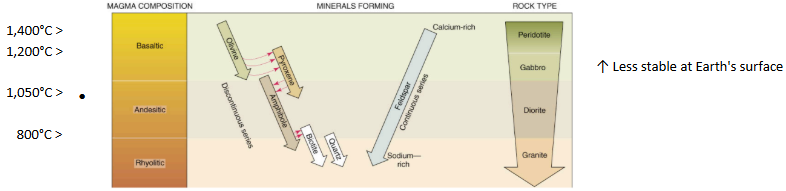
What does this diagram show?
The composition of rock in the order which rocks form
Dilute solution
A mixture containing a relatively small volume of solute dissolved in a large volume of solvent
A solute
A substance that dissolved in a solvent to form a homogeneous mixture called a solution
A solvent
The substance that dissolves another substance (the solute) to form a homogeneous miuxture known as a solution
A solution
A homogeneous mixture of two or more substances
Homogeneous
A mixture, reaction, or syustem where all components exist in a single, uniform phase
Heterogeneous
A mixture, reaction, or syustem where there is a combination of two or more substances that exist in a non-uniform phase
How long (in years) would it take for a 1 mm diameter sphere of quartz to dissolve at pH5 in a dilute solution?
34,000,000 years
How long (in years) would it take for a 1 mm diameter sphere of biotite to dissolve at pH5 in a dilute solution?
900,000 years
How long (in years) would it take for a 1 mm diameter sphere of pyroxene to dissolve at pH5 in a dilute solution?
~10,000 years
How long (in years) would it take for a 1 mm diameter sphere of olivine to dissolve at pH5 in a dilute solution?
~2,000 years

What does this diagram show?
A graph showing the ratio of certain elements in the soil (x axis) relative to elements in the Earth’s crust (y axis)
Zirconium (Zr)
An element found in the mineral zircon
Why is zirconium (Zr) important for plotting the ratio of certain elements in the soil relative to elements in the Earth’s crust?
It is used as a reference element as it stays in environments (soils) for very long, due to its slow weathering rate
How do carbon (C) and nitrogen (N) get into the soil (from the atmosphere)?
Plants (mainly) take in these elements into their biomass through decomposition, photosynthesis, and other microbial processes, which then get into the soil
What are four examples of elements that are easily weathered (in the presence of water) and are thus depleted in soil?
Calcium (Ca)
Magnesium (Mg)
Potassium (K)
Sodium (Na)

What does this diagram show?
A soil profile
What is one thing that must be taken into account before studying the horizons of soil profiles?
Not all soil profiles contain each horizon
What is the order in which each master horizons exists at (top-to-bottom)?
(O/H) organic layer
(A) top-soil/surface layer
(E) eluviation layer
(B) sub-soil layer
(C) parent rock/substratum layer
(R) bedrock layer
(O/H) organic layer
(O): unsaturated organic layer at the surface / (H): saturated organic layer at the surface
What substance(s) are found at the (O/H) organic layer?
Humus
(A) top-soil/surface layer
Mineral horizon at/or near the surface with humified organic matter associated with mineral materials
What substance(s) are found at the (A) top-soil/surface layer?
Minerals with humus
(E) eluviation layer
Mineral horizon just below the surface which has lost: clay, iron (Fe), or organic material, by downward movement (eluviation)
What substance(s) are found at the (E) eluviation layer?
Leached materials and organic matter (silt)
(B) sub-soil layer
Sub-surface mineral horizon resulting from the change in situ of soil or the washing in of materials from above (illuviation)
What substance(s) are found at the (B) sub-soil layer?
Deposited minerals and metal salts
(C) parent rock/substratum layer
An unconsolidated or weakly consolidated mineral horizon which has evidence of rock structures, lacking properties of: A, E, or B layers
What substance(s) are found at the (C) parent rock/substratum layer?
Partly weathered rock
(R) bedrock layer
Continuous hard or very hard rock
What substance(s) are found at the (R) bedrock layer?
Unweathered parent rock
Translocation
The (vertical or horizontal) movement of minerals from one point to another
What are the five main types of translocation that occur within soil profiles?
Eluviation
Illuviation
Leaching
Capillary action
Pedoturbation
Eluviation (“washing out”)
The downward removal of soil materials from an upper layer by percolating water
Percolation
The slow, downward movement of water from the soil layer into deeper, permeable rock strata
Strata
The distinct, horizontal layers of rock, soil, or sediment, formed by geological deposits
Illuviation (“washing into”)
The deposition or accumulation of the leeches materials from above into a lower horizon
Leaching
A specific type of loss where water dissolves minerals and carries them down through the soil, often removing them from the profile entirely
What master horizon is formed by the process of leaching?
The (E) eluviation layer (silt)
Capillary action
The upward movement of water and dissolved nutrients from lower, wetter soil regions to drier, upper regions
Pedoturbation
The mixing of soil materials, which can disturb the formation of distinct horizons
What five pedological processes control soil formation?
Biological activity (organisms)
Climate
Parent material (eg. rock)
Relief
Time
Relief
The physical elevation, shape, and slope of the Earth’s surface

What does this diagram show?
The rate of weathering based on vegetation
What is the fastest rate soil can form in mm/yr in Oregon, USA?
0.268 mm/yr
What is the fastest rate soil can form in mm/yr in Australia?
0.053 mm/yr
What are three reasons as to why soil classification is important?
To describe a soil for the exchange of knowledge
To show the relationship between soils
For mapping
Regional soil classification system for Scotland
The soil survey of Scotland (1984)
International soil classification system
World reference base for soil resources (FAO, 1998)

What does this diagram show?
The order of which soils are classified
What are soil formation processes linked to?
Soil classifications

What does this diagram show?
The influence of parent material (C horizon)
Case study: five most common parent material found in Scotland
In situ (residual) shattered and weathered rock
Glacial till
Fluvioglacial meltwater deposits of gravel and sand, and in highland areas, morainic deposits
Mountain-top detritus
Recent deposits, including: aeolian sand, alluvium raised beach deposits, and peat
Glacial till
Unsorted, weathered mineral material, and unweathered rock, which has been modified with water, transported by ice
Fluvioglacial
Geological processes, deposits, and landforms created by meltwater from glaciers and ice sheets
Mountain-top detritus
Frost-shattered debris with common rock and scree
Example: four most common parent material found in Britain
Acid rocks (eg. granite) - podzols
Glacial till - cambisols to glay soils
Limestones - cambisols
Sandstones - cambisols
Podzol
A poor acidic soil
Gley
A waterlogged clay-rich soil (depending on the % of clay)
Cambisol
A type of rich brown earth soils
Examples: two most common parent materials found around the world
Arenosols (eg. Australia) and andosols (eg. Iceland, Indonesia, and Japan, etc.)
Arenosols (arena = sand)
Quartz rich > sandy soils, easily eroded and which leach nutrients
Andosols (volcanic soils)
Parent material of volcanic ash, pumise, and tuff, etc.

What does this diagram show?
The geology of Scotland
Pedogenesis
The natural process of soil formation and development
What are the two major pedological processes that influence soil classification?
Climate and relief (topography)
How does an arid and semi-arid climate influence soil classification?
High temperature and low precipitation climates cause evaporation and deposition of salts (eg. durisols, gypsisols, and solonetz)
How does a humid temperate climate influence soil classification?
Seasonal variations in temperature and precipitation causes climates to have rich organic materials nearer the surface and within horizons (eg. liuvisols, podzols, and umbrisols)
How does a humid tropic climate influence soil classification?
High temperature and high precipitation climates cause highly weathered soils with nutrients supplied by vegetation (eg. acrisols, alisols, ferralsols, and lixisols)
How does a permafrost climate influence soil classification?
Soils show influence of frost-action and permafrost (eg. cryosols)
How does a climate with (high/low) precipitation influence soil classification?
High rainfall causes leaching of soluble salts, and more: clays, organic matter, cation exchange capacity, and nutrients / low rainfall causes lime layers and salt crusts
How does a climate with (high/low) temperature influence soil classification?
High temperatures lead to a rapid breakdown of organic material with a small increase in clay minerals as temperatures also increase / evaporation rates depend on the impact of rainfall
How does altitude (relief) influence soil classification? (Example: UK)
In the UK, colder and wetter conditions lead to the accumulation of organic materials (eg. peats)
Altitude
The vertical distance between an object and the Earth’s surface
How does aspect (relief) influence soil classification?
The warmth (temperature) of the soil
Aspect
The compass direction that a topographic slope faces)
How does catena (relief) influence soil classification?
By dictating how local topography and hydrology alter a soils properties