Archeology / Anthropology
 Call Kai
 Learn
Learn Practice Test
 Spaced Repetition
 Match
Match Flashcards
 Knowt Play
1/114

There's no tags or description
Looks like no tags are added yet.
Name | Mastery | Learn | Test | Matching | Spaced | Call with Kai | Chat |
|---|
No analytics yet
Send a link to your students to track their progress
115 Terms
Holism
The anthropological commitment to consider the full scope of human life, including culture, biology, history, and language, across space and time.
Culture
An integrated system of beliefs that govern and morally classify behavior
Reductionism
the reduction of complex systems to simpler components that are more manageable to study
Adaptive Perspective Of Culture
A research perspective that emphasizes technology, ecology, demography, and economics as the key factors in defining human behavior.
Ideational Perspective Of Culture
A research perspective that focuses on ideas, symbols, and mental structures as driving forces in shaping human behavior.
Potlatch
A Native American celebration meant to show wealth and divide property among the people
Archeology
the study of ancient cultures based on artifacts and other remains
Linguistic Anthropology
the study of language and linguistic diversity in time, space, and society
Cultural Anthropology
the study of people's communities, behaviors, beliefs, and institutions, including how people make meaning as they live, work, and play together
Biological/Physical Anthropology
The study of humans as biological organisms, dealing with the emergence and evolution of humans and with contemporary biological variations among human populations.
Stratification
A structured ranking of entire groups of people that perpetuates unequal economic rewards and power in a society.
Deep Time
a framework for considering the span of human history within the much larger age of the universe and planet earth
Nabonidus
Last king of the Neo-Babylonian Empire, commonly known as the first true archeologist.
Who wrote "On The Origin Of Species" ?
Charles Darwin
When did the society of antiquaries dissolve ?
1614
Etymology
the study of the origin of words and the way in which their meanings have changed throughout history
Which notorious antiquarian was previously an English strongman ?
Giovanni Battista Belzoni
A.D
Anno Domini (in the year of our lord)
B.P
before present (1950)
Processual Paradigm
The paradigm that explains social, economic, and cultural change as primarily the result of adaptation to material conditions. External conditions (for example, the environment) are assumed to take causal priority over ideational factors in explaining change.
Post-Processual Paradigm
A paradigm that focuses on humanistic approaches and rejects scientific objectivity. It sees archaeology as inherently political and is more concerned with interpreting the past than with testing hypotheses. It sees change as arising largely from interactions between individuals operating within a symbolic and/or competitive system.
Who is most known for the discovery of Deep Time?
James Hutton
Who founded the Society of Antiquaries in 1572?
Matthew Parker
Who Wrote -- The Geological Evidences of the Antiquity of Man. (1863)
George Lyell
Processual-Plus Paradigm
Open mindedness (put theoretical ego aside) Recognition of theories, labels, etc to shape our interpretation of the past Basically stay in the gray area, Look at field materials and general patterns use the tools that work for the job
Look at field materials and general patterns
Basically stay in the gray area, use the tools that work for the job
Who's quote is: "Archaeology is anthropology or it is nothing" ?
Phillip Phillips (1900 - 1994)
Ethnocentrism
Belief in the superiority of one's nation or ethnic group.
Cultural Relativism
the practice of judging a culture by its own standards
Enculturation
Etic Approach
an approach that is cross-cultural, searching for generalities across cultures
Emic approach
a perspective in ethnography that uses the concepts and categories that are relevant and meaningful to the culture under analysis
Artifact
an object made by a human being, typically an item of cultural or historical interest.
Feature
non-portable artifact
Assemblage
A collection of different artifacts and materials recovered from the same specific context or time period
Stratigraphy
the study of rock layers and the sequence of events they reflect
Midden
a garbage mound left by prehistoric people
Who was the notable female archeologist who is also known for the creation of the Iraqi borders?
Gertrude Caton-Thompson
Who is widely considered the first true professionally taught archeologist?
Jens, J.A Worsaae
Who was the first woman to write an archeology textbook?
H. Marie Wormington
Anthropological Approach
The primary concern of human being is to unveil his/her being as human or what being human ought to be.
Low Level Theory
the observations and interpretations that emerge from hands-on archaeological field and lab work: (eg. made of obsidian, (21.5 mm long, weighs 2.1 grams)
Middle Level Theory
hypothesis that links archaeological observations with the human behavior or natural processes that produced them (e.g ongoing human behavior or natural processes + the material results of that behavior or those processes)
High Level Theory
theory that seeks to answer large "why" questions of all intellectual inquiry about the human condition, (eg: raising questions such as: Why did we humans become cultural animals? Why did hunter-gatherers become agriculturalists? Why did social stratification arise?)
Old World
Europe, Asia, Africa
New World
the name given by Europeans to the Americas, which were unknown to most Europeans before the voyages of Christopher Columbus
piestocene epoch
geological epoch that lasted from about 2.58 million to 11,700 years ago, known as the ice age.
Statistical Population
a group of similar things that a scientist is interested in learning about
What is a Sample Universe?
The region that contains the statistical population and that will be sampled.
What determines the size and shape of a Sample Universe?
The research question and practical considerations.
stratified random sample
a sample from selected subgroups of the target population in which everyone in those subgroups has an equal chance of being included in the research
Global Positioning System (GPS)
A system that determines the precise position of something on Earth through a series of satellites, tracking stations, and receivers.
Plow Zone
the upper portion of a soil profile that has been disturbed by repeated plowing or other agricultural activity
Shovel Testing
A sample survey method used in regions where rapid soil buildup obscures buried archaeological remains; it entails digging shallow, systematic pits across the survey unit.
Backhoe Trenches
to evaluate near-surface and geologic conditions (i.e., up to 15 ft deep),
with borings being used to investigate deeper subsurface conditions.
Surface Survey
The systematic location and mapping of surface remains in the archaeological record.
Subsurface Survey
Remote sensing techniques of area below ground carried out at ground level—includes auguring, coring, shovel testing, and use of magnetometer, resistivity detector, and similar means
Remote Sensing
The acquisition of data about Earth's surface from a satellite orbiting the planet or other long-distance methods.
Proton Magnetometer
A sensor that can detect differences in the soil's magnetic field caused by buried features and artifacts.
Soil Resistivity
A method of subsurface detection which measures changes in conductivity by passing electrical current through the ground. This is generally a consequence of moisture content, and in this way, buried features can be detected by differential retention of groundwater.
Ground Penetrating Radar (GPR)
A remote sensing technique in which radar pulses directed into the ground reflect back to the surface when they strike features or interfaces within the ground, showing the presence and depth of possible buried features.
Geographic Information Systems (GIS)
A set of computer tools used to capture, store, transform, analyze, and display geographic data.
Excavator's toolkit
Small Pick, Trowel, Brush, Dust Pan, Water, Shover, Large Pick, Wheelbarrow, Zembeli, Bulk Scraper
Provenience
An artifact's location relative to a system of spatial data collection.
Test Excavation
a small initial excavation to determine a site's potential for answering a research question
Datum Point
a permanent, fixed point of reference used in mapping a baseline
Natural Levels
A vertical subdivision of an excavation square that is based on natural breaks in the sediments (in terms of color, grain size, texture, hardness, or other characteristics).
Arbitrary Levels
The basic vertical subdivision of an excavation square; used only when easily recognizable "natural" strata are lacking and when natural strata are more than 10 centimeters thick.
Total Station
A computerized surveying and mapping instrument that uses a laser beam or radio waves to measure the distance and angle between the instrument and the target and then calculates the exact position of the target.
Water Screening
a sieving process in which deposit is placed on a screen and the matrix washed away with hoses; essential where artifacts are expected to be small and/or difficult to find without washing
Flotation
The use of fluid suspension to recover tiny burned plant remains and bone fragments from archaeological sites.
Geoarcheology
An interdisciplinary scientific field that applies the concepts, methods, and techniques of the earth sciences—such as geology, geomorphology, and soil science—to solve archaeological and historical research problems

Law Of Superposition
In any undeformed sequence of archaeological strata or soil layers, the oldest layers lie at the bottom and the progressively younger layers are deposited on to
Alluvial Sediments
Loose materials like clay, silt, sand, and gravel that are dropped by running water in streams, rivers, and floodplains
Eolian Sediments
Particles of sand, silt, and dust that have been eroded, transported, and deposited by the action of wind
Deposition
The process by which material remains, artifacts, and sediments are added to the archaeological record over time.
Natural Deposition
The environmental processes that accumulate soil, sediment, or debris over and around artifacts, naturally burying and preserving archaeological sites
Cultural Deposition
The process by which human activities leave behind artifacts, ecofacts, and features that form the physical archaeological record
Cache
A deliberate, single-action deposit of related items hidden by ancient peoples for future retrieval, storage, or ritual use
Collovial Sediments
loose, unconsolidated soil and rock fragments that accumulates at the base of a slope or hill due to the pull of gravity and non-channelized surface flow
Roof Fall
the objects dropped by Colluvial Sediments
O-Horizon
Humus on the ground surface
A-Horizon
Topsoil
E-Horizon
Eluviation Layer
B-Horizon
Subsoil
C-Horizon
Regolith
R-Horizon
Bedrock
Reverse Stratigraphy
When older geological or archaeological layers end up on top of younger ones.
Floralturbation
The mixing and disturbance of soil caused by plants, such as through root growth or the uprooting of trees
Faunalturbation
Faunalturbation is the natural mixing or displacement of soil, sediment, and archaeological materials caused by the actions of animals
Cyroturbation
Argillturbation
Graviturbation
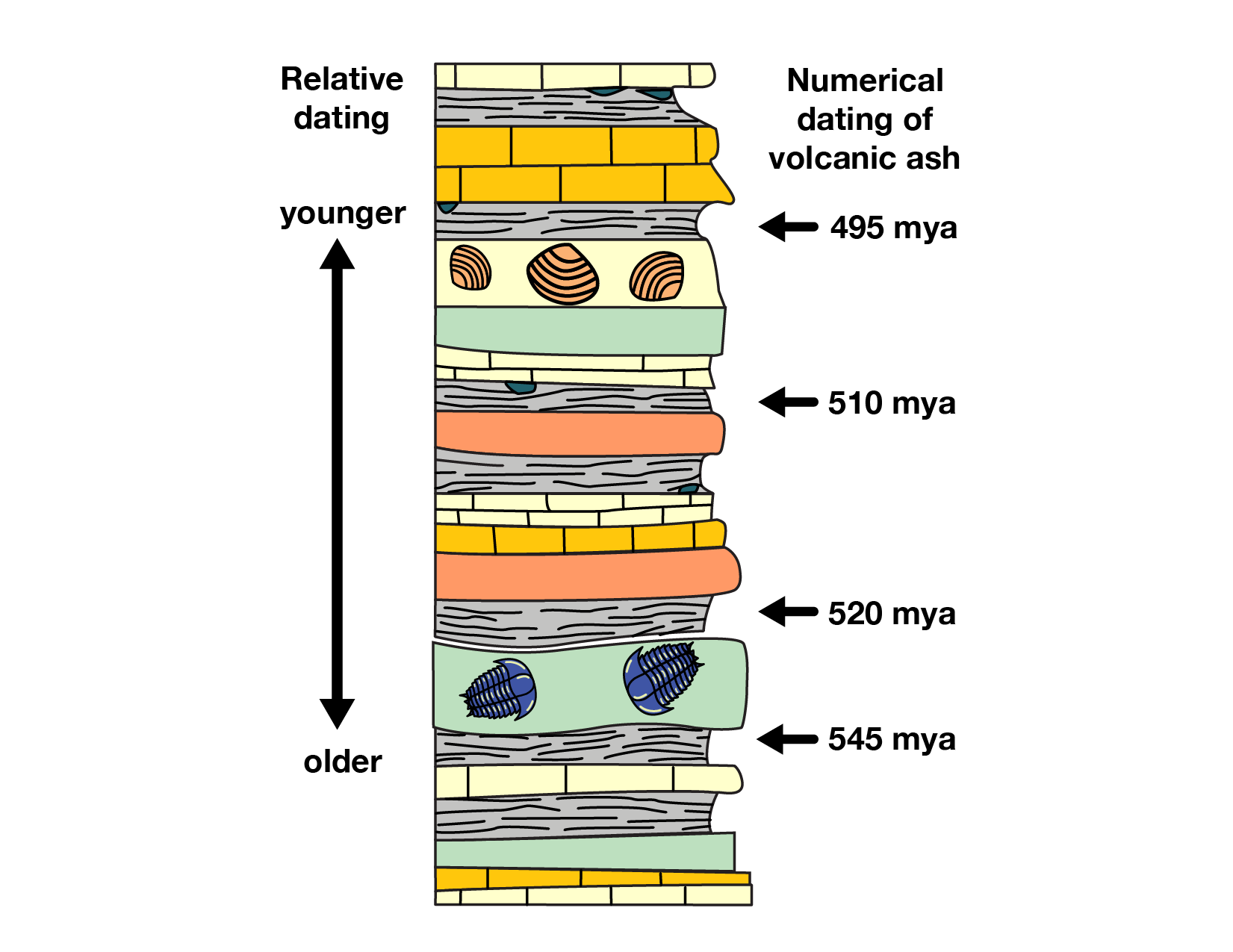
Relative Dating
A scientific method used to determine the chronological order of past events and rock layers without calculating their exact numerical ages

Absolute Dating
A scientific process used to determine the numerical age, in years or a specific time range, of a rock, fossil, or archaeological artifact
Relative Age
the age of a rock layer, fossil, or event compared to other surrounding materials, rather than its exact numerical age in years
Absolute Age
the numerical age in years of a rock, fossil, or artifact, determined primarily through absolute dating