7. Obstructive Heart Defects
 Call Kai
 Learn
Learn Practice Test
 Spaced Repetition
 Match
Match Flashcards
 Knowt Play
1/19

There's no tags or description
Looks like no tags are added yet.
Name | Mastery | Learn | Test | Matching | Spaced | Call with Kai | Chat |
|---|
No analytics yet
Send a link to your students to track their progress
20 Terms
what is an obstructive heart defect?
a narrowing of a major vessel that makes it harder for blood to leave the heart
the heart must generate more pressure to push blood through the narrowed area
which heart defects are classified as obstructive?
coarctation of the aorta
pulmonary stenosis
aortic stenosis
what is coarctation of the aorta?
narrowing of the aorta
pressure is higher before the narrowing and lower beyond it


how does coarctation of the aorta affect pressure around the narrowing?
pressure is higher before the narrowing (supplying the head and neck) and lower beyond it (supplying the lower body)

what upper-extremity findings are expected with coarctation of the aorta?
too much blood is sent to the head and neck
increased BP
strong, bounding pulses in the arms
nosebleeds

what lower-extremity findings are expected with coarctation of the aorta?
not enough blood is sent to the lower body
decreased BP and weak
absent pulses in the legs

why does coarctation of the aorta cause different findings in the arms and legs?
blood reaches the arms before the usual narrowing, while blood traveling to the legs must pass through it
what symptoms can occur with coarctation of the aorta?
irritability
frequent nosebleeds
leg pain with activity
dizziness or fainting
headaches
systolic murmur

what serious complications can occur with coarctation of the aorta?
aortic rupture (tearing open of the aorta)
aortic aneurysm (abnormal bulging of the aortic wall)
stroke

what heart sound may be heard with coarctation of the aorta?
a systolic murmur
what is pulmonary stenosis?
narrowing of pulmonic valves that obstructs blood flow from the right ventricle toward the pulmonary arteries and lungs
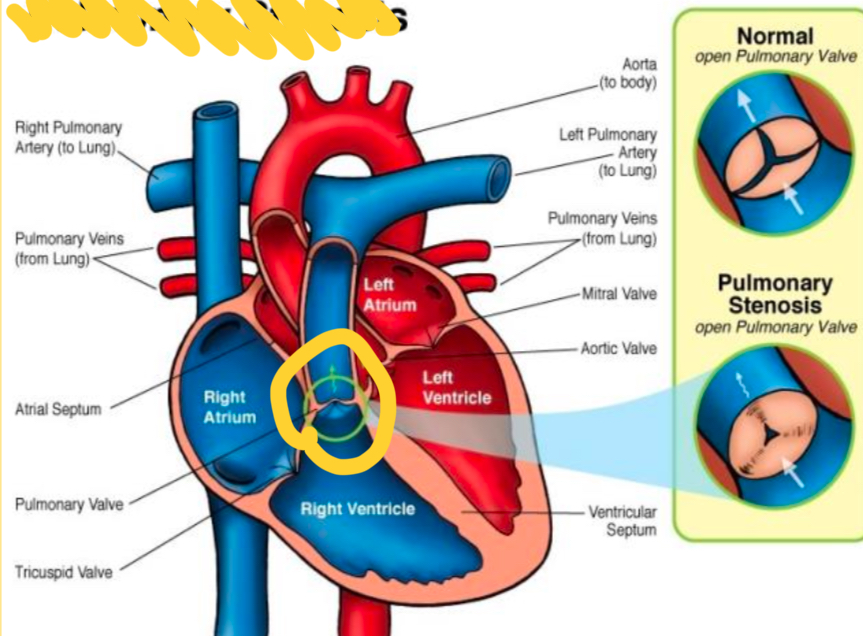
what does the extra pressure from pulmonary stenosis cause?
right ventricular hypertrophy

how does the severity of pulmonary stenosis affect symptoms?
mild narrowing may cause no symptoms, while severe narrowing greatly limits blood flow to the lungs

what assessment findings can occur with pulmonary stenosis?
dyspnea fatigue with activity
signs of heart failure
cyanosis if severe
high pitched click after 2nd heart sound
murmur
may be asymptomatic
what is aortic stenosis?
narrowing of aortic valves that obstructs blood flow from the left ventricle into the aorta
aortic stenosis _____ cardiac output
decreases
how does aortic stenosis affect left ventricular pressure?
pressure rises because the left ventricle must push harder to move blood through the narrowed outlet
increased left ventricular pressure in aortic stenosis causes _____
ventricular hypertrophy
how can aortic stenosis eventually cause fluid buildup in the lungs?
the overworked left ventricle can fail, causing pressure to back up through the left atrium into the lung vessels
what assessment findings can occur with aortic stenosis?
easily fatigue
chest pain, dizziness with prolonged standing
a thrill (vibration)at the base of the heart
systolic murmur
faint pulses if severe