Ag and Ab Interactions
 Call Kai
 Learn
 Practice Test
 Spaced Repetition
 Match
 Flashcards
 Knowt Play
1/31

There's no tags or description
Looks like no tags are added yet.
32 Terms
A good antibody is ___ to what we measure and has ___ binding (allows us to detect binding).
specific; tight
There are two components in laboratory testing: antibody and antigen.
One component is known and the other is ___.
Ex. HCG testing - patient antigen (unknown) specific for HCG antibody (known).
unknown
Lab testing combines a reagent antibody or antigen with a ___ antibody or antigen.
patient
To visualize Ab–Ag detection, we need ___ of large complexes.
agglutination
For agglutination, the antigen needs ___ bindings sites (epitopes) and ___ should be able to bind multiple sites.
Additionally for agglutination, Ab and Ag concentrations must be in ___; otherwise, a false ___ may occur.
multiple; antibody; equilibrium; negative
Sensitivity is a true ___, meaning it is able to accurately bind to what it is ___ to bind.
positive; supposed
Specificity is a true ___, meaning it is able to ___ bind to what it is supposed to bind - if it binds to anything else, its a false reaction.
negative; only
Affinity is the initial force of ___ that brings Ab and Ag together.
It exists between the Ab ___ portion and the Ag ___ site.
attraction; Fab; determinant
Low affinity may cause a false ___ due to lack of binding.
negative

Affinity strength depends on ___, or how well the antigen fits the antibody.
A good Ab–Ag fit indicates ___ affinity.
specificity; high
Ab and Ag are held together by ___ bonds, which are weak and ___.
(because of no ___ sharing)
noncovalent; reversible; electron
The four noncovalent interactions are: ___/ionic, ___ bonding, ___, and ___ ___ ___.
electrostatic; hydrogen; hydrophobic; Van der Waals
Ionic interactions attract ___ charged groups.
These interactions are affected by ___ and environmental ___ strength.
oppositely; pH; ionic
Van der Waals forces involve attraction between an electron ___ and another atom's ___.
It is present among ___ atoms to some degree and is the ___ interaction.
cloud; nucleus; all; weakest
Avidity is the sum of ___ attractive forces that hold Ab-Ag bonds together
Think of individual Affinity bonds – now imagine they all work together!
all
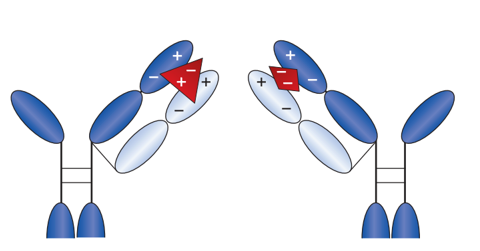
Which diagram has the highest affinity? Which noncovalent interaction makes it stronger than the other?
left; electrostatic/ionic
___ describes the strength with which a multivalent antibody binds a multivalent antigen.
Which has a higher avidity because it can bind more sites, IgM or IgG? What valence does it have?
Avidity; IgM; 10
High avidity can compensate for low ___.
The initial binding force may be ___, so binding will take ___; however, high avidity can maintain binding because the bonds will keep the Ab-Ag complex ___.
affinity; low; longer; together
The ideal antibody has high ___ AND high ___.
affinity; avidity
The hybirdoma method produces large quantities of ___ antibodies with ideal Ab–Ag interactions.
monoclonal
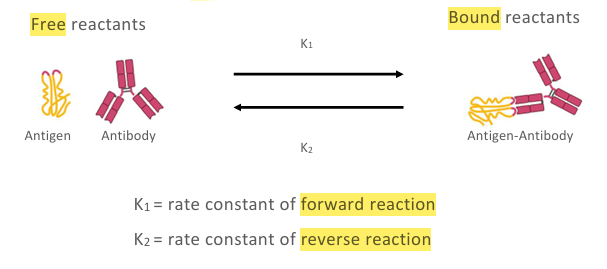
The Law of Mass Action states that Ab–Ag binding is ___.
Free reactants are in ___ with bound reactants.
The equilibrium constant represents the difference in rates of the ___ (free → bound) and ___ (bound → free) reactions.
reversible; equilibrium; forward; reverse
For laboratory testing, we want equilibrium to favor the ___ reactants so the Ab–Ag reaction can be detected.
bound
In the Law of Mass Action, it is important to know that the equilibrium constant is not always ___, could be 80/20 - just wherever it likes to be.
50/50
In the Law of Mass Action, the equilibrium constant (K) is a measure of the ___ of ___ between Ab and Ag.
goodness; fit
The equilibrium constant is the ratio of K1 (forward/bound) / ___ (reverse/free).
This equates to [___] / [Ag][Ab].
K2; AgAb

[AgAb] = concentration of ___ Ab–Ag complex.
bound
[Ag][Ab] = concentration of ___ reactants.
free
Ideally, the concentration of ___ complex should be higher than the concentrations of ___ reactants.
bound; free
A higher K means there is ___ bound Ag–Ab complex.
As K increases and more Ab–Ag complex forms, testing becomes more ___.
more; sensitive
Specificity defined by the antigen that ___ the production of the antibody.
A specific antibody reacts with a ___ antigen (whatever it is specific for - it should not react with anything else- if so, leads to false positives!!)
induces; homologous
Cross-reactivity occurs when an antibody reacts with antigens that are structurally ___ to the original antigen.
The antibody binds to a ___ antigen than the one that caused its production.
Greater similarity = ___ cross-reactivity (ex. ABO antibodies from exposure to environment (heterophile antibodies)
similar; different; greater
We do not want cross-reactivity, but it sometimes happens. We do our best to pick specific enough abs that ___ cross-reactivity to avoid potential false positives.
limit