Neuro: Motor Systems and Functions
 Call Kai
 Learn
Learn Practice Test
 Spaced Repetition
 Match
Match Flashcards
 Knowt Play
1/166

There's no tags or description
Looks like no tags are added yet.
Name | Mastery | Learn | Test | Matching | Spaced | Call with Kai | Chat |
|---|
No analytics yet
Send a link to your students to track their progress
167 Terms
Typically, when talking about motor innervation, we are referring to... (What type of neuron?)
General motor neurons (GSE)

Where are the neuronal cell bodies of motor spinal nerves located?
Ventral horn of the spinal cord

Where are the neuronal cell bodies of cranial motor nerves?
In a nucleus
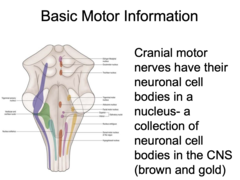
What is the difference between a ganglia and nucleus?
- Nucleus - a collection of neuronal cell bodies in the CNS
- Ganglia - a collection of neuronal cell bodies outside the CNS
*Don't have to memorize*
Cranial nerve nuclei location (Just a photo)

When talking about autonomics we are referring to.... (what type of neuron?)
Visceral motor neurons (GVE)

TRUE/FALSE
GVE is a two neuron system
True

Where is the first neuron located in the two neuron system of GVE?
First neuron is located in a nucleus in the brainstem

Tracts (Just a photo)

Brain cortexes (Just a photo)

___________ ____________ is a complex system composed of several individual components that together produce movement.
Motor control

What components are included in the motor system?
- Motor neurons
- Descending motor pathways and associated cortical areas
- Basal ganglia
- Cerebellum

The motor system consists of ____________ ___________ Pathways that are directly responsible for the voluntary activity of the muscles of the head, neck, and limbs
Direct Activation Pathways

TRUE/FALSE
The direct motor pathway is polysynaptic
FALSE
The direct motor pathway is monosynaptic

Cortical upper motor neurons (UMN) project to and synapse with a lower motor neuron (LMN) that is located in either the ____________ or ________ ________.
- Brainstem
- Spinal cord

UMN starts from the _________ cortex and travels into _____ separate tracts
- Motor cortex
- Two separate tracts
What are the two tracts of the UMN?
- Corticobulbar tract
- Corticospinal tract

In the corticobulbar tract, where are the UMNs, and where do they project?
UMNs in the cortex of the brain project to cranial nerve motor nuclei and then LMNs in the brainstem.

In the corticospinal tract, where do the UMNs project?
UMNs in the cortex project to the ventral horn of the spinal cord on the opposite side (contralateral) to where the LMN cell bodies are located

LMN starts from ___________ _______ of spinal cord or brainstem and ends in the appropriate skeletal muscle of the _______ side.
(eg. All peripheral motor nerves)
- Ventral horn
- Same side

___________ ___________ _______________ are neurons that travel from the spinal cord to the muscles of the body and are directly responsible for the generation of force by excitation of the muscles they innervate
Lower motor neurons, also called alpha motor neurons

___________ _________ ___________ are neurons that travel between the brain and the spinal cord
Upper motor neurons
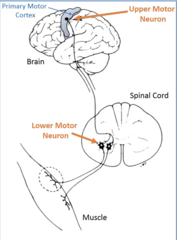
LMNs respond to input from what three sources?
1. Dorsal root ganglia
2. Spinal interneurons (cells that do not project out of the area)
3. Projections from higher centers such as the brain stem and cerebral cortex

Lower motor neurons project from the _________ horn of the spinal cord
Ventral

____________ motor neurons are LMNs that cause contraction of the skeletal muscles
Alpha motor neurons
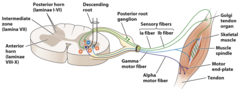
______________ motor neurons are LMNs that adjust the tension in the muscle spindle fibers so they can accurately detect a stretch.
Gamma motor neurons

The _________ _______ is the alpha motor neuron and all the muscle fibers it innervates
Motor unit

A _________ ______ includes all the motor units of a single muscle
Motor pool

The ___________ motor neurons innervate and maintain tension in muscle spindles
Gamma motor neurons

Primary Descending (Motor) Pathways (Just a photo)

What are the 2 pyramidal motor tracts? (direct)
1. Corticospinal tract
2. Corticobulbar tract

What are the 4 extrapyramidal motor tracts? (indirect)
1. Rubrospinal
2. Reticulospinal
3. Vestibulospinal
4. Tectospinal/colliculospinal

__________________ corticospinal tracts involve the
- Cortex
- 90% decussation of axons in medulla
- Tract formed in lateral column
Lateral coricospinal tracts

Where do the decussation (crossing) of axons occur?
The medulla

What type of movements do the lateral corticospinal tracts cause?
Skilled movements of hands and feet

_____________ corticospinal tracts are the 10% of axons that do not cross (do not decussate)
Anterior

What muscles do the anterior corticospinal tracts control?
Controls neck and trunk muscles
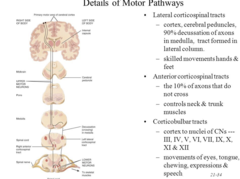
______________________ tracts involve the cortex to nuclei of CNs - III, IV, V, VI, VII, IX, X, XI, & XII (all cranial nerves with a motor aspect)
Corticobulbar tracts

What movements do the corticobulbar tracts cause?
Movements of eyes, tongue, chewing, expressions, and speech

As the corticospinal tract travels down the brain stem, a majority of its fibers decussate to the ________________ side within the medulla then continues to travel down the spinal cord to provide innervation to the ________ ______________.
- Contralateral
- Distal extremities

In the medulla the axons become grouped together anteriorly to form a swelling known as the ______________
Pyramid
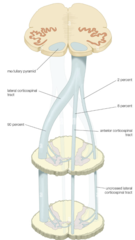
80-90% of the fibers __________ at the pyramids to form the __________ corticospinal tract
- Decussate
- Lateral corticospinal tract

10-20% of the fibers do not cross, and form the ____________ corticospinal tract.
Anterior corticospinal tract

The majority of the corticospinal fibers will terminate on interneurons rather than directly on motor neurons in the __________ horn of the spinal cord
Ventral

Where are the cells of origin in the Corticospinal pathway?
Motor Cortex

What is the pathway of axons in the Corticospinal pathway?
- Starting from the motor cortex, the axons travel to the medulla where they decussate at the pyramids of the medulla
- Enter the later funiculus of the spinal cord as the Lateral Corticospinal tract.
- The axons end by synapsing with either LMNs or interneurons in the ventral horn

After decussating at the pyramids, the neurons enter the __________ _________________ of the spinal cord as the Lateral Corticospinal tract
Lateral funiculus

In the corticospinal pathway, the axons end by synapsing with either ______ or _________________ in the ventral horn
- LMNs
- Interneurons

In the corticospinal pathway,
- Lesions above the medullary decussation = _______________ deficit
- Lesions below the decussation = _______________ deficit
- Contralateral
- Ipsilateral

Just as the corticospinal tract synapses on LMN cell bodies in the spinal cord, the corticobulbar tract synapses on ___________ ________ cell bodies in the _____________.
- Cranial nerve cell bodies (nuclei)
- Brainstem

What cranial nerves are involved in the corticobulbar tract? (Hint: CNs involved in motor)
- CN III (Oculomotor nucleus)
- CN IV (Trochlear nucleus)
- CN V (Trigeminal nucleus)
- CN VI (Abducens nucleus)
- CN VII (Facial motor nucleus
- CN IX, X, and XI (Nucleus ambiguous)
- CN XII (Hypoglossal nucleus)

What CNs are NOT involved with the corticobulbar tract?
- CN I
- CN II
- CN VIII
*Don't need to know*
Cranial nerve nuclei columns (Just a photo)

Which branch of the Trigeminal nerve has a motor component?
Only V3 has a motor component

What two ways can LMNs receive input from UMNs?
Either from:
- Both sides of the brain (bilateral)
- From opposite side of the brain (contralateral)

Which cranial nerves have bilateral UMN innnervation?
- Most GSE column: III, IV, VI
- All SVE column: V, VII (upper face), IX, X, XI

Which cranial nerves have contralateral UMN innervation?
- SVE: VII (lower face)
- GSE: XII

The dorsolateral pathways are involved in the finer motor control of the __________ _______________
- Distal musculature (finger movements)
- Distal = away from body
- Proximal = towards the body

What does anatomical position look like?

Axons of the dorsolateral system reach the LMNs that lie more _____________ in the ventral horn. They also terminate in only ________ spinal segments; this precise targeting by individual axons allows precise control over muscle groups.
- Laterally
- One or two

The ____________ _______________ Tract is especially important for the control of distal musculature and for actions of the extremities. Innervates the ___________ and __________ part of the spinal cord and controls fine movements of the extremities.
- Lateral Corticospinal Tract (LCST)
- Cervical
- Lumbar

The other pathway in the dorsolateral system is the _____________ tract. The ____________ tract courses next to the LCST within the lateral funiculus and is also important for the control of distal limb musculature.
- Rubrospinal Tract
- Rubrospinal Tract

The Ventromedial system (VMS) is about control of _______ and ________________ musculature
- Axial
- Proximal
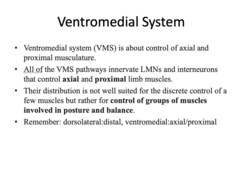
All of the VMS pathways innervate ________ and ________________ that control axial and proximal limb muscles
- LMNs
- Interneurons

The distribution of the VMS is not well suited for the ___________ control of a few muscles but rather control of groups of muscles involved in ____________ and _________________
- Discrete
- Posture and balance

- Dorsolateral controls _________ musculature
- Ventromedisal controls __________________ musculature
- Dorsolateral: Distal
- Ventromedial: Axial/proximal

The _________ motor neurons are located in either the motor cortex of the brain or the brainstem and are the main neurons that initiate voluntary movement throughout the body by connecting the cerebral cortex to the brain stem and spinal cord.
Upper motor neurons

What are some tracts, or pathways, that upper motor neurons can travel, and serve different functions?
- Pyramid
- Extrapyramidal
- Rubrospinal
- Tectospinal
- Reticulospinal tracts

The upper motor neurons travel down a tract where they will then synapse with the lower motor neurons located in the _________ ________
Spinal cord

In the _____________ tract, the upper motor neurons will be responsible for controlling conscious movement
Pyramidal Tract
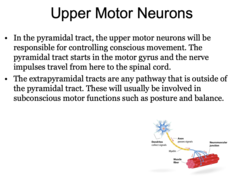
The pyramidal tract starts in the __________ _________ and the nerve impulses travel from here to the _________ ______
- Motor gyrus
- Spinal cord

The extrapyramidal tracts are any pathway that is __________ of the pyramidal tract. These will usually be involved in ______________ motor functions such as _____________ and __________
- Outside
- Subconscious
- Posture and Balance

Tracts other than corticospinal/corticobulbar tracts are known as __________________ tracts
Extrapyramidal tracts
What are the components of the extrapyramidal system?
1. Basal Ganglia
2. Midbrain giving rise to following bulbospinal tracts:
A. Rubrospinal tract.
B. Vestibulospinal Tract.
C. Reticulospinal Tract
D. Tectspinal Tract.
E. Olivospinal Tract.

What does the rubrospinal tract do?
Rubrospinal tract influences the limbs

What does the vestibulospinal tract do?
Vestibulospinal tract influences balance of the trunk

What does the tectospinal tract do?
Tectospinal tract coordinates movements to capture or avoid targets

What does the reticulospinal tract do?
Reticulospinal tract coordinates startle and escape reflexes

The ________________ tract is an extrapyramidal tract that is involved in the involuntary movements to maintain and improve the body's balance
Rubrospinal tract

The ___________________ tract, another extrapyramidal tract, is responsible for the movements of the muscles within the neck
Tectospinal tract
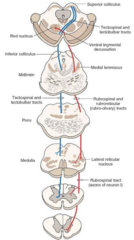
In the reticulospinal tract, the reticular formation makes up a ___________ _______ through much of the brainstem. It contains many different __________ groups.
- Central core
- Nuclear

In the reticulospinal tract, pontine and medullary nuclei projects to the ___________ horn of the spinal cord
Anterior/Ventral horn

What are the functions of the reticulospinal tract?
Influence motor functions such as voluntary and reflex movements and is also responsible for muscle tone

Motor - Sensory Integration (Just a photo)

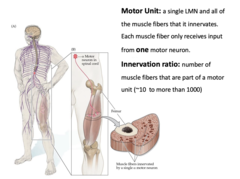
A ___________ _______ is a single LMN and all of the muscle fibers that it innervates
Motor unit
TRUE/FALSE
Each muscle fiber only receives input from one motor neuron
TRUE

_____________ ________ is the number of muscle fibers that are part of a motor unit (~10 to more than 1000)
Innervation ratio

________ ___________ _______ is the group of LMNs that innervate a single muscle
Motor neuron pool

Which has a larger motor neuron pool:
Muscles used for strong/powerful movements or muscles used for fine movements?
Muscles used for finer movements have a larger motor neuron pool
A motor unit is an individual motor neuron and all the ____________ ____________ it innervates
Muscle fibers

The neuromuscular junction is the synapse between a motor neuron and a __________ _________
Muscle fiber

*Not expected to memorize this slide*
Hierarchy of Motor Control (Just a photo)

Motor System Hierarchy (Just a photo)

Control of voluntary movements has three stages: _____________, ____________, and ______________, which are performed by different brain regions
- Planning
- Initiation
- Execution

Where does the planning of movement occur in the brain?
Where does the actual initiation of movement occur in the brain?
The planning of a movement begins in the cortical association areas, while the actual initiation of the movement occurs in the motor cortex.

The alpha motor neurons in the ___________ and ________ _______ are responsible for the ________________ of the movement
- Brainstem
- Spinal cord
- Execution

The __________ and _________ _________ are responsible for fine-tuning movements and are involved in both planning and execution
- Cerebellum
- Basal ganglia

What are the 3 cortical motor areas?
1. Primary Motor Cortex (M-I)
2. Supplementary Motor Area (M-II)
3. Premotor Cortex (PMC)
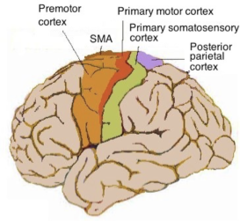
The __________ ___________ comprises three different areas of the frontal lobe, immediately anterior to the ___________ _____________
- Motor Cortex
- Central Sulcus

All the three cortical motor areas project directly to the spinal cord via the ________________ tract
Corticospinal
