NRS 304 - 1st exam
 Call Kai
 Learn
Learn Practice Test
 Spaced Repetition
 Match
Match Flashcards
 Knowt Play
1/81

There's no tags or description
Looks like no tags are added yet.
Name | Mastery | Learn | Test | Matching | Spaced | Call with Kai | Chat |
|---|
No analytics yet
Send a link to your students to track their progress
82 Terms
Comparing a bird’s forelimb to that of a mammal or lizard, list or describe the structures that are examples of the loss/reduction, fusion, and thinning of bones.
Mammals vs birds
Loss or reduction of bones (IE digits of forelimbs)
Fusion of bones (IE carpometacarpus, fusion of carpals + metacarpals)
Thinning of bones (radius + humerus)
Lizards vs birds
Lizards have lots of thick robust bones
Not a lot of metacarpals, but long digits
Compare and contrast the bone structure of the wing of a bird and a bat. List two similarities and two differences.
Bats
Bats have web of skin stretched on a frame
Digits elongated to have attached skin
Birds
Bumps on ulna
Shedding feather

What bone is this?
Carpometatarsus

What is 1?
Tibiotarsus

What is 2?
Tarsometatarsus
To which bones do the primary feathers attach? To which do the secondary feathers attach?
Primary — secondary digit, carpometacarpus
Secondary — ulna

Regarding how the wing bones support the airfoil, how does the bat wing differ from that of birds?
Bat bones are thick and long phalanges connect parts of the wing into one
Bat wrists are flexible
In what ways does the anatomy of a bird’s furcula differ from the clavicles of a human?
Modified pectoral girdle — clavicles fused into furcula (wishbone)
Springiness to pop back up
Flexibility
Fat deposition
Thin bone

What is the function of the keel of a bird’s sternum?
Muscle attachment for wings
Attachment site for pectorals and supracoradoideus muscles
Sternum not keeled in some flightltess birds (IE kiwis)
Big muscle/bone in broiler chickens
Describe two anatomical features of a bird that contribute to the concentration of weight closer to the center of mass (compared to mammals).
Birds
Reduction of weight in extremities
Loss of tail
Longer neck
Muscle and bone tissue concentrated near center of mass, connective tissue outside of center of mass (wings)
No muscles in feet, just tendons
Little to no jaw muscles
Mammals
Muscle and bone tissue concentrated near center of mass, connective
Comparing a bird’s hindlimb to that of a mammal, list or describe the examples of the loss/reduction, fusion, and thinning of bones.
Birds
Femur bone super small and inside body
Hip bone different orientation (horizontal)
Other bones get proportionally longer
Fibula fused
Tibia fused with tarsal bones (tibiotarsus)
Fused metatarsal and tarsal (tarsometatarsus, where they are banded) — longer tarsometatarsus in long-legged waders (help maintain center of balance when sitting)
Loss of 5th digit
Perching importance (first digit helps grasp)
Loons cannot walk, push themselves
Mammals
Hip bones different orientation (vertical), fused
Femur longer
Fibula unfused
Comparing a bird’s pelvic girdle to that of an iguana, in what ways does the bird’s pelvic girdle show fusion and loss of bones?
Birds
Pelvic bone and vertebrae fused in synsacrum (top arrows)
Short tail, bones fused into pygostyle (bottom arrows)
Rudder
Reduce Weight
Iguana
Basic
Attachment of pelvic girdles to spine
Not much of a joint

In what ways is the pelvic region of a bird like that of a human?
They both have a tail bone
Comparing the skull of a bird to that of an iguana, what is different about the bone structure of a bird?
Birds
Large space for orbit (eyes) and brain
No jaw muscles
No teeth
Bills
Iguana
Teeth
Jaw muscles
In a living bird, you do not see the bones that make up the bill. What do you see instead?
Keratin (modified epidermal/dermal tissue), tool used for hummingbirds and trees swallows
What characteristics of many of the bones of birds contribute to weight reduction? How is this related to the bird’s respiratory system?
Large nares/sinuses
Large orbits
Pneumatic ones (hollow bones), associated with airsac system
Hollow maxilla (no teeth)
Be able to identify and distinguish between the following toe arrangements in birds: anisodactyl, zygodactyl, syndactyl, and pamprodactyl. Also, what characteristics do all these arrangements have in common?
Diversity of foot shapes, toe arrangements reflect different diets and habitat associations
Anisodactyl — reversed hallux (digit 1 face backward for holding on trees), most common in birds, passerines
Zygodactyl — 2 in front 2 in back, woodpeckers, parrots, for grip on trees and grip in general
Syndactyl — toes 2,3,4 close together, 1 digit in back (kingfishers to grab fish)
Pampodactyl — 4 toes all close together, swifts, cannot perch on wires or tree branches, clinging to surfaces of ledges

If you watched the lungs of a bird during its inhalation, in what way would it look different from the lungs of a mammal?
2 breath cycle
Has air sacs, not just lungs
Lungs don’t expand
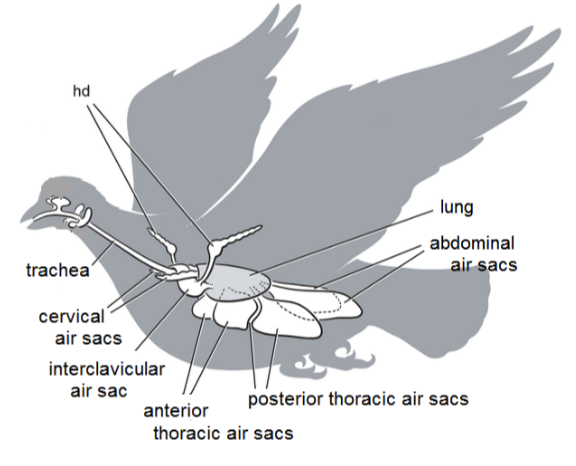
Compared to the lungs of a mammal, what is different about the bird’s lung with regard in the flow of air through the structure?
Unidirectal
2 cycle breathing process
Air flows continuously in lungs
Singing birds — exhale air vibrates membranes in sarynx
Steps
1st inhale — air moves through/past lungs to posterior airsacs
1st exhale — air moves into lung tissue
2nd inhale — waste air moves to anterior air sacs
2nd exhale — waste air finally leaves body (anterior sacs —> trachea)

In what way is bird poop distinctively different in its appearance from that of all mammals, and what is the reason for the difference?
Excretory system
No urinary bladder
Nitrogen removed as derived uric acid, requiring no dilution in water (white material, acidic)
Feces mixed with uric acid
Compare and contrast mammals and birds regarding their body temperature and thermoregulation. Give two similarities and one difference.
Endothermy/homeothermy — body temperature created metabolically, maintained at high levels similar to mammals
Body temperature shifted much warmer than mammals, birds require more energy compared to mammals
The current scientific consensus is that birds evolved from which major clade of dinosaurs?
Early evidence pointed to Archosauria
Theropod dinosaurs specifically (carnivorous, running dinos = T rex, raptors)
Before the 1990s, there were other widely held theories on the origin of birds. What happened in the 1990s that led to increasing evidence supporting the theropod origin?
Resolution came from study of fossils from China and elsewhere, including increasing number of fossilized theropods with feather-like structures
Describe one piece of evidence (or set of related finds indicating) that feathers evolved in other (non-avian) lines of dinosaurs
Struthiominus — similar to ostriches, may have used these feathers for courtship
You should be able to recognize four synapomorphies that define the phylogeny of saurischians (inherited by modern birds).
Furcula — wishbone, helpful for springiness
Reduction of digits IV and V, anything that moves fast needs reduction in weight (loss of muscles)
Enlarged antorbital fenestra (nares)
Reversed hallux (difficult to interpret in 2-dimensional fossils)
Specimens of Archaeopteryx date to which geological period? Why do we know so little about the evolution of birds before ~150 mya?
Late Jurassic bird (150-125~ mya), only known bird
You should be able to recognize flight-associated characteristics of Archaeopteryx that are shared with modern birds.
Outline of feathers, including secondary and primary feathers
Asymmetrical vanes in flight feathers
Separate primary + secondary feathers
Furcula (wish bone)
Reduced finger bones
Tarsometararsus-like fusion (feet digits)

You should be able to recognize characteristics of Archaeopteryx that are not found in modern birds but are ancestral in the theropod phylogeny.
Had teeth, no bill
Long tail (no pygostyle)
Clawed forelimb digits
List three extant species that are examples of “ratites” in the Palaeognathae.
Emu
Ostrich
Kiwi
What are the three major groups of Neognathae? Give an example of a locally common species of each.
Galliformes (loons and turkeys)
Anseriformes (ducks and swans)
Neoaves (everything else IE vultures and owls)
What is the name of the largest order of Neoaves, and why is the group referred to as the perching birds?
Passeriformes
Have squat-grip characteristic, most specialized in this order, they have a tight lock grip in place during sleep

What kind of feather is this?
Flight

What kind of feather is this?
Contour

What kind of feather is this?
Bristle

What kind of feather is this?
Down/y

What kind of feather is this?
Filoplume

What kind of feather is this?
Semiplume
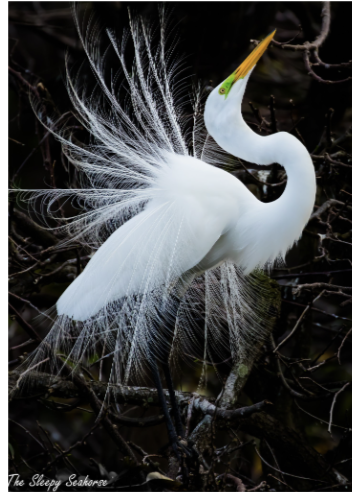
What kind of feathers are these?
Other plume
What is the function of a flight feather?
For flight
What is the function of a contour?
Waterproof
What is the function of bristle?
Tactile
What is the function of down?
Insulation?
What is the function of filoplume?
Keeping other feathers in order
What is the function of semiplume?
Thermal isolation
What is the function of other plume?
Breeding/courtship for egrets and herons

What is 1?
Barb
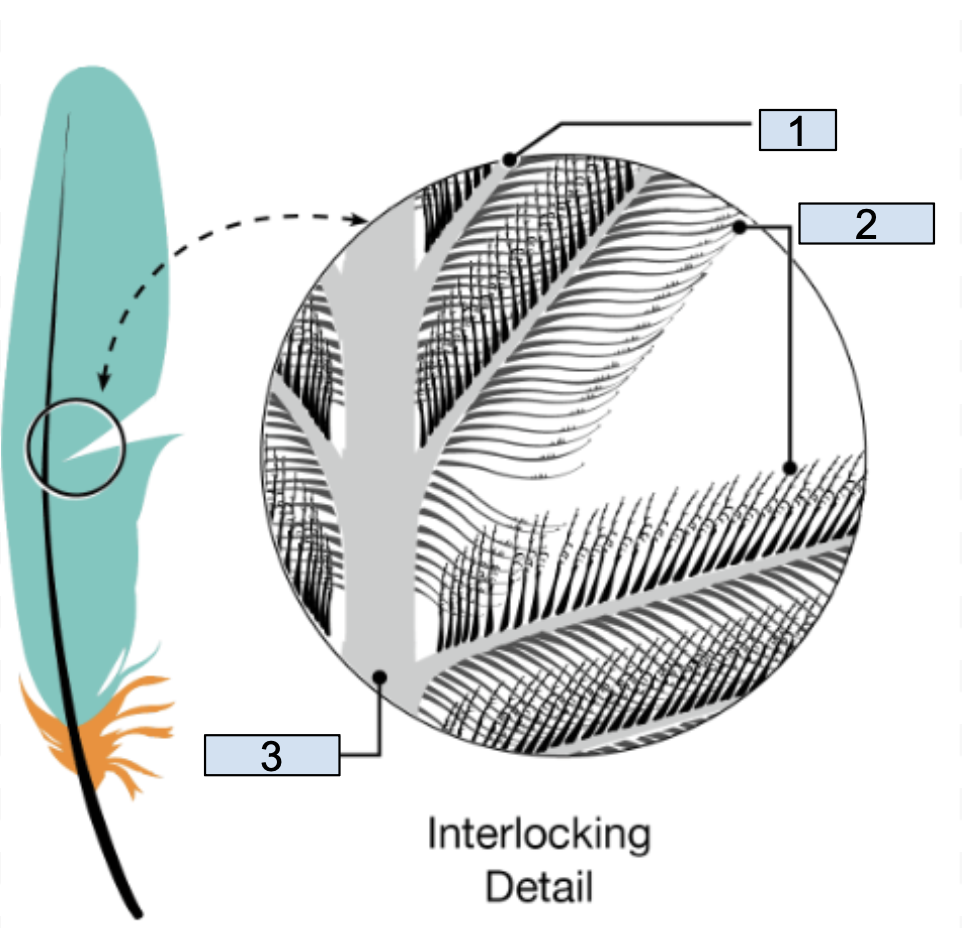
What is 2?
Barbules

What is 3?
Rachis
Be able to describe the interlocking process that forms the pennaceous feather vane.
Creates an air foil, interacts with wind like a sailboat
The vane near the base of a flight or contour feather is typically plumulaceous as opposed to pennaceous. Explain the structural characteristics that make that part of the feather plumulaceous. What is the hypothesized function of the plumulaceous part?
Plumacious — insulation (barbules loose and flexible)
Explain the structural characteristics of down that give it its insulating function.
Little to no rachis, barbules have no hooks
Compared to most other raptors, what is different about the flight feathers of an owl? Give one hypothesized explanation for this difference.
Make no sound, no stickiness/velcro in feathers
Sounds minimized by filamentous extensions of barbules
Theory — barbules don’t slide, reduction/change of turbulence, muffles sound of rushing over wings
Where would you expect to find bristles on a bird? What is the function of a bristle, and what is it about the structure of a bristle that facilitates that function?
Functions as sensor, tip and base (calamus) of barbs change shape
Found on head of birds
What are pterylae and apteria, and what is the function of the latter? (You will not be required to identify the different feather tracts).
Pterylae — feather tracts, where they grow
Apteria separates pterylae, this provides heat loss (thermoregulation) (brood patch)
Birds spend a considerable amount of time preening. What is the function of preening, and how do they do it? What is the role of the uropygial gland?
Preening — reposition of feathers and vanes, removes parasites by applying waxy material
Uropygial gland — oil-producing gland
Most of the period of molting occurs outside the time frame of other expensive phases of a bird’s annual cycle. What are those other phases?
Breeding
Migration
Before a bird gains its adult (definitive) plumage, which sets of feathers does it have?
Juvenile plumage
What is meant by definitive basic and definitive alternate plumage? During which part of a bird’s life does it have the alternate plumage (typically)?
Definitive — basic plumage
Alternate — breeding plumage
In the lecture slides, I gave the examples of American goldfinch and sanderling as species that have separate basic and alternate definitive plumages. Find/list two other species of birds on our class list that have this characteristic.
Common loon
Red-throated loon
In the lecture slides, I gave the examples of black-capped chickadee and mute swan as species that have only a basic definitive plumage. Find/list two other species of birds on our class list that have this characteristic.
Turkey vulture
Black vulture
Most bird species can fly during the period in which they are molting their flight feathers. How is this possible?
Flight feathers replaced sequentially, flight capability retained
Adult male mallards in (or molting into) their eclipse plumage often migrate to a secluded location for a few weeks. Why?
An extreme loss of feathers cause them to be unable to fly
Melanin acts to strengthen feather tissues. How would this be apparent in the primary feathers of a ring-billed gull in the weeks before it molts its flight feathers?
Melanin will be at ends of feathers
How can melanin-based color patterns be inferred from fossils?
Melanosomes (the cells) of skin being preserved in high resolution
In lecture, I used the examples of gray catbird, house sparrow, and common raven as species with plumage coloration dominated by which type of melanin?
Eumelanin
Comparing an American kestrel to a peregrine falcon, which species probably has more pheomelanin in its plumage? Explain your answer.
Kestrel would have more pheomelanin since they have more tans, red-browns, and yellows in their plumage than falcons
In a leucistic male American goldfinch in its definitive alternate plumage, which colors would you expect to be retained? Explain your answer.
Yellows since they aren’t produced by carotenoids rather than melanin
It is theorized that female house finches can select for higher quality males based on the male’s plumage. How do carotenoid-based pigments fit into this theory?
They acquire their color from their food, so the brighter the male the healthier
Researchers studying some species of owls use black light to assist in distinguishing between older and newer feathers. Why is this possible in some owl species?
They have porphyrins which are in UV spectrum, coating that muffles feathers
An adult ring-billed gull in its alternate plumage has immaculate white on its head and breast. How is this white coloration produced? Compare and contrast that process to the one that produces the white of clean snow and a bleached white sheet of paper.
Refraction of light
Artificial light will remain white breaking down while if you crush feathers it will no longer be white
In terms of how the color is produced, in what way is the blue in a blue jay like that in a blue sky? In the feathers that are strikingly blue, what characteristics of the feathers ensure that only blue is seen?
Selective refraction of blue wavelengths involving stacking melanin granules in air pockets, other melanosomes absorbed other colors
An adult male blue-throated mountain gem (a species of hummingbird that can be found in southern Arizona) has an iridescent blue throat. A male eastern bluebird also has strikingly blue plumage, though it is not iridescent. In what way is the production of blue similar in both species? What is different about the production of blue in the mountain gem? What role do melanosomes play in iridescence?
Mountain gem — refraction of light (constructive/destructive interference, stacking of granules, thin melanin layers)
Eastern bluebird — refraction of colors, absorb all colors but blue
Similarities — refraction, not actually that color/iridescence
How is it possible for a bird to have greenish plumage but lack green pigments?
Blue light scattered back (reflectance), yellow carotenoid pigments is reflected, mixes into green
Study the relationships shown in the graph on slide #3 and speculation on the causes of the difference between the curves for mammals and birds.
Birds — lower retention time for fluids and particles (weight loss for flights, faster metabolism)
Mammals — higher retention time for fluids and particles
From our class list of bird species in RI, pick six species that feed in much different ways and briefly describe how each feeds and how the anatomy of the bill matches the feeding mode.
Crossbills — crossed top and bottom works like pliers to extract seeds from pinecones
Eagles — hook-like bills to tear large prey
Herons — sharp pointed bills to capture/puncture fish and amphibians
Wrens — thin probing bill to capture small insects
Woodpeckers —chisel-like beak to chop away wood to reveal insects
Swifts — wide gaping mouth to capture flying insects
Describe the unusual tongue anatomy of the woodpecker.
Hyoid apparatus (bones) modified, tongue wraps around entire skull, shoots out super long
Describe the form and function of the crop.
Outpocketing of esophagus, temporary storage
What is unusual about the crop of a pigeon (regarding its function)?
Pigeons produce crop milk
What are the functions of “stomach oil” in seabirds such as fulmars and storm petrels?
Rich outsource of lipids, defense mechanism vomiting
Be able to identify the proventriculus and gizzard and describe their functions.
Proventiculus — secretes HCl, pepsinogen, mucus, stores stomach oils in some birds
Gizzard — muscular organ that breaks up food (work like teeth), tough lining of Colin, may contain ingested grit

Be able to identify the digestive ceca and describe their functions.
Blind sacs, primary site for fermentation of carbohydrates to turn into short-chain fatty acids and bases

Be able to identify the cloaca and describe its function.
Collect/form feces
Uric acid
Reproductive organs