chapter 10
 Call Kai
 Learn
 Practice Test
 Spaced Repetition
 Match
 Flashcards
 Knowt Play
1/16

There's no tags or description
Looks like no tags are added yet.
17 Terms
Strong IMF means a substance will be
a solid or liquid at room
temperature.
Stronger intermolecular forces make it harder to make solids
become liquids or gases. It also makes it harder for
liquids to become gases. More energy (heat) is needed to break these
forces so molecules can spread out and become the new spaced out phase (liquid or gas).
Stronger IMF means higher boiling and melting points. It takes
more energy (heat) to break the
intermolecular forces holding the molecules together.
You Try: Put in order from strongest to weakest
look

In order to evaporate, a particle must have
enough KE to
overcome the IM forces of
attraction (they need to break free from each
other) overcome the IM forces of
attraction (they need to break free from each
other)
As particles with the highest KE evaporate
away from liquids, the average KE?
decreases,
so the temperature decreases
Liquids that evaporate easily are volatile
(gasoline) and those that do
not evaporate
easily are nonvolatile (oil)
Particles in a liquid with the
highest KE and at
the surface of the liquid will evaporate
Sublimation occurs when the
vapor pressure of the solid is greater than or equal to the surrounding atmospheric pressure.
A phase diagram
shows the
conditions of temperature and
pressure that are necessary for a
substance to exist as a solid, liquid,
or gas.
look
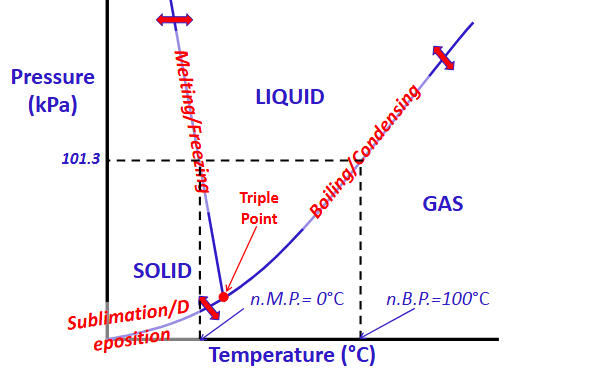
Triple point:
The conditions of temperature and pressure at which all
three states of matter are in equilibrium
with each other (S, L, G, exist
simultaneously).
If the solid/liquid line slants to the left, the liquid
state is more
dense than the solid state (liquid region is larger)

f the solid/liquid line slants to the
look right, the solidright, the solid
state is denser than the liquid state (solid region isstate is denser than the liquid state (solid region is
larger).


a) −30 °C and 2000 kPa
• (b) −90 °C and 1000 kPa
• (c) −60 °C and 100 kPa
• (d) −40 °C and 1500 kPa
• (e) 0 °C and 100 kPa
• (f) 20 °C and 100 kPa
a. Liquid
b. Solid
c. Gas
d. Liquid
e. Gas
f. Gas
The temperature and pressure required to
roduce a
supercritical fluid. A supercritical fluid is a state between a
liquid and a gas and has properties of both.
A unit cell shows the locations of
lattice points repeating in all directions