AST101 part 2
 Call Kai
 Learn
 Practice Test
 Spaced Repetition
 Match
 Flashcards
 Knowt Play
1/126

There's no tags or description
Looks like no tags are added yet.
127 Terms
Newton: Speed
The rate of change of position.
Newton: Velocity
Speed and direction
Newton: Acceleration
Rate of change of velocity
Newton’s first Law:
An object in motion remains in motion unless acted upon by an outside force
Newton’s second law:
Acceleration is proportional to Force and inversely proportional to mass
F = mA
More Force means more acceleration
More Mass means less acceleration
Newton’s third law:
For every force, there is always an equal and opposite reaction force.
Momentum
Mass times Velocity
p = mV
In close system, momentum is conserved
Angular Momentum:
Mass times velocity times distance
w = mVr
In a closed system, angular momentum is conserved
Angular Momentum and Orbits:
Distance is large — Speed is small
Distance is small — Speed is large

Newton’s Universal Law of Gravitation
There is a force between any two objects in the Universe.
force is proportional to: product of the masses of each object
force is inversely proportional to the square of the distance.

Newton’s Universal Law of Gravitation — cont.
The force depends on M1 times M2.
Double the mass of either object = double force
Half the mass of either object = half force
Double distance = reduce force by d²
Half distance = reduce by d²
Acceleration Due to Gravity
Near the Earth, with no air resistance, all objects would speed up by 10m/s every second.
Freefall
Only force acting on an object is gravity
Freefall in space — orbit
Travelling around 26,000 km/h – force required go in a circle is the same as the force of gravity.
Orbits
Velocity highest closest to center of mass — perihelion, biggest angle to orbit
Velocity lowest farthest from center of mass — aphehelion, smallest angle to orbit

Moon’s gravity on earth

Tides — moon
The varying gravitational force squeezes both the Earth and the moon
oceans respond to tidal forces from the moon
friction with rotating earth causes tidal bulge to lag behind
applies force on earth, causing rotation to slow down (14h to 24h)
Tidal locking
same face always facing
Tides — sun
The Sun also causes tidal forces on the Earth!
2 tides
facing moon and facing sun
Spring tide
In a full moon or new moon, tidal forces from the moon and the earth add
twice a month
largest tides

Neap tide
If quarter moons, Tides from sun cancel moon’s tides
twice a month
smallest tides

Tides summary
There are two high tides and two low tides per day!
Distances
Diameter of earth = 12k km (1 earth unit)
Diameter of the sun = 1.3 million km (129 earths)
Distance from earth to sun = 1 AU
Masses
Mass of earth = 5.97x10^24kg 1 earth unit
Mass of sun = 333k earths
The sun is white, not yellow
Atmosphere scatters light from the sun
In daytime sun is white
Why is the sunset red?
Unscattered red light
When red light hits the atmosphere, it passes right through
Gone through a lot of air = dimmer

Cross section of the sun
Core
Radiative zone
Convective zone
Photosphere
Corona

Plasma
At high temps, electrons are stripped away from the nucleus = this state is called plasma
Where is the energy coming from? NOT BURNING
Nuclear Fusion in the sun
Converting 4 protons = 2 positrons (positively charged electrons) + 2 neutrinos + 2 gamma rays + 1 helium nucleus
lower mass than starting — released as energy
E = mc²
A lot of energy from a small bit of mass
Fusion is hard.
The positive charge on the protons makes them repel each other
Needs high temperatures (millions of degrees)
Needs high speeds
Also needs high density — more collisions
Core is 160 times denser than water
Pressure, Temperature, and Density
Higher temp = higher speed, higher pressure
Higher density = higher pressure

Hydrostatic equilibrium in the sun
Force of pressure in the sun is the same as the force of gravity — sun is stable
more density
more fusion
higher temp
higher pressure
core expands
density drops
equilibrium restored

Nuclear fission
Neutrons can hit an atom’s nucleus
Becomes unstable
Split the atom
Total mass is less than start
Releasing energy and other neutrons
Chain reaction
Structure of the sun
Core: fusion, 10mil C, 100X density of water
Radiative: hot but calm, few million C, density of water
Convective: hot air rising, cooling, then falling (brings heat to surface), hundreds of thousands C, density of styrofoam
The Surface of the Sun
Bright regions: Hot plasma rises from below
Darker regions: cooler plasma sinking
(convection)
Sunspots
Sunspots are cooler spots on the surface of the Sun.
(4000 C rather than 5500 C)
Sunspots and Solar Flares
UV Lightshows very hot plasma around sunspots
The filaments follow Magnetic field lines
Sunspot activity is on an 11 year cycle — correlates with radioactivity from solar flares

How do we know? Vibrations
The Sun vibrates, kind of like a bell
Observations of vibrations on surface show the interior structure of the Sun
Vibrations match what is predicted by the models
How do we know? Neutrinos
The models predict a flux of Neutrinos from the core of the sun.
These Neutrinos are measured!
Emission
All the light came from some sort of emission
Reflection
Light bounces off something that is reflective (straight lines) – in one direction
Reflection doesn't have to be 100%, can be partial reflection
Scattering
Scattering is reflection in all directions (rough surface)
Only a certain wavelength (colour) is scattered
Things have colour because of the wavelength that is scattered (or coloured emission)
Every other colour got absorbed
Absorption
For black objects, all colours of light are absorbed
If you can see it, it's not black
Light colours vs dark colours
Light – all get reflected, some more than others
Dark – everything absorbed, some more than others
White – all get reflected equally
Transmission
Light comes along some object, goes through, and comes through the other side
Semi-transparent (some colours get absorbed) vs transparent
White light from the sun is colour of every wavelength
If the sun was orange the beam would be orange
White objects reflect all light equally
How do screens make their colours?
By adjusting RGB, can get emissions of different colours
White – All colours on
Black – all lights off
Yellow – red and green
Cyan – green and blue
Purple – red and blue
Waves
Wavelength: distance between peaks
Amplitude: height of peaks
Frequency: how often the peaks arrive

Light is an Electromagnetic wave (what is purple)
ALL light (in a vacuum)
Travels at 300,000 km/s
Same speed
The wavelength or frequency determines the colour
Shorter wavelength – bluer
Longer wavelength – redder
Purple? – red light sensors have a leak for sensitivity to blue light
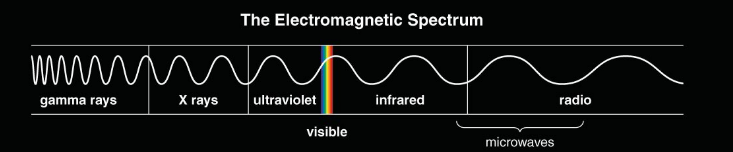
Electromagnetic spectrum
Thermal Radiation
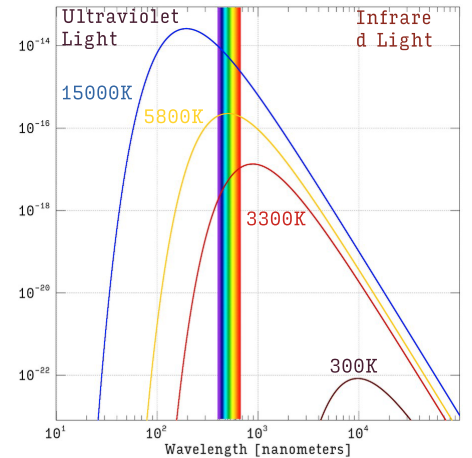
Anything that is ‘warm’ glows
The temperature of the object effects its spectrum
hot things brighter
hot things peak at a shorter wavelength

Planck spectrum
Intensity x Wavelength
Hot Gas Emssion
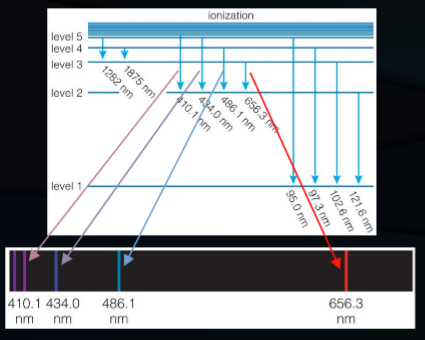
When low pressure gas is excited, it glows with distinct colours
Excite electrons, forming plasma, calms down, emit light
Hot Gas Emssion — emission lines
Much of the light comes out in specific colors – called emission lines
each element has its own pattern
Energy Levels
Different transitions give light of different colors!
Absorption lines and Emission lines

Thermal radiation from?
From a hot dense source

Emission line spectra
From hot low density gas

Absorption line spectra
From cool low density gas with a hot source behind it

Understanding the Sun’s Spectrum
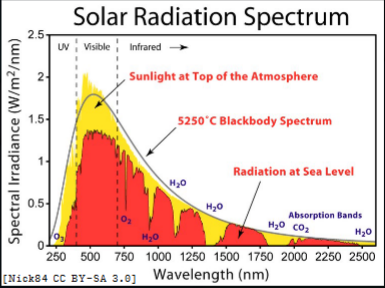
The Sun’s spectrum is continuum plus absorption lines
Continuum is due to opaque, high density hot interior (blackbody)
Absorption lines are due to cooler gas in the photosphere
Examples of Spectra: The sun from space
Stars (like the Sun): Mostly a continuous spectrum, but with emission and absorption lines

Examples of Spectra: The sun from Earth
The Earth’s atmosphere has huge absorption lines from greenhouse gasses - Especially in the infrared
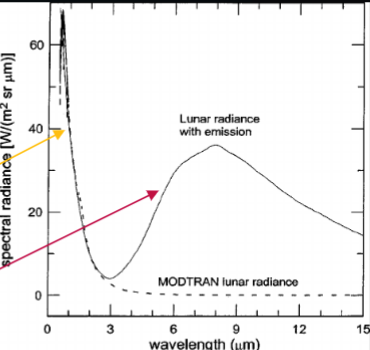
The Moon’s spectra
Reflection of the Sun’s thermal spectrum
Thermal emission from the warm rock
No atmosphere, so no absorption lines
Nebula
Nebula produce emission lines
lines used to determine composition
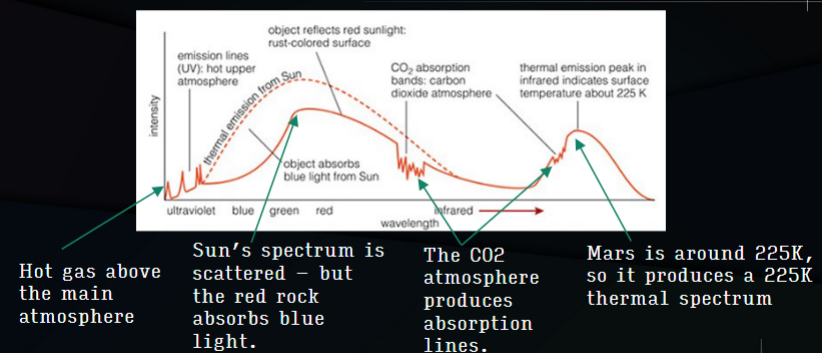
The spectrum of Mars from space
hot gas above main atmosphere
red light from sun scattered
CO2 atmosphere
Mar’s thermal spectrum
Light can tell us about it’s source!
Temperature:
location of the peak of spectra
emission and absorption lines
Density:
emission/absorption lines
width of the lines
Composition:
each atom has unique lines
Doppler Effect
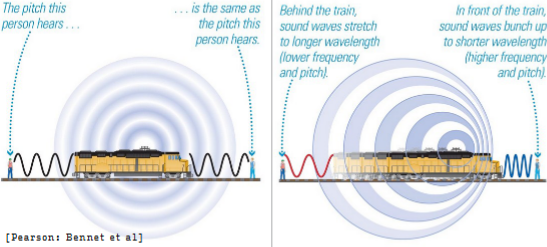
Sound is a presure wave, Pitch is frequency
Source is coming towards = pitch (freq) is higher
Source is going away = pitch (freq) is lower
Doppler Effect for light
Moving away = redshift
Moving toward = blueshift
Molecular clouds
In galaxies
Mix of gas and dust
¾ hydrogen
¼ helium
Traces of other elements
Appears black because the dust blocks light
Can we see inside molecular?
Molecular clouds are very cold (-260celcius)
Measured spectrum and see peak
Sub-millimetre light
Very dim and cold
Not visible to the eye
Step 1: Molecular Cloud
Mix of gas and dust
Step 2: Protostar
Blobs of denser and hotter matter
Attract more matter due to higher gravity
AND higher pressure in the center
Higher density = higher pressure
Higher temp = higher pressure
More gas gets pulled in, core becomes = denser, hotter = eventually enough for fusion
Step 3: Main Sequence Star
Hydrostatic equilibrium in a star
Star starts out with ¾ hydrogen and ¼ helium
In the core, fusion is converting hydrogen into helium
Helium content increases
Step 4: Hydrogen Shell burning Red Giant
Core begins to cool and shrink
Collapse stopped by degeneracy pressure – all atoms as close as they can get
Inert helium core
Hydrogen pulled inside starts to fuse – more energy than normal
Star starts to expand into red giant
Step 5: Helium Core burning Red Giant
Eventually, add enough helium from hydrogen shell burning to burn helium
Helium into oxygen and carbon
And also hydrogen shell burning
Step 6: Helium Shell burning Red Giant
Inert carbon core provides enough pressure for helium shell burning
And hydrogen shell burning
Thousands of times more energy
Star expands by a factor of 1000
Step 7a: planetary nebula
Increasing energy coming out blows off the hydrogen and helium envelope
Lit up by hot core = planetary nebula
Can disperse and become new molecular clouds
Step 7b: White Dwarf
What's left? Carbon and oxygen core
White dwarf – extremely dense and inert
Starts extremely hot – Cooools down for billions of billions of billions of years
Final state is unknown
Terrestrial Planets
Small
Rocky
Relatively thin or no Atmosphere
Few moons
Made from Heavy Elements
Jovian Planets
Large.
Gas + Liquid.
Many moons.
Mostly light elements
Observations
inner planets rocky, outer planets gas/ice
planet orbit in ecliptic plane
planet orbit in same direction as sun’s rotation
moon’s orbit most in same direction
Exceptions
earth, saturn, and uranus are tipped
venus rotates backwards very slowly
triton (neptune moon) orbits out of plane and backwards
The Nebular Hypothesis
As protostar forms, conservation of angular momentum makes it spin very fast
Collisions between particles flatten the orbit — forming disk of gas and dust
ALL young stars have this (shape varies)
Small bits stick to larger bits
Eventually gravity pulls them together to form planets

The Frost Line
The closer to the protostar, the hotter it is
Distant disk is cold enough for light molecules (methane) to condense/freeze
Near disk only heavy molecules (like metals) can condense
Frost line — cont.
Disk is 98% hydrogen and helium
2% everything else
Outside frost line, most of everything else can condense
Inside frost line only metals — a lot less material
Terrestrial Planets form inside the frost line!
Heavy elements, small because less material
Jovian Planets form outside the Frost Line!
Rocks, metal, and ice
Larger cores use gravity to accrete large gas envelopes
Each planet has its own disk, which then forms moons
Not all planetesimals end up as parts of planets.
Inner solar system = rocky asteroids
Outer solar system = icy comets
The Heavy Bombardment Period (what shows lots of collisions)
Early on lots of planetesimals (asteroids and comets)
Collisions frequent
Surfaces of airless bodies (e.g. moon) show lots of collisions
Far fewer planetesimals now
The Age of the Solar System
Radioactive materials decay into other elements
E.g. potassium-40 decays into argon-40 (1.25 billion years half life)
By looking at ratio of elements, can determine age
The age of earth
Based on the ratio of Potassium-40 to Argon-40
Earth’s oldest rocks are 4.55 Billion years old
The Universe is about 3 times older than the Earth.

Where did the moon come from?
Moon is made of same stuff as Earth’s crust
planet around the size of mars crashed into earth
most material fell back down to earth
small bit stayed = moon
Other exceptions from?
Tipped rotation = giant collisions
Venus rotating backwards = collisions?
Triton = probably got captured into neptunes orbit
Proplanetary disk inside frostline
0.2% metal (solid)
0.4% rock (solid)
1.4% hydrogen compounds (gas)
98% helium and hydrogen (gas)
Only metal and rock can from planetesmials
Proplanetary disk outside frostline
0.2%: Metal (Solid)
0.4%: Rock (Solid)
1.4%: Hydrogen compounds (Solid Ice)
98% helium and hydrogen (gas)
Metal, rock, and hydrogen compounds can form planetesimals
Creating Craters
Planetesimal striking surface with speed around 100,000km/h
Vapourises rock and creates enormous explosion
Crater is left
Why so few craters on earth, mars, and venus?
Craters after heavy bombardment period
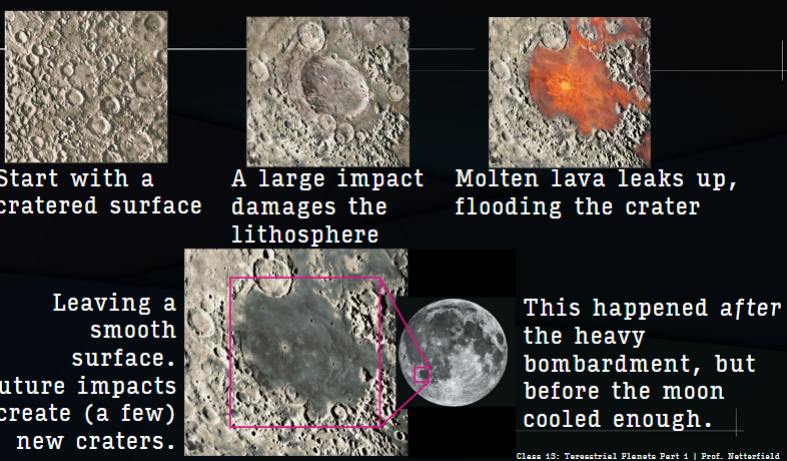
Large impact can damage the lithosphere
Molten lava leaks up, flooding crater
Leaves smooth surface
Future impacts create few new craters
Happened after heavy bombardment, before moon cooled enough (doesnt happen now)
Looking inside planets: Drill holes? X-rays?
Deepest hole is 12km
Earth’s radius is 6371km
X-rays cant penetrate rock
Looking inside planets: Sound waves
Using direction and timing of earthquakes, the interior of the planet can be probed – detected by seismometers