Pig Anesthesia & Ruminant Anesthesia
 Call Kai
 Learn
 Practice Test
 Spaced Repetition
 Match
 Flashcards
 Knowt Play
1/23

There's no tags or description
Looks like no tags are added yet.
24 Terms
What are the main guidelines for pre-anesthetic preparation for ruminants?
Food + Water
• Starvation (and water deprivation) prior to general anaesthesia
Controversial, very few perform water deprivation, and thoughts that food deprivation may alter important bacteria
• Calves: food for 8-12 h (water 8 h)
Any calves on milk supply should not be starved
• Adult cattle: food for 12 (-24) h (water 12 h)
• Large mature bulls: food for 24-36 h (water 24 h)
Where are IV catheters placed in ruminants for pre-anesthetic preparation?
Cow - neck
Ear - vein usually in periphery
DO NOT want to be intra-arterial
What are the main drugs used for premedication in cattle?
Both may cause uterine contractions - should not be given in the last trimester

What are the main drugs used for premedication in small ruminants?
• Hypoxaemia and pulmonary oedema reported in sheep following a2 agonists administration
• Worse when IV and during anaesthesia
• If possible supplemental O2
Best - to use detomidine IM, and provide supplemental oxygen
What are common bovine anesthetic protocols for adult bovines?
Ketamine - does not always allow placement of ET tube
Thiopentone - removes reflexes associated with ketamine but increased risk of regurgitations
GA always protect airway - intubate!!

What are common bovine anesthetic protocols for calves?

What are common bovine anesthetic protocols for small ruminants?
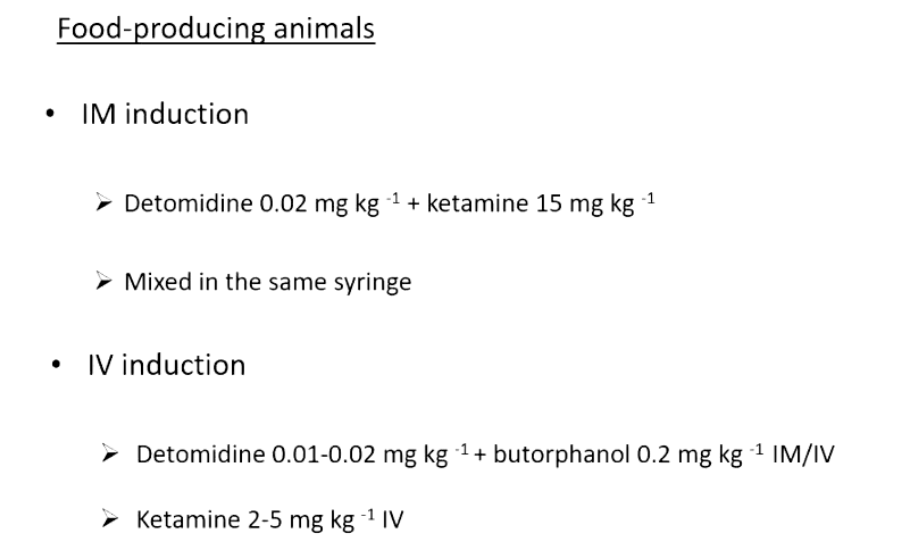
What are common bovine anesthetic protocols for research animals?

What drugs are typically used for maintenance of ruminants?
• Volatile anaesthetics
Isoflurane → under the cascade
• No nitrous oxide !!!
• Bovine triple drip
Guaifenesin 5% + Ketamine 1-2 mg ml-1 + Xylazine 0.1 mg ml-1
Guaifenesin - not authorized in UK, only US
• (Chloral hydrate?)
What drugs are typically used for analgesia?
Variety of NSAIDs available, Opioids are more limited, only including: Butorphanol, Levomethadone (Not usually available), can use ketamine
Lidocaine - gray area - regional anesthesia but not listed for IV, listed only for loco-regional
Use GB MRL Register + cascade
• Opioids
Butorphanol and levomethadone only opioid in Table 1
• NSAIDs
• Locoregional anaesthesia
• Ketamine CRI intra-op.
• Lidocaine CRI
What are the main regional analgesic techniques?
• Epidural analgesia and anaesthesia - takes a very long time for recovery and for them to stand up, can take >3hrs
• IVRA
• Head blocks
Cornual
Ophthalmic
Dental
• Flank blocks
• Others
Why is intubation in calves difficult? Is it as difficult in adult cattle?
• Small ruminants and young calves
Can be very difficult
Poor visibility of the larynx
• Skilled assistance essential
• Adult cattle and bigger calves relatively easy
• Manual intubation
• Blind intubation
Similar to horses
Only 50% success rate
What are some common difficulties regarding intubation in ruminants?
Regurgitation and subsequent aspiration of ruminal content
Ruminal tympany - bloat
Cardiovascular depression
Respiratory compromise
Salivation
Describe the recovery period for ruminants following anesthesia.
• Sternal recumbency
• Cuffed ETT
• N.B. High volume epidural/ intrathecal anaesthesia
Prolonged recumbency
• Usually calm and quiet
What does pre-anesthetic prep look like for pigs?
• Fasting - suitable since GI tract is more similar to cats and dogs
8-12 h
≤ 24 h for abdominal surgery
• Weight
• Venipuncture tricky
always need IM sedation, want to reduce stress to reduce malignant hypothermia
Why is IM sedation indicated in pigs?
• IM sedation
* Subcutaneous fat: sedative intra-fat not effective!!!
• Long needle
• Remote injection technique if necessary
• IM behind ears
→ Avoids valuable meat producing hams
→ Less fat
What are common pig anesthesia protocols?
Need quiet environment for azaperone to work

What are some common research animal - pig anesthesia protocols?

Why is intubation challenging in pigs?
More difficult than goat or sheep
• Anatomical challenge - difficult to see larynx, want long laryngoscope
Pharyngeal Diverticulum: Pigs have a blind-ending pouch (a pharyngeal diverticulum) located right above the esophagus, which can easily trap the endotracheal tube or a guide by mistake.
Bulky tissue
• Oral cavity
• Larynx
• Trachea
How is maintenance done in pigs?
Food-producing animals
Volatile anaesthetics: isoflurane
Research Animals
s. above
Propofol CRI
Alfaxalone CRI
Swine triple drip
Guaifenesin 5% + Xylazine 1 mg ml-' + Ketamine 1 mg ml-1
2.2-4.4 ml kg-1 h-1
Why is maintenance of body temperature so important in pigs?
Are very sensitive to temperature changes, not a lot of hair
• Hypothermia and hyperthermia possible
• Hypothermia more common
- Use a vasodilatory drugs (e.g., azaperone,
isoflurane)
- Large, hairless skin surface area
- Heat dissipation likely
- Active warming for long procedures and
post-op.
What is porcine malignant hyperthermia? (MH)
Porcine malignant hyperthermia (MH)—often associated with porcine stress syndrome (PSS)—is a fatal, inherited genetic disorder of skeletal muscle calcium regulation in pigs Pigs experience a hypermetabolic crisis and hyperthermia
• Genetic Defect: It is caused by an autosomal recessive point mutation in the ryanodine receptor gene (RYR1).
• Calcium Release: The mutation causes a defective calcium channel in skeletal muscle cells, leading to a massive, uncontrolled release of calcium into the cytoplasm.
Sustained Muscle Contraction: High concentrations of free calcium force the actin and myosin filaments in skeletal muscles to bind continuously, resulting in severe muscle rigidity and locked spasms.
Hypermetabolic Burnout: To keep up with this locked state, muscle cells frantically burn through adenosine triphosphate (ATP) and oxygen. They ramp up both aerobic and anaerobic metabolism, consuming oxygen, generating excessive carbon dioxide (CO₂), and producing severe lactic and respiratory acidosis.
Heat Generation: All of this accelerated cellular work, inefficient mechanical energy conversion, and ATP hydrolysis release massive amounts of thermal energy faster than the body can dissipate it, driving core body temperature up rapidly
• Triggers: Episodes can be triggered by physical stress, transport, fighting, intense exercise, halogenated inhalation anesthetics (such as halothane), or muscle relaxants like succinylcholine.
• Susceptible Breeds: Most commonly found in heavily-muscled breeds selected for lean meat, such as Piétrain, Landrace, and related crossbreeds
Not common, often fatal, no specific treatment
• After exposure to triggering agents
• Certain breeds overrepresented
• Poland China, Pietrain, Landrace, Large White
What are clinical signs of porcine malignant hyperthermia?
Clinical Signs
• Generalised muscle rigidity (starts at toes)
• Blotchy skin
• Severe and sustained hyperthermia
• Hyperkalaemia
• Hypercapnia
• Metabolic acidosis
• Cardiac arrythmias
If an anesthetized pig is suspected to have porcine malignant hyperthermia, what are the next steps?
• Terminate anaesthesia
• Remove vaporizer + replace circuit with uncontaminated one
• Hyperventilate with 100% oxygen
• Cool down
• Dantrolene → not in Table 1/GB MRL Register
• Symptomatic treatment of
Metabolic acidosis
Hyperkalaemia
Cardiac arrythmias