4. Pharmocokinetics (part three)
 Call Kai
 Learn
 Practice Test
 Spaced Repetition
 Match
 Flashcards
 Knowt Play
1/21

There's no tags or description
Looks like no tags are added yet.
22 Terms
Varying in drug concentration levels in plasma
Normally when a drug is administered, the concentration peaks and then it starts to drop, then by administering more of the drug, the drug concentration will increase again. (causes zig zag pattern)
By drip infusion you can administer drug at a constant rate so that a steady state can occur.
When does steady state occur in drip infusion?
After five half-lives

What if you urgently need to reach steady state and cannot wait five half-lives.
You can administer a loading dose
This is a larger-than-normal initial dose of a medication given at the start of treatment to quickly reach a target therapeutic level in the body.
What do doctors do if pharmocokinetic behavior of drug is so unpredictable?
Therapeutic drug monitoring
Doctor takes blood samples to measure concentration of drug in blood
Happens when effect of drug doesnt occur or if toxicities occur.
Can be used to check if patients are taking drugs as they should (some drugs do not give immediate effects
Drugs in a formulation
Drug substances are mostly administered as part of a formulation (tablet, cream, etc.)
Formulations are combinations with one (or more) ‘pharmacological inactive’ agents that serve varied and specialized functions:
Stability
protection
to allow processing into a tablet
etc.
targeted and delayed release
Targeted release → often a tablet with coating that only released at a certain pH value.
Delayed release → if you have slow release, then there isn’t a spike in plasma concentration
What are reasons for different formulations
Besides targeted and delayed release:
Pharmaceutical, technical or economical reasons
Improved stability → lower tablet dose
Mask taste or smell
To protect the drug against the stomach pH.
Physico-chemical properties of the active compound
Salt, ester, prodrug
crystalline structure
particle size
the drug vehicle
Disintegrants, surfactants, coatings etc.
Solvent(s)
Production process
Compression force
Suspension technique, stirring etc.
Tablets
Convenient
Stable
Easy administration
Palatable
Flexible
What do tablets contain?
Diluents or fillers to increase the bulk of the formulation
Binders to cause the adhesion of the powdered drug and inactive ingredients
Anti-adherents or lubricants to assist the smooth tableting process
Disintegrating agents to promote tablet break up after administration
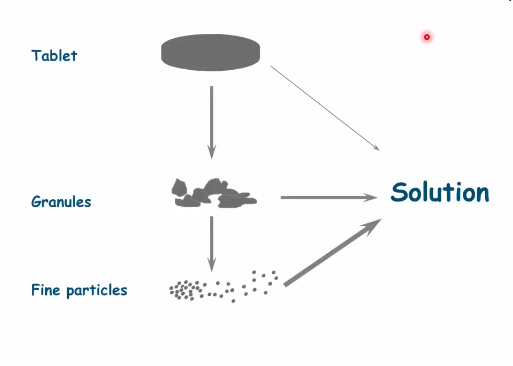
Uncoated tablet
Rapid disintegration
Why modified release formulations?
Therapeutic reasons, for example
Site specific delivery
to achieve a desired pharmacokinetic (PK) profile
To reduce potential side-effects
Technical or pharmaceutical reasons, for example
Stability issues (Before or after administration)
Multiple active components in one formulation
Taste
Solubility
What is a modified release formulations
A modified-release formulation (or dosage form) is a pharmaceutical preparation designed to alter the rate and/or site of drug release compared with an immediate release preparation administered by the same route.
What are the technologies behind modified release? (microporous membranes)
Has drug on inside and microporous membrane on outside.
This would allow water to slowly penetrate into drug and then building up pressure on the inside.
Alternatively there is one single small hole that allows penetration of water (EOP)

Capsules
Hard or soft gelatin
Outer shell
Inside: liquid, oil, powder, grains
Food supplements (e.g. fish oil)
Oral mucosal route
Buccal mucosa (in cheek)
Sublingual mucosa (under tongue)
Only for tasteless drugs (otherwise nastyy)
Rapid effect
Avoid first-pass metabolism
Rectal route
Local action
Constipation, inflammatory bowel disease
For babies or children if they cannot swallow
Avoides first pass effect.
What are the five parenteral routes?
Intravenous (i.v.)
Intramusuclar (i.m.)
intraperioteneal (i.p.)
Subcutaenous (s.c.)
Intradermal (i.d.)
Dosage forms for parenteral routes
Solutions
Suspension
emulsion
Solids (e.g. for implants)
Steps towards systemic exposure after parenteral routes depending on the different dosage forms
Solution in water = best → diffuses rapidly into capillaries
Suspension in oil = hardest → has to dissolve first, then diffuse then partition into tissue fluid → may take a lot of time.

I.v. parenteral nutrition (for who, composition of iv, where, complications)
Who: patients who are severely malnourished or have contradictions to enteral feeding
Amino acids, dextrose, fat emulsions, vitamins, trace elements, electrolytes, may add medications
Where: most often central nervous line
Complications: secondary to central venous access, infection and sepsis, metabolic complications
Pulmonary adminstration
Local action (e.g. asthma)
Systemic action (e.g. anaesthetics)
Advantage
Rapid effect
No first pass effect
Sprays, solutions, aerosols
Transdermal route
Local action (e.g. corticosteroid cream)
Systemic action (e.g. morphine patch)