Lecture 5: Population screening and Ethical issues (Counselling with Saj)
 Call Kai
 Learn
Learn Practice Test
 Spaced Repetition
 Match
Match Flashcards
 Knowt Play
1/25

There's no tags or description
Looks like no tags are added yet.
Name | Mastery | Learn | Test | Matching | Spaced | Call with Kai | Chat |
|---|
No analytics yet
Send a link to your students to track their progress
26 Terms

***What is NBS (new born screening)
A screen done on ALL newborns for TREATABLE CONDITIONS
the list of conditions screened for varies by province
Done by a heel prick and sent to the lab
An Opt-out test
*******Outcome 2 (Identify the historical principles behind newborn screening and
judge how these have evolved over time)
WHAT ARE THE 10 CLASSIC PRINCIPLES by which new born screening was derived?
KNOW THIS FOR THE EXAM
The conditions screened for should be an Important health problem
there should be an accepted treatment for patients with recognized disease (if no treatment = no point in detecting)
Facilities for diagnosis + treatment should be available
There should be a recognizable latent or early symptomatic phase (Screening is only effective if catching the condition during this window allows doctors to start treatment before irreversible damage occurs)
there should be a suitable test or examination
The test should be acceptable to the population
The natural history of the conditions, including development form latent to declared disease should be adequately understood
There should be an agreed policy on whom to treat as a patient
The cost of case finding (including diagnosis and treatment of diagnosed) should be economically balanced in relation to possible expenditure on medical care as a whole
Case finding should be a continuing process and not a “once and for all” project
What is Phenylketonuria (PKU)
probs not important
a rare inherited metabolic disorder (build up of phenylalanine (Phe) A.A. in the body because lack of an enzyme)
Early detection allows for EARLY intervention with a low-phenylalanine medical diet, = normal life
prevents permanent brain damage, seizures, and severe intellectual disability.
*****Objective 1+ 2: Did CF (cystic Fibrosis) fit the 10 classic principles of NBS when we first brought it on?
NO
it broke some of the principles
*****Objective 1+ 2: Which of the 10 classic principles of NBS did CF (cystic Fibrosis) break when we first brought it on?
hint: 3
***What about now? are these principles still broken by CF?
There should be a suitable test or examination: Mutation in CFTR
PAST: At the time there were no suitable tests
NOW: we have sequencing + the SWEAT TEST = golden standard test
The natural history of the conditions (development from latent to declared disease) should be adequately understood
PAST: at the time we did not know everything
NOW: we know to test healthy adults with asthma
Chronic sinopulmonary disease
GI/nutr abnormalities
Azoospermia
Shortened life span
There should be an accepted treatment for patients with disease
PAST: not many
NOW: Targeted drugs
Pulmonary: oral, inhaled, IV antibiotics, bronchodilators, anti-inflammatory agents, mucolytic agents, chest physiotherapy
Gastrointestinal: Nutritional therapy special formulas for weight gain and additional fat-soluble vitamins & zinc
*****Outcome #1 (Describe the role, rationale, and areas of controversy for population carrier screening)
What is the CONTROVERSY with NBS (new born screening?)
1) It is an OPT OUT test meaning that unless you say NO the baby will be test
HOW do you opt out if you DONT KNOW THIS TEST is even a thing/ will happen to your baby
A lot like Dr. House and his “NON-consensual screening” in a way
2) We are adding more and more tests to NBS that don’t fit the principle, at what point are we detecting for things that don’t need to be protected?
How close are we to EUGENICS?
eg. Should we test for hearing loss? Deaf families may not want hearing children as they mainly communicate by sign language
*****Objective 1: What are the key principles maintained when determining if a disease should be added to the NBS? Which principles can be skirted?
Does Early detection Make a difference in treatment + outcome?
Does it REDUCE the SEVERITY of outcome
Does ROUTINE checks FAIL TO DETECT? if yes NBS = better
Other principles are still somewhat maintained but they are fluid and flexible
****Objective # 2: NBS vs. Eugenics: how are they different and how are they similar?
Similar:
both are testing for what a governing body deems abnormal/ Someone else decided what was best for me
Who holds the decision making power/ occurs out of my control? even in NBS while it is opt-out most parents don’t know this is a thing
Was not told
Differences:
NBS occurs AFTER the child is born = not preventing a child from coming into being
The intent behind NBS is not cleansing of the population but rather patient care
*****Objective 1: what are the BENEFITS + RISKS of NBS?
Benefits:
Identification
Early intervention (can reduce cost + reduce severity)
Reduced morbidity + mortality
Family planning (future babies + inform extended family
Risks:
Parental anxiety (false +) - scare tons of families so that we dont miss the 1 kid who would really benefit
Missed diagnosis (false -)
the right “not to know”
Unanticipated outcomes (Eg. dad isn’t dad)
Labelling - Diagnosis of benign conditions
****What is CARRIER SCREENING? what does it look for?
Done before or during pregnancy (preconception or prenatally), or sometimes before marriage to determine if someone is a CARRIER for AUTOSOMAL RECESSIVE conditions + X-LINKED traits

*****What are the GOALS of carrier screening?
INFORM REPRODUCTIVE DECISION-MAKING options
natural conception
Refraining from conceiving
Adoption
Egg/Sperm donor
Preimplantation genetic diagnosis
Prenatal diagnosis
*****Objective 4: What does it mean by Traditional Carrier screening was TARGETED?
Screening was targeted based on what things?
Tests only for specific genetic conditions based on your ethnicity/race, or family history
Ethnicity and family/personal medical history was looked at to see who is @ higher risk of being a carrier = they would be offered carrier screening
eg. screening for carrier status of a disease is only offered to those from an ethnicity that commonly has carrier status or those with family history of said disease
******What is the INCLUSION CRITERIA for carrier screening? aka. who qualifies for screening?

*****(KNOW) How does the term INTERVENTION DIFFER between NBS + Carrier screening?
Carrier screen = Child not here yet therefore → pregnancy termination is an option
NBS = Child already here → intervention = make the child better
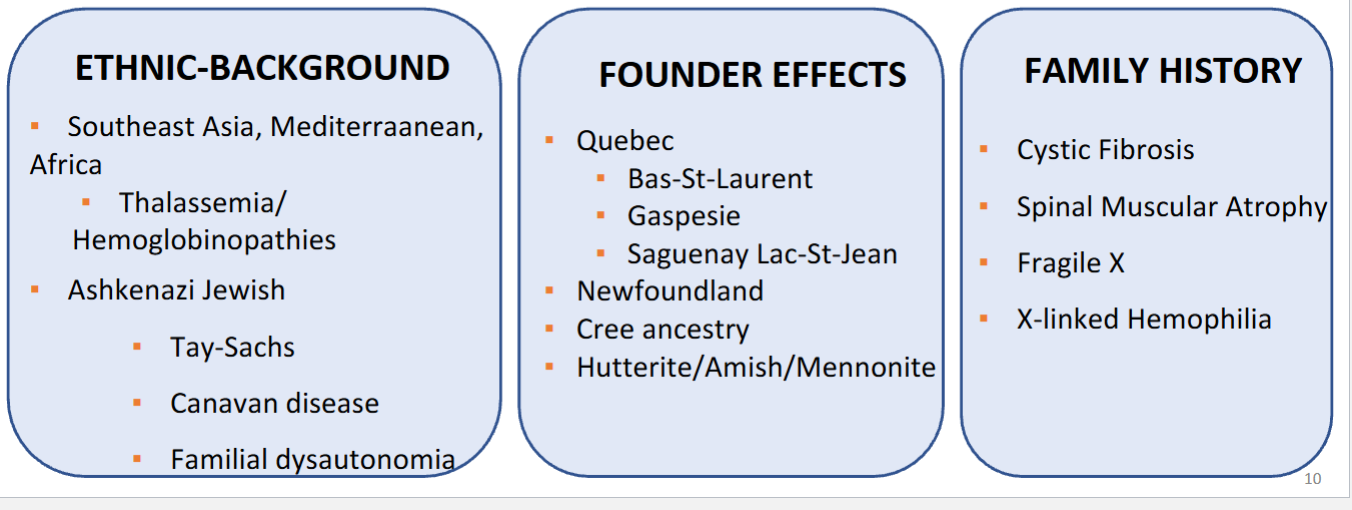
*****Objective 4: Canadian targeted carrier screening guidelines
ETHNIC BACKGROUND: What ethnicities are tested + What diseases are associated
FOUNDER EFFECT: What groups of people are tested + what diseases are associated
FAMILY HISTORY: What Diseases are tested?
*******Objective 4: What is expanded Carrier screening
how does it differ from traditional targeted screening?
non-targeted (universal) → gradually replacing ethnic based screening in the US
a single test screens individuals for dozens or hundreds of genetic conditions SIMULTANEOUSLY
DOES NOT take into account: Ethnicity, Frequency or Family history (the same bag of tests is given to everyone
majority of outcomes = nothing is detected
*****Objective 4: Compare Trad vs. Expanded carrier screening in terms of:
Approach
Cost
Professional practice recommendations
Standard of care
Note: Society of Obstetricians and Gynaecologists of Canada (SOGC) and the Canadian College of Medical Geneticists (CCMG) issue joint guidance regarding reproductive genetic carrier screening in Canada

*****Objective 4: what is one BENEFIT EXPANDED carrier screening has over traditional targeted?
Based on Frequency of the carrier state, Some things can be Missed in trad. targeted screening
eg. Asian = carrier for disease more common for europeans
*****Objective 4: What is some dangers/disadvantages/CONSIDERATIONS (3) with Expanded carrier screening?
Increased ANXIETY: We detect something different about your gene but we DONT KNOW WHAT IT MEANS
Counselling is limited for RARE or MILD/VARIABLE phenotypes (aka. we found something but we don’t know what it means)
Social implications: Equity and affordability (need to PAY for expanded) + Eugenics (designer baby)
If detect something is wrong partner may need testing (do we need to pay? moving over to public? Jump the line?)

***What are the steps/process to getting an EXTENDED carrier screen in CANADA?
PRIVATE PAY = jumps the queue into public health care

****What is DTC(direct to customer) testing?
What step does it cut out entirely aka. how is it different than carrier screening
Cut out the physician entirely. The test is ordered by the customer directly eg. 23 + me
at least for expanded carrier screening it is ordered by the physician
*****What is the key finding of KAISER PERMANENTE study in regards to genetic testing?
Growing burden on healthcare systems caused by direct-to-consumer genetic health risks (DTC-health risk)
High Patient Volume: Physicians often get presented with patients who got genetic testing from a DTC
The "Counseling" Bottleneck: Because direct-to-consumer platforms intentionally bypass the traditional physician-mediated or pre-test genetic counseling models, patients frequently look to their primary care doctors to interpret raw data or vague risk factors
Knowledge Gaps: The study underlined a major discrepancy—while patients expect clear medical direction from their doctors regarding these kits, many primary care providers and medical specialists require further education, resources, and institutional training to accurately assess the clinical utility and legitimacy of various commercial testing companies
23+me is it FDA approved?
was it always FDA approved
Currently 23+me is the only DNA approved company
Initially testing was not FDA approved
23+me and many other companies were forced to stop. Found multiple instances of conflicting results between/with companies

40% of DTC results are false positives: What did an AMBRY GENETICS study want to look at when comparing DTC with med lab tests (2 goals/ comparisons)
Clinically audit direct-to-consumer (DTC) raw genetic data to see if commercial findings are medically accurate and reliable.
Evaluate Concordance (Agreement): The researchers wanted to see if the dangerous genetic mutations flagged in a consumer's DTC raw data would actually show up when re-tested in a high-complexity, traditional clinical medical laboratory.
Investigate Variant Classification: They wanted to find out if third-party interpretation tools (like the ones from your previous slide) and DTC companies classify mutations the same way clinical geneticists do (e.g., whether something a consumer app calls a "high cancer risk" is actually considered completely harmless by medical standards
*****From the Ambry study results How do DTC genetic tests compare against traditional med. lab tests?
Test lab QUALITY if very high (the same standard as a trad. med lab test)
BUT…
Scope of Coverage = Extremely limited.
For example, a DTC BRCA test may only look for 3 specific mutations common in Ashkenazi Jewish populations.
Accuracy & Validation = Variable.
Analytical accuracy is high for the tested markers, but raw data has a notoriously high false-positive rate (up to 40% in some validation studies).
Variant classification: Classification of a gene as benign or pathogenic etc. does not follow the same standard
eg. DTC report may label it as increased risk but AMBRY classifies it as benign (deep intronic = more likely benign)
Result Interpretation = There is no interpretation by the company, generally generated reports from data
majority of test results are given by a doctor
only some of the time are DTC report or raw data is provided
and sometimes 3rd party interpretation service reports are given