AQA A-Level Biology Topic 1: Biological Molecules
 Call Kai
 Learn
 Practice Test
 Spaced Repetition
 Match
 Flashcards
 Knowt Play
1/93

There's no tags or description
Looks like no tags are added yet.
94 Terms
What are monomers?
Monomers are *small units* which are the components of larger molecules.
What are polymers?
Polymers are molecules made from *many monomers* joined together.
What are examples of monomers?
*Monosaccharides, amino acids* and *nucleotides*
What are examples of polymers?
*Polysaccharides, polypeptides* and *polynucleotides*
What reaction allows two monomers to bond together?
A *condensation reaction* allows *two monomers* to be joined together by a chemical bond, *releasing a water molecule*.
What reaction breaks the chemical bond between two molecules?
A *hydrolysis reaction* allows the chemical bond to break between two molecules and this happens due to the *addition of water*.
What are carbohydrates?
Carbohydrates are molecules which consist only of *carbon, hydrogen and oxygen*.
What is the small unit that makes up a carbohydrate.
Monosaccharides
What is formed when two monosaccharides go through condensation reaction?
A *disaccharide* is formed.
What is the special bond that is formed during the condensation reaction between two monosaccharides?
A *glycosidic bond*
What is formed when many monosaccharides go through condensation reaction?
A *polysaccharide* is formed.
What are examples of monosaccharides?
- *Glucose* (*α-glucose* and *β glucose*)
- *Galactose*
- *Fructose*

What is the structure of both α-glucose and β glucose?
They both have *6 carbon atoms*, α-glucose has its OH group attached at the *bottom right* and β glucose has its OH group attached at the *top right*.

Which disaccharide is formed when two α-glucose molecules join together?
Maltose

Which disaccharide is formed when a glucose molecule and fructose join together?
Sucrose

Which disaccharide is formed when a glucose molecule and galactose join together?
Lactose
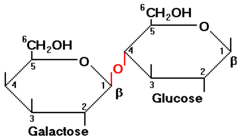
What are the three polysaccharides that are formed from glucose monomers?
- *Glycogen* (formed by the condensation of α-glucose)
- *Starch* (formed by the condensation of α-glucose)
- *Cellulose* (formed by the condensation of β glucose)
What is starch?
Starch is what plants *store as excess glucose*. When plants require glucose for respiration and energy, starch is broken down into glucose.
What mixture does starch consist of?
*Amylose* and *Amylopectin*
Describe the structure of starch?
Amylose is a *long, unbranched chain of α-glucose* molecules. Due to its specific glycosidic bonding, its shape becomes *coiled*, which makes it very *compact*.
Amylopectin is a *long, branched chain of α-glucose* molecules. It has got many *side branches* on it.
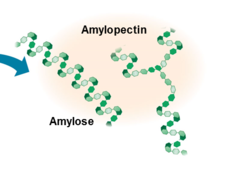
Explain the relationship between the structure and function in starch.
The coiled and compact shape of amylose allows a *lot of energy to be stored*, therefore making it good for energy storage.
The side branches on amylopectin allow *enzymes to break down* the molecule and make it *easier to break the glycosidic bond*. This means that energy can be *released quicker* for important functions like *respiration*.
Starch is also *insoluble* and therefore *do not affect the water potential*, so water cannot enter cells by osmosis.
What is the test for starch?
*Add the test sample to iodine solution* (potassium iodide solution).
If the solution turns from *brown/orange to blue/black*, then *starch is present*.
What is glycogen?
Glycogen is the *main energy storage* in animals and it stores excess glucose to be used later on, such as respiration.
Describe the structure of glycogen.
Glycogen has a *large number of side branches*, similar to amylopectin's structure.
Explain the relationship between the structure and function in glycogen.
The side branches in glycogen allow it to be *broken down much quicker* by enzymes, meaning that energy can be *released quickly* as well.
Also, since it is highly branched, a *high amount of energy is released*. The energy released can be used for important processes such as respiration.
Glycogen is also *insoluble* and therefore *do not affect the water potential*, so water cannot enter cells by osmosis.
What is cellulose?
Cellulose is the main component found in cell walls to *help provide structural support.*

Describe the structure of cellulose.
Cellulose is a *long, straight, unbranched chains of β glucose* molecules. Each chain is linked together by *hydrogen bonds* to form *strong cross links* and *strong fibres known as microfibrils*.
Explain the relationship between the structure and function of cellulose.
The microfibrils *help provide structural support for the cell wall*, meaning that it can help the cell wall to not burst. when water tries to enter in.
*The strength of the cell wall is contributed by the many hydrogen bonds* that are between the cellulose chains, making cellulose a *strengthening material* for plants .
What is the test for reducing sugars?
- Add test sample to *Benedict's Reagent*.
- *Heat* it gently
- If solution turns *brick red*, then a *reducing sugar is present*.
- If the solution stays blue, then no reducing sugar is present.
What is the test for non-reducing sugars?
After the test for reducing sugars, you should:
- *Add dilute hydrochloric acid* to the test sample (*hydrolyse* the polysaccharides/disaccharides into its constituent monosaccharides)
- Then add *sodium hydrogencarbonate* to *neutralise* the acid. (Benedict's reagent does not work in acidic conditions)
- Add the sample to *Benedict's reagent* and then *heat* the sample.
-If the solution turns *brick red* then a *non-reducing sure is present*. If the solution stays blue then there isn't a non-reducing or reducing sugar present.
What are lipids?
Lipids are biological molecules that are composed of *carbon, hydrogen and oxygen* and they are only *soluble in organic solvents (such as alcohols)* and *insoluble in water*.
What are the two types of lipids called?
*Triglycerides* and *Phospholipids*
How are triglycerides formed?
Triglycerides are formed by the *condensation reaction* of *one glycerol* molecule and *three fatty acid chains*.
What is the bond formed between the glycerol molecule and each fatty acid chain?
*Ester bond*
What are the two types of fatty acids called?
*Saturated fatty acids* and *Unsaturated fatty acid*
What is the difference between saturated and unsaturated fatty acid chains?
Saturated fats *do not have double bonds* between their carbon atoms.
Unsaturated fats *do have double bonds* between carbon atoms.
What does the double bonds cause the fatty acid chain to do?
It causes the fatty acid chain to *kink/bend*, causing the chain to *not be able to pack together tightly* and therefore are *liquids in room temperature (oils)*.
How does triglyceride's structure relate to their properties?
- Triglycerides have a *high ratio of energy storing carbon-hydrogen bonds to carbon atoms* and therefore and *excellent source of energy*.
- Triglycerides has a *low mass to energy ratio*, meaning that they are a *good storage molecules*.
- Triglycerides *insolubility (due to being large and non-polar)* in water means that their storage *does not affect the water poteintial* of cells.
How does the structure of a phospholipid molecule look like?
In phospholipids, one of the fatty acid chains is *replaced by a phophate group/phosphate head*.
Fill in the gap: The phosphate group is _______________ to water and therefore is ______________________.
The phosphate group is *attracted* to water and therefore is *hydrophilic*.
Fill in the gap: The fatty acid chains _______________ water and therefore are ________________.
The fatty acid chains *repels* water and therefore are *hydrophilic*.
How does phosholipid's structure relate to their properties?
- Since phospholipids have a hydrophilic and hydrophobic side, the molecule is *polar* meaning that when placed in water, they form a *bilayer*. The hydrophilic head to hold at the surface of the cell membrane.
- This phospholipid bilayer is what forms the *cell membranes*, which *controls what enters and leaves the cell*.
- The *centre of the bilayer is hydrophobic*, meaning water soluble substances *cannot enter easily*.
What is the test for lipids?
The test for lipids is known as the *emulsion test*.
The steps are:
- Add test sample with *ethanol* in a test tube.
- *Shake it* thoroughly
- *Pour* the solution in *water*
- If there is a *cloudy white/milky colour* then this indicates that a *lipid is present*
What are proteins?
Proteins are biological molecules that are composed of *carbon, hydrogen, oxygen and nitrogen* and they come in all shapes and sizes.
What are the monomers of proteins?
The monomers of protein are *aminio acids*.
What do you form when two amino acids join together?
A condensation reaction takes place forming a *dipeptide*.
What do you form when more than two amino acids join together?
A condensation reaction takes place forming a *polypeptide*.
Describe the structure of an amino acid.
- *Amine Group (H2N)*
- *Carboxyl Group (COOH)*
- A *variable* carbon-containing group *(R)*
- A hydrogen (H)
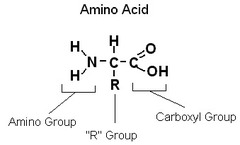
How many different amino acids can you get?
There are *20 different amino acids*,each determined by their different R groups.
What bond is formed during a condensation reaction of amino acids?
A *peptide bond* is formed between the amino acids.

What are the 4 structures that proteins are called and explain them?
They are called:
-*Primary structure*: The sequence of amino acids that makes up the polypeptides of a protein
-*Secondary structure*: The way in which the chain of amino acids of the polypeptides of a protein is folded. *Hydrogen bonds* form between the amino acids, to form 3D shapes like an *alpha helix or beta pleated sheet*.
-*Tertiary structure*: the folding of a whole polypeptide chain in a precise way, as determined by the amino acids of which it is composed. *Hydrogen bonds, ionic bonds and disulfide bridges are formed*.
-*Quaternary structure*:*More than one polypeptide chains* linked together and held by bonds.
In the tertiary structure, why does the ionic bonds and disulfide bridges from?
Ionic bonds form due the *attraction between negative and positive charges* on different parts of the molecule. These can *easily be broken by pH changes*.
Disulfide bridges from when *interaction between the amino acid cysteine* occur. These are usually *strong and not easily broken*.
What determines the function of a protein?
The *shape* of the protein.
Describe the test for proteins?
The test for proteins is known as the *biuret test*
The steps are:
- *Add the test sample* to a test tube.
- Then add *sodium hydroxide solution*.
- Then add *copper(II) sulfate solution*.
- If the solution turns from *blue to purple*, then it indicates that *protein is present*
What is an enzyme?
*Enzymes are biological catalysts* that *increase the rate of reaction* by *lowering the activation energy* of the reaction they catalyse.
Which protein structure does enzymes have?
Enzymes have a *tertiary structure*, which is why enzymes are *highly specific*.
What reactions do enzymes catalyse?
*Metabolic reactions* (*intracellular* and *extracellular*)
What is the active site on an enzymes?
The *active site*, which has a specific shape, is the part of an enzymes where the *substrate* molecules bind to.
What is formed when a substrate fits into an enzyme's active site?
An *enzyme-substrate complex*
Explain the induced-fit model.
The induced fit model proposes that when an enzyme and a substrate interacts with each other, *a change is induced in the shape of the active site*, moulding around the substrate molecule.
The change in shape of the active site *puts pressure/strain/stress* on certain bonds in the substrate, *lowering the activation energy* required to break the bond.
How are the properties of enzymes relate to their tertiary structure?
Their tertiary structure allows enzymes to be *highly specific*, meaning that it will usually catalyse one reaction since their *active site is complementary to a specific substrate*.
Each different enzyme has a *different tertiary structure* and so a different active site.
What are the 6 factors that affect enzyme activity?
- *Temperature*
- *pH*
- *Enzyme concentration*
- *Substrate concentration*
- *Concentration of competitive inhibitors*
- *Concentration of non-competitive inhibitors*
How does temperature affect the enzyme activity?
Temperature from start to optimum:
- Increases *kinetic energy* of molecules
- Molecules *move more rapidly*
- Increase in *chances of successful collisions*
- Increases chance of *forming enzyme-substrate complex*
- *increase rate of reaction*
Temperature higher than optimum:
- *Bonds* holding the tertiary structure *break*
- *Active site shape is lost*
- Substrate can *no longer be complementary*
- Enzyme-substrate complex *cannot be formed*
- Enzyme *denatured* and *rate of reaction decreases*
How does pH affect the enzyme activity?
- All enzymes have an *optimum pH*.
- When an enzyme has a pH *above or below their optimum temperature*, ions found in the acid or alkali cause *the bonds that hold the tertiary structure to break*.
- Therefore the *active site shape is lost* and *enzyme-substrate complexes can no longer be formed*.
- The enzyme is *denatured*.
How does the substrate concentration affect the enzyme activity?
*Increasing the substrate concentration* means that:
- *more* chance of *successful collisions*
- *more* chance of *forming enzyme-substrate complex*, therefore *increasing rate of reaction*
- this continues until the *maximum rate of reaction* is reached (when all the *active sites are full/occupied*)
How does the enzyme concentration affect the enzyme activity?
*Increasing the enzyme concentration* means that:
- *more* chance of *successful collisions*
- *more* chance of *forming enzyme-substrate complex*, therefore *increasing rate of reaction*
- this continues until the *maximum rate of reaction* is reached (when all the *substrates are used*)
What is a competitive inhibitor?
A substance with a *similar shape* to the substrate and a *complementary shape* to the enzyme's active site.
What is a non-competitive inhibitor?
A substance, *with a different shape* that *binds to another site* on the enzyme other than the active site.
How does the concentration of competitive inhibitors affect the enzyme activity?
A competitive inhibitor binds to the active site, blocking substrates to bind instead, *preventing enzyme-substrate complex* to form, and rate of reaction increases at a lower rate.
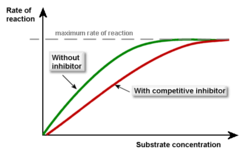
How does the concentration of non-competitive inhibitors affect the enzyme activity?
A non-competitive inhibitor binds to the another site on the enzyme and this *causes the active site's shape* to change, meaning that the substrate is not complementary and less enzyme-substrate complexes are formed, meaning that rate of reaction is at a lower rate.

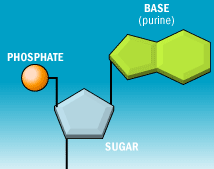
Describe the structure of a nucleotide
Made up of a *pentose sugar, a nitrogen-containing base and a phosphate group*.
How is a polynucleotide formed?
A polynucleotide is formed when two nucleotides join together by a *condensation reaction* between the phosphate group of one nucleotide and the sugar of another.
The chain of phosphates and sugars is known as the *sugar-phosphate backbone*.

What is the bond formed between two nucleotides?
A *phosphodiester bond*.
What is DNA?
DNA (Deoxyribonucleic acid) is a molecule found in all organisms. It *holds all the genetic information*.
What is the structure of each DNA nucleotide?
Each DNA nucleotide consists of a *deoxyribose sugar*, an *organic base* and a *phosphate group*.
What is the structure of a DNA molecule.
A DNA molecule is twisted into a *double helix* composed of *two separate strands* of polynucleotides joined together by a *hydrogen bonds between complementary bases*.

What are the 4 possible bases that can be found in a DNA molecule and which bases are complementary to each other.
The possible bases are *adenine, guanine, cytosine and thymine*.
*Adenine pairs with thymine* and *guanine pairs with cytosine*.through complementary base pairing.
How does the structure of the DNA lead to their properties?
The *double stranded* feature helps DNA to become *more stable* and act as template in semi-conservative replication.
The *coiled feature* helps the DNA to be *more compact*.
The complementary base pairing ensures semi-conservative replication to occur as the *hydrogen bonds* between the bases are *weak* and can *easily be broken* during semi-conservative replication.
Describe the process of DNA replication.
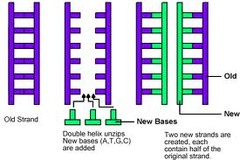
DNA replication occurs in interphase by *semi-conservative replication*.
*DNA helicase* is used *separate strands and break the hydrogen bonds* between both strands.
Both strands act as *template* and *free complementary nucleotides bind to the exposed bases* of the template strands.
Complementary base pairing betwen adenine and thymine and guanine and cytosine.
*DNA polymerase* joins nucleotides and the *hydrogen bonds reform*.
Semi-conservative replication is finally done with new DNA molecules *containing one old strand (template strand) and one new strand*
What is RNA?
RNA (Ribonucleic acid) is a molecule found in all organisms. It *transfers genetic information from the DNA to the ribosomes*.
There are two types of RNA and they are called mRNA (messenger RNA) and tRNA (transfer RNA).
What is the structure of each RNA nucleotide?
Each RNA nucleotide consists of a *ribose sugar*, an *organic base* and a *phosphate group*.
What is the structure of a RNA molecule.
An RNA molecule is relatively short and it is single stranded.
What are the 4 possible bases that can be found in a RNA molecule and which bases are complementary to each other.
The possible bases are *adenine, guanine, cytosine and uracil*.
*Adenine pairs with uracil* and *guanine pairs with cytosine*.through complementary base pairing.
What is ATP?
ATP (Adenosine triphosphate) is an *energy carrier molecule* that *delivers energy* for life processes.
What is the structure of ATP?
ATP is made from *1 adenine base, 3 phosphates and a ribsose sugar*.

How does ATP help release energy?
ATP get *broken down* into *ADP (Adenosine Diphosphate) and Pi (Inorganic phosphate ion)* in a *hydrolysis reaction using ATP hydrolase*, meaning energy is *released* from the bonds.
How does ATP reformed?
ATP get *reformed* when *ADP (Adenosine Diphosphate) and Pi (Inorganic phosphate ion)* join together during a *condensation reaction using ATP synthase*, meaning energy is *carried and stored* in its bonds.
What makes ATP a good deliverer of energy?
ATP is an *immediate source* and only need to *break one weak bond*. It is also a *manageable source* as it *releases samll amount of energy*
What are the different uses of ATP in organisms?
- *protein synthesis*
- *organelle synthesis*
- *DNA replication*
- *cell division (mitosis)*
- *active transport*
- *metabolic reactions*
- *movement*
- *maintaining body temperature*
- To *add inorganic phosphate* to other substances and make them *more reactive* and change their shape. This is known as *phosphorylation*.
Describe the structure of a water molecule?
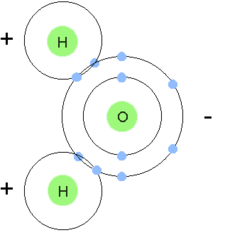
A water molecule is made up of *two atoms of hydrogen and one of oxygen*
Water molecules are *dipolar* since hydrogen has a slightly positive side and the oxygen has a slightly negative side. Therefore water molecules can form *hydrogen bonds* with each other.
State the properties of water?
- Water is an important metabolite that is used in many important metabolic reactions, including condensation and hydrolysis.
- Water has a high specific heat capacity as water takes a lot of heat energy to heat it up due to the presence of the hydrogen bonds. This allows water to buffer changes in temperature.
- Water has a large latent heat of vaporisation as it takes a lot of energy to break the hydrogen bonds between water molecules, allowing water to evaporate.
- Water has a strong cohesion and high surface tension due to their polarity, which helps water molecules to stick together.
- Water is also a place where solutes can be separated out and dissolved based on their charge. This is due to the polarity of water.
What is the importance of water in living organisms?
The high specific heat capacity allows certain habitats to not be affected. For example, when water freezes it becomes ice, which is less dense than liquid, so it floats on the surface insulating the water beneath it, prevent it from freezing and providing a habitat for the organisms
The ability to dissolve solutes is very useful in important processes like diffusion and active transport.
The high latent of heat vaporisation allows organism to cool down and this happens when humans sweat. We cool down when the sweat evaporates.
The high cohesion between water molecules is very useful when water is transported in plants (thorugh the xylem) and transport in other organisms.
What are inorganic ions?
Inorganic ions occur in solution in the cytoplasm and body fluids of organisms, some in high concentrations and others in very low concentrations.
What are the examples of inorganic ions?
- hydrogen ions to determine pH, higher the hydrogen concentration, lower the pH
- iron ions are a component of haemoglobin
- sodium ions are involved co-transport of glucose and amino acids
- phosphate ions are a component of DNA and ATP