Quattrocento Italy (1400-1500)
 Call Kai
 Learn
Learn Practice Test
 Spaced Repetition
 Match
Match Flashcards
 Knowt Play
1/16

There's no tags or description
Looks like no tags are added yet.
Name | Mastery | Learn | Test | Matching | Spaced | Call with Kai | Chat |
|---|
No analytics yet
Send a link to your students to track their progress
17 Terms
Linear Perspective
Linear perspective was developed and systematically used by Italian Renaissance artists during the 1400s. It became one of the defining innovations of Renaissance painting.
definition: A mathematical system used to create the illusion of three-dimensional depth on a flat surface.
Naturalism
Italian artists increasingly wanted figures to look like real human beings rather than flat, symbolic figures from medieval art.
Humanism
Humanism was extremely influential in Renaissance Italy. Artists became increasingly interested in human experience and the capabilities of human beings.
Definition: A Renaissance intellectual movement that emphasized human potential, individual achievement, reason, education, and the study of classical Greek and Roman culture.
Classical Influence
Italian Renaissance artists believed they could learn from the artistic achievements of ancient Greece and Rome. Italy also contained many surviving Roman buildings and sculptures that artists could study.
Definition:
The influence of ancient Greek and Roman art, architecture, literature, and ideas.
Contrapposto
Contrapposto was borrowed from ancient Greek and Roman sculpture and revived during the Quattrocento era.
Definition:
A standing pose where a figure's weight is shifted onto one leg, causing the hips and shoulders to tilt in opposite directions.
Chiaroscuro
Definition:
The use of light and dark to create the appearance of three-dimensional form.
Italian artists increasingly used light and shadow to make figures appear solid and three-dimensional.
Foreshortening
Artists were becoming increasingly interested in representing bodies accurately within three-dimensional space.
Idealized Figures
Artists were influenced by ancient Greek and Roman ideals of beautiful, harmonious human bodies.
Figures that are made to look more perfect, beautiful, or physically harmonious than ordinary people.
Balanced Composition
Renaissance artists increasingly valued order, proportion, harmony, and organization.
Definition:
An arrangement where the visual elements feel stable, organized, and evenly distributed.
Symmetry
When elements on one side of a composition mirror or balance elements on the other side.
Classical Architecture
Columns
Arches
Domes
Pediments
Classical capitals
Symmetrical buildings
Roman-style architecture
Why it relates to Quattrocento:
Italian Renaissance artists deliberately revived classical architecture.
Religious Subject Matter
Annunciation
Nativity
Crucifixion
Madonna and Child
Last Supper
Saints
Biblical stories
Why it relates to Quattrocento:
Religion remained an enormous part of Italian art. Renaissance innovation did not mean artists stopped making religious art.
The important change is that artists increasingly depicted religious stories using naturalistic figures, realistic space, and Renaissance techniques
Look for: Mary, Jesus, angels, saints, biblical scenes, etc.
Secular Subject Matter
Art that is not primarily religious.
Humanism and Renaissance culture encouraged greater interest in people, individuals, society, and worldly subjects.
Narrative Scenes
Renaissance artists used realistic figures, gestures, expressions, architecture, and perspective to make stories feel more believable and understandable.
A scene that tells a story or depicts a specific event.
For example, the Annunciation tells the story of the Angel Gabriel announcing to Mary that she will give birth to Jesus.
Fresco and Tempera
Tempera was a major Italian painting medium during the 1400s, particularly for panel paintings, before oil became increasingly important.
Fresco was extremely important in Italian Renaissance art, especially for churches, chapels, and large narrative cycles.

Sandro Botticelli - The Birth of Venus
contropossto
Classical subject matter instead of christian
Balanced composition - Venus is placed centrally, making her the clear focal point. The surrounding figures frame her and help direct the viewer's attention toward her
Idealized rather than completely realistic figures - This is important because Renaissance artists were interested in studying the human body, but they didn't always aim for photographic realism. Botticelli uses the human body to create an ideal of beauty and grace.
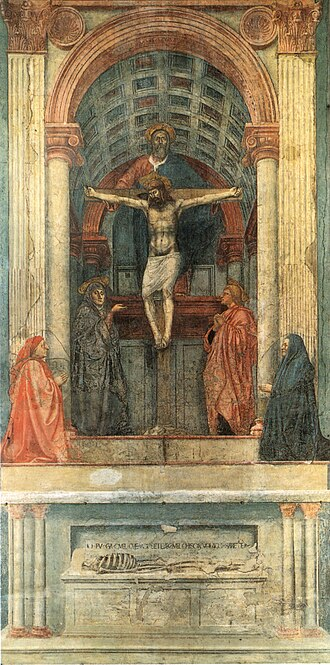
linear perspective
symmetry
Religious subject matter
foreshortening