Genetics test 2
 Call Kai
 Learn
 Practice Test
 Spaced Repetition
 Match
 Flashcards
 Knowt Play
1/126

There's no tags or description
Looks like no tags are added yet.
Name | Mastery | Learn | Test | Matching | Spaced | Call with Kai | Chat |
|---|
No analytics yet
Send a link to your students to track their progress
127 Terms
what are nucleotides composed of
deoxyribose sugar, phostphate group, and nitrogenous base
Where is the phoshodiester bond in nucleotides
between the 5’ phophate and the 3’ hydroxyl on the sugar
What was griffith’s experiment
griffith worked with strpococcus pneumonia, a smooth virulent form and a rough non-virulent form. When injecteing the S cells into rats they died. When injecting R cells into rats they lived. When injecteding heat killled S cells they lived. When he injected heat killed S cells milxed with living R cells the rats died
What was Avery, MacLeod, and McCarty’s experiment
Avery, Macleod, and McCarty’s looked at what substance was being transformed. They added protease (protein destroyed) and the R cells transformed into S cells. They added Rnase(RNA destroyed) and the R cells transformed in to S cells. They added DNase (DNA destroyed) and the R cells was not transformed. They added ultracentrifugation (fats eliminated) and the R cells transformed into S cells.
What did both the Griffith and Avery, MacLeod, and McCarty experimetns look at
Transformation of bacteria
What was the Hershey Chase experiment
Used to figure out the genetic material. Used radioacive P-32 (for DNA) and radioactive S-35 (proteins) to see if protein or DNA was inserted into bacteria by phages. With p-35 (DNA) radioacivity was recovered in host and passed onto phage progeny. With S-35 (protein) radioactivity was recovered in phage ghosts
What did the and Hershey and Chases experiment prove
DNA enetrs cells and carries genetic information
How do bacteria tranfer DNA
Transformation: takes DNA from environment
Transduction: genes transfered directly from bacteria
Conjugation: two cells in contact
What helped find the shape of DNA
Rosalind Franklin’s lap used X-ray to take a photo DNA and showed Helical pattern
Watson and Crick built the double helix model of DNA in 1953
Which experiment confirmed DNA’s replication pattern
The Mesleson-Stahl experiment confirmed the semi - consevatitve replication pattern of DNA
What was done in the Meleson-Stahl experiment
E.Coli was grown for many generations with Nitrogen 15. The colony was moved to a medium with Nitrogen 14 and started to replicate. Daugher DNA had one strand of nitrogen 14 DNA and one strand of nitrogen 15 DNA
What catalyzes phosphodiester bonds
DNA polymerase
What are the two stages of DNA replication
Initation and Elongation
What does DNA polymerases need to begin
Four dNTPs , a single-stranded template, and primer with exposed 3’ hydroxyl
which side of the strand does DNA polymerase add nucleotides to
the 3’ OH of the new strand
What is initation in DNA replication and what is involved
Iniation: proteins open up the double helix and prepare it for complentary bass paring
involved: iniator protein, DNA helicase, Single stranded binding proteins (ssbs), and primase
What does the initiator protein do?
bind to the origin of replication
what does DNA helicase do
unwinds helix
what does SSBPs do
keep the helix open
What does primase do
synthesizes RNA primers
What does topoisomerase do
relieves spercoil casued by helicase unwinding
What is elongation in DNA replication and what is involved
Elongation: proteins connect the correct sequence of nucleotides on newly formed DNA strands
involved: DNA pol III, DNA pol I, DNA ligase, leading and laggind strand
What does DNA pol III do
catalyzes phosphodiester bonds- works off the primase
What is the leading strand
continously synthesised strand (5’→ 3’)
What is the lagging strand
discontinoususly synthesiszed strand (3’ → 5’)
What does DNA pol I do
replaces RNA primer with DNA
What does ligase do in DNA replication
join okazaki fragments togeher to make lagging strand continuous
What are the steps of recombination at the moleclular level
double strand break fromation, resection, strand invasion, formation of double holliday junction , branch migration, and resolution of the holiday junction
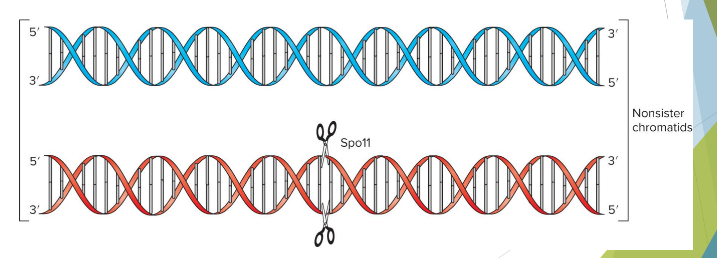
In DNA recombination what happens at double strand break formation
Spo11 breaks phosphodiester bonds of both strands of one chromatid
In DNA recombination what happens at resectioning
5’ end of each broken strand is degrated by exonuclease to create 3’ single stranded tails

In DNA recombination what happens at strand invasion
Dmc1 helps one single strand tail invade a non-sister chomatid and forms stable hertoduplex
Displacement loop (D-loop) from invaded chromatid is stabliized by single strand binding protein

in DNA recombination what happens at the formation of double holliday junction
d-loop and othe 3’ tail form a second heterduplex
DNA synthesis replaces the DNA degerated during formation of the 3’ tails
DNA ligase reseals the DNA backbone

In DNA recombination what happens at Brach migration
heteroduplex region of both DNA molecuels is lengthened

in DNA recombination what happens at the resolution of the Holliday junction
holliday junctions are resolved by resolvase and ligase

How does recombination happen without crossing over
anticrosser heicase disentangles the invading strand from the nonsister chromatid preventing holliday junction formation

what is site specific recombination and what catalyzes it
Site specific recombination promotes breakage and rejoing of DNA molecules at particular sequence. A single protien call recombinase sufficeintly catalyzes all breakage and joining steps
What are the main types of point mutations
substitution, deletion, and insertion
What is the differnt between a transition and trasverstion mutations
transition: changes a purine for a purine or a pyrimidine for another pyrimidine
transversion: chages a purine for a purimidine or pyrimidine for a purine
What is a forward mutation
changes the wild-type allele to a differnt allele
what is a reverse mutation
changes mutant allele back to wild-type
what type of mutations are transfered to progeny
germ line mutations
what are protogrophs
wild type bacteria that can grow on minimum media
what experiment proved mutations are spontaneous and random
the Luria-Delbruck Fluctuation experient
what are auxotrophs
mutant- cannot grow on minimal media without a supplement
why is relica plating used and what is the technique
verifies the bacterial resistance is the result of preexisting mutations and can be used to test the origin of bacterial resistance. Stamps the bacteria from master plate onto new plate

What mutations happens with depurination
hydrolysis of purine bases, bond breaks betwen the purine and the sugar
what mutation happens with deamination
the amino (NH2) group is removed, can chagne C → U or A → G
What mutation is the result of X-rays and Cosmic rays
a break in the sugar-phosphate backbone of DNA, causes deleation of bases
What mutation is the result of ultraviolet light
adjacent thymines form abnormal covalent bonds, thymine dimers
what mutations happens with oxidation
damage of individual bases, G mis-pairs with A
What happens with slipped misparing
trinucleotide repeats happen up to 50 times in a row, children of carrier have an expanded number of repeats
Bases repeated: CGG, CAG, CTG, GCC, GAA
What happens with intercalating agents
insertion between DNA bases cause frameshifts leading to insertion of a random base pair or deletion of base pair
What happens with base analogs
Analogs are chemicaly alike to DNA bases and pair with A and G. Can turen A to T site to G to C site after replication
What is the affect of hydroxylation
addition of a hydroxyl (OH) group , adds OH to C, now C pairs with A instead of G
What are the effects of alkylating agents
addion of ethyl or methyl groups , changes G to pair with T
What is the purpose of the Ames Test and what does it not tell us
detect if a chemical is a mutagen but does not tell us how much DNA damage it cost
In the Ames test what shows if something is a mutage
if a high number of reventants (auxotrops → prototrophs) are present after incubation
What does Base excision repair remove
damaged bases and single strand breaks w
what does nucleotide excision repair do
detects and removes DNA lesions/ distortion, ex: thymine dimers
What does DNA mismatch repair do
detects and repairs base mismatches and short insertions and deletions
What are the repair mechanisms for double strand breaks
Homologous recomombination (only S/G2 phase) and Nonhomolgous end joining
What is an example of a deaminatting agent
nitrous acid (HNO2)
what is an example of a intercalating agent
ethidum bromide, proflavine, acridine orange
what is an example of a base analog
5-bromouracil (5-BU)
What is an example of a hydroxylating/oxidizing agent
hydroxyl radicals (.OH), ROS
what is an example of a alkylating agent
EMS, MMS, nitrogen mustards
What mutagen/DNA damage(s) use base excision repair as a repair mechnanism
Nitrous acid (deamination), Hydroxyl radicals/ROS, and EMS/MMS (alkylation)
what mutagen/DNA damage(s) use nucleotide exsion repair as a repair mechanism
UV light and intercalating agents( ethidum bromide, proflavine)
What mutagen/DNA damage(s) use mismatch repair as a repair mechanism
replicaiton error
what mutagen/DNA damage(s) use HR or NHEJ as a repair mechanism
X-rays/ionizing radiation , double strand breaks
what are complementation test used for
determine if two mutations are on the same genes
what do supplementation test used for
determing the order of genes in a biochemical pathway
What makes up an amino acid
amino group, carboxyl group, r group, and h

where are the amino acids linked by peptide bonds
between the carboxylic groups

what establishes the reading frame
the start codon
what is the start codon and the amino acid it codes for
AUG and Met
what are the stop codons
UAG, UAA, UGA
what is the product of transcription called
the transcript
what is required for transcription initation in prokaryotes
RNA polymerase and promoters
What is the role of RNA polymerase in the initation of transcrtiption in prokayotes
bind to the promoter sequence near the beginning of the of the gene and starts transcription, locally unwinds the double helix
What happens in elongation of transcription
RNA polymerase addes nucleoties in 5’ → 3’ direction, moves downstream the DNA
what happens at termination of transcription
terminators (rna sequences) signal the end of transcription and RNA polymerase falls off of DNA, RNA transcript is released
why is transcription different in eukaryotes
Eukaryotic genes have enhancers that are required for transcription, genes are transcribed by pol II
what is need to make mature mRNA in eukaryotes
5’ G methylated cap, poly- a tail, splicing of inrons
What are the differernt sites were spicing occurs in an intron
splice donor (GU beginning of intron), branch site (A in the middle of intron), and Splice acceptor (AG end of intron)a

what catalyzes slicing
the spliceosome is the machinge that cuts the extra pieces out and stiches pieces together, only assembled for splicing
what is envolved in translation
mRNA, tRNA, and ribosomes
what are the diffent function of the small and large ribosome subunit
small: bind to mRNA
large: has peptidyl transferase activity, catalyzes the formation of peptide bonds
how do tRNAs help with translation
have anticodons that bind to mRNA, brings correct amino acid to codon
what is the wobble position
5’ end of tRNAs anticodon , recognizes more than one codon
What happens in translation initation of prokaryotes
ribosomes bines to Shin-Dalgarno box and AUG, fMet-tRNA position in p-site, large subunit binds
what happens in translation initiation of eukaryotes
small ribosoms subunit binds to methylated 5’ cap, then migratges to the first AUG codon, initator tRNA caries Met
what happens in translation elongation
addition of amino acids to c-terminus of polypeptide, charged tRNAs ushered into A site by proteins called elongation factors
what happens in translation termination
release factors recognize and bind to the stop codons, release of ribosomal subunits, mRNA, and polypeptide
how many reading frames do each double stranded region have
6
what is an open reading frame
an region of DNA with no stop codons so translation can continue
how do mutations in non-coding regions alter gene expression
they have an effect on regulatory sequences
What are the types of loss of funtion mutations and what is the common dominance pattern
amorphic (null) and hypomorphic, these mutations are usually recessive to wildtype
what happens with a amorphic mutation
the gene has no function
what happens with a hypomorphic mutation
there is reduced levels of production of normal progein or it is less efficient