Pharm Chem Topic 8 Short Test
 Call Kai
 Learn
Learn Practice Test
 Spaced Repetition
 Match
Match Flashcards
 Knowt Play
1/5

There's no tags or description
Looks like no tags are added yet.
Name | Mastery | Learn | Test | Matching | Spaced | Call with Kai | Chat |
|---|
No analytics yet
Send a link to your students to track their progress
6 Terms
Write down the names and the formulas of the materials to be investigated today.
caffeine: C₈H₁₀N₄O₂
theobromine: C₇H₈N₄O₂
theophylline: C₇H₈N₄O₂ (same as theobromine)
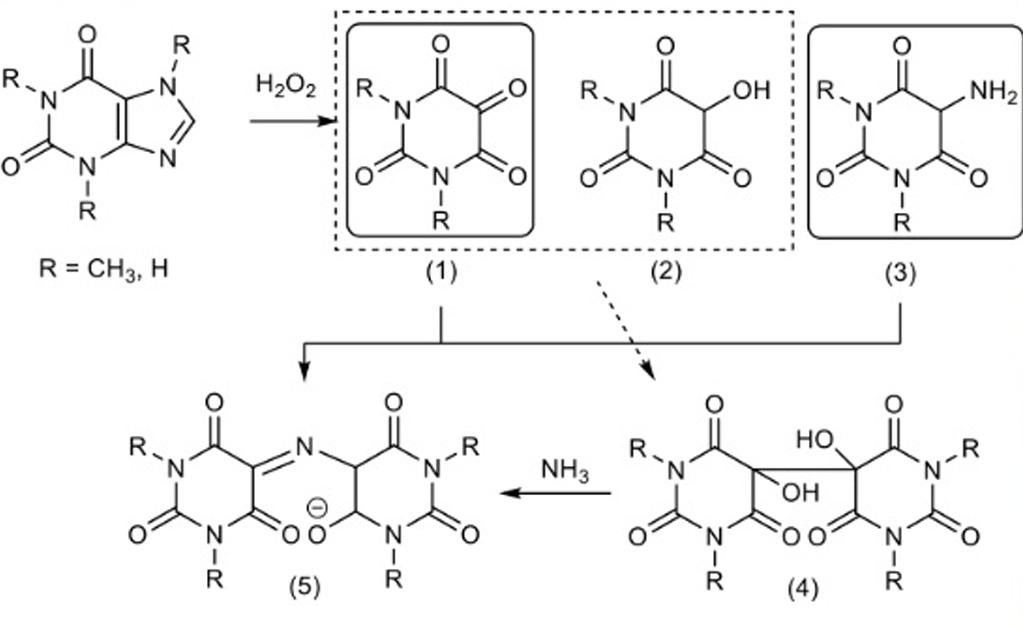
Write down the reaction equation of the Murexide reaction.
How could you differentiate caffeine, theobromine and theophylline with NaOH?
(What should you do and what happens? Color changes?)
Caffeine:
Add sample to a red mixture of water + NaOH + phenolphthalein.
Boil → red colour remains.
Theobromine:
Add sample to a red mixture of water + NaOH + phenolphthalein.
Boil → turns colourless.
Cool → turns red.
Theophylline:
Add sample to a red mixture of water + NaOH + phenolphthalein.
Shake → turns colourless.
Name the xanthine derivatives examined in the lab practice.
Draw the chemical structures too!

How could you identify the xanthine group of the molecules? Write down the process of the identification reaction and the probable observations! (The reaction equation is not needed!)
Alternative:
Which reaction can be used to detect xanthine group? Write down the reaction procedure and the colour changes. What is the name of this reaction?
In a porcelain dish: put sample + hydrogen peroxide (H₂O₂) + HCl.
Evaporate to dryness (on steam bath).
To the solid residue, add aqueous ammonia (NH₃) solution → purple colour.
Name of reaction: Murexide
Write down the process of the titration of theophylline. What kind of indicator should be used and what are the colours before and after the end-point?
Process:
Transfer sample to an Erlenmeyer flask using water.
Add silver nitrate while shaking.
Add bromothymol blue indicator.
Titrate with NaOH.
Before endpoint: yellow
After endpoint: blue