Anatomy Exam 2
 Call Kai
 Learn
 Practice Test
 Spaced Repetition
 Match
 Flashcards
 Knowt Play
1/30

There's no tags or description
Looks like no tags are added yet.
31 Terms
Among these nutrients, which one requires digestion before being absorbed by the digestive system? check all that apply.
triglycerides
glycogen
cellulose
starches
proteins
What kind of molecule are starches?
A plant based carbohydrate - polysaccharide
Is it possible to have diet completely devoid of DNA?
No
Is it possible to have a completely fat free diet?
No
Which organ does the bulk of enzymatic digestion?
Small intestine
What kind of molecule is cholesterol?
None of the above (it is a lipid steroid)
It is possible to have a diet completely devoid of proteins
False
What kind of molecule is sucrose?
Disaccharide
Which type of digestion can be done in the mouth?
Enzymatic and mechanical
What kind of molecule are triglycerides?
A molecule containing fatty acids
Which of the following can be used as a fermentation chamber by animals?
Rumen, cecum, and colon
Why is the SA node, rather than the AV node or Purkinje fibers, the heart's pacemaker?
It is the largest node in the heart
It is directly connected to the brain
Its slow climb is the fastest, so it reaches threshold first and resets the other cells
It is the only tissue with funny channels
Its slow climb is the fastest, so it reaches the threshold first and resets the other cells
What causes the plateau phase of the contractile myocyte action potential?
Na⁺ entering through funny channels balances K⁺ entering
All channels close at once
Ca²⁺ entering through L-type channels balances K⁺ leaving the cell
Gap junctions stop passing ions
Ca2+ entering through L-type channels balances K+ leaving the cell
Which channel opens when a contractile myocyte reaches threshold?
L-type Ca²⁺ channels
Fast voltage-gated Na⁺ channels
Funny channels
T-type Ca²⁺ channels
Fast voltage-gated Na+ channels
How does acetylcholine from the vagus nerve slow the heart?
It blocks gap junctions between myocytes
It opens more funny and Ca²⁺ channels, steepening the slow climb
It raises the resting potential of contractile myocytes to −70 mV
It opens extra K⁺ channels and reduces the funny current, flattening the slow climb
It opens extra K⁺ channels and reduces the funny current, flattening the slow climb

What is 4?
SA node
right bundle branch
AV node
Purkinje fibers
left bundle branch
bundle of His
AV node

What happens to the heart during period 3?
ventricles contracts and send blood to the lungs and other organs
heart is relaxed and atria fill in with blood
atria contracts and the ventricles fill up with blood
Atria contracts and the ventricles fill up with blood
A decrease in heart rate, as seen during sleep and hibernation, is called:
Bradycardia
Tachycardia
Stenosis
Regurgitation
Bradycardia
An increase in heart rate during exercise, fever or stress is called:
Fibrillation
Bradycardia
Tachycardia
AV block
Tachycardia

Where is the right ventricle?
C
The ridges that make the inside of the cardiac chambers uneven are called:
Chordae tendineae
Auricles
Intercalated discs
Trabeculae
Trabeculae

Where is the atrium?
B
Which layer makes up the bulk of the heart and is the source of its contractions?
Visceral pericardium
Myocardium
Endocardium
Fibrous pericardium
Myocardium

Where is the left pulmonary artery?
I
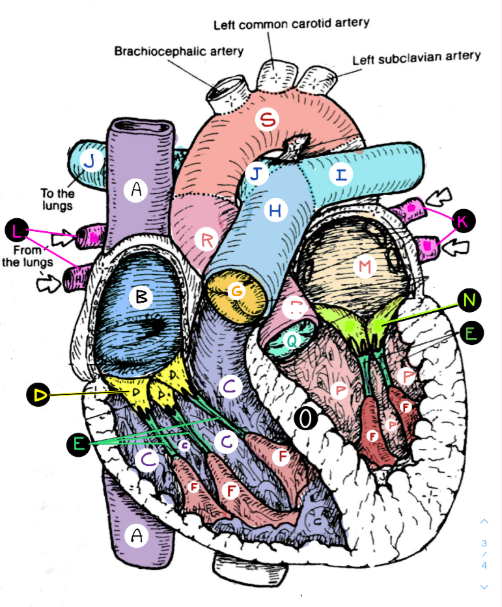
Where are the right pulmonary veins?
L
How many pulmonary veins enter the left atrium?
Four (two left and two right)
During ventricular systole (step 3), which valves are pushed open?
All four valves
The AV valves (tricuspid and mitral)
The semilunar valves (pulmonary and aortic)
No valves; they all close
The semilunar valves (pulmonary and aortic)
Which sequences correctly traces the flow of blood through the heart?
Venae cavae → right atrium → tricuspid valve → right ventricle → pulmonary valve → pulmonary trunk → lungs → pulmonary veins → left atrium → mitral valve → left ventricle → aortic valve → aorta
The main role of the atria is to fill up the ventricles (T or F)
True
When a text says 'systole' or 'diastole' without naming a chamber, which chambers should you assume it refers to?
The ventricles
Both atria and ventricles together
The atria
The auricles
The ventricles