Lecture 1: Membrane Trafficking

0.0(0)
Studied by 0 people
call kaiCall Kai
learnLearn
examPractice Test
spaced repetitionSpaced Repetition
heart puzzleMatch
flashcardsFlashcards
GameKnowt Play
Card Sorting

1/26

encourage image

There's no tags or description

Looks like no tags are added yet.

27 Terms

1
New cards

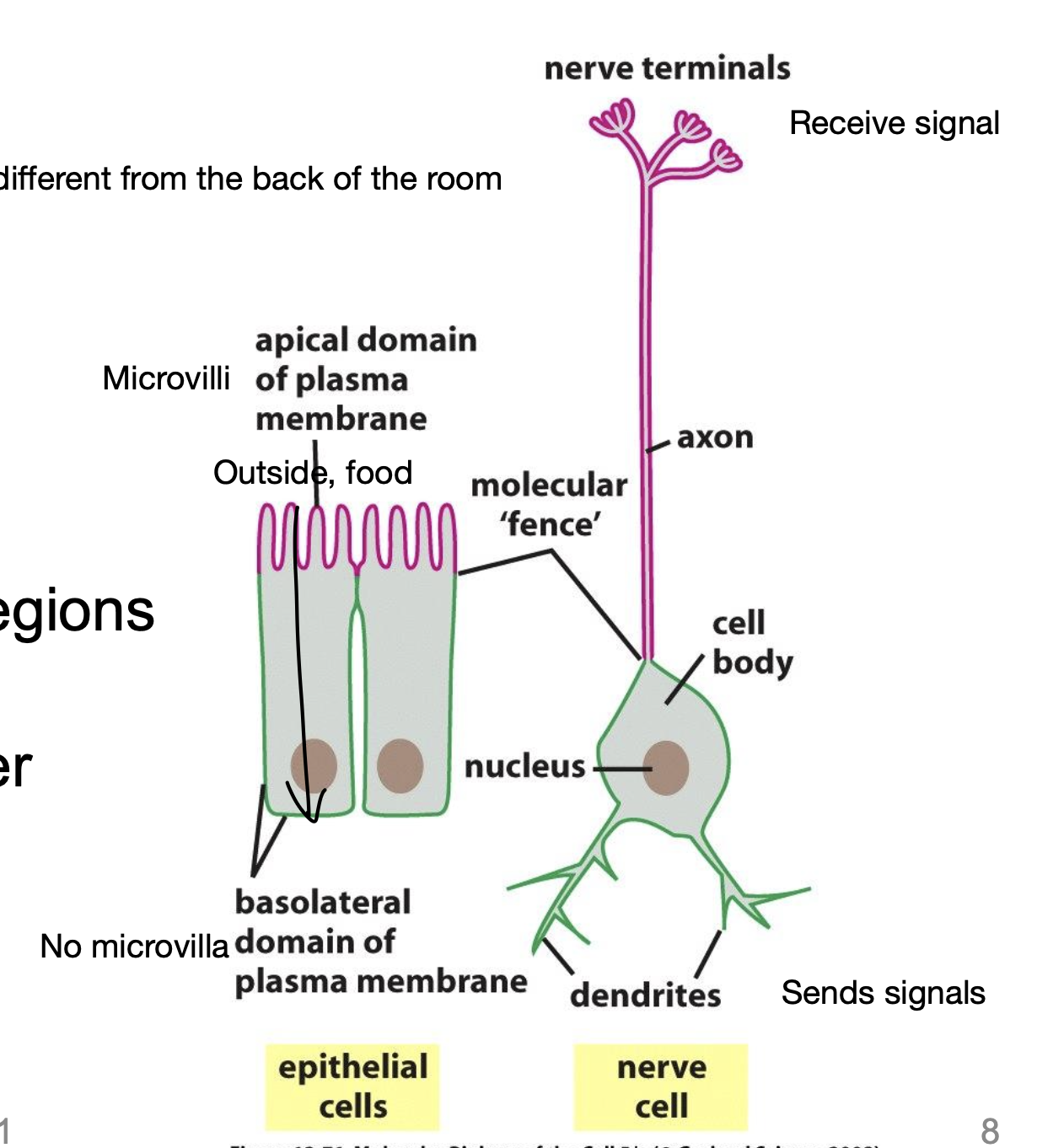
cell polarization is essential for multicellular organisms

  • what does polar mean?

  • What can polarized cells do?


  • • Polar = different at either end

    • • Apical domain

    • • Basolateral domain

    • NOT ALL CELLS have polarization

  • • Polarized cells can:

    • • Have different functions at different cell regions

    • • Define inside vs outside

    • • Transmit signals from one end to the other

<ul><li><p>• Polar = different at either end</p><ul><li><p>• Apical domain</p></li><li><p>• Basolateral domain</p></li><li><p>NOT ALL CELLS have polarization</p></li></ul></li><li><p>• Polarized cells can:</p><ul><li><p>• Have different functions at different cell regions</p></li><li><p>• Define inside vs outside</p></li><li><p>• Transmit signals from one end to the other</p></li></ul></li></ul><p></p>
2
New cards

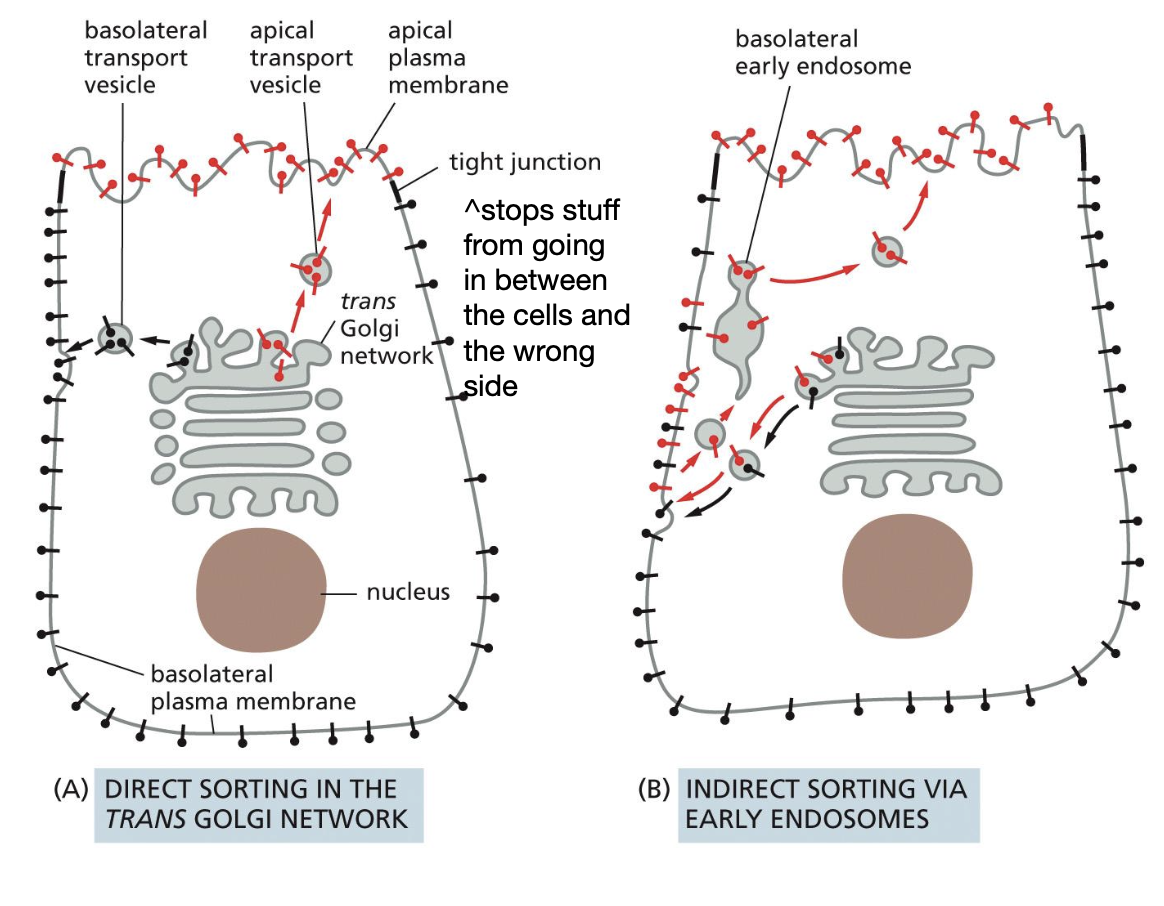
Membrane trafficking can send different proteins to different domains

  • what is membrane trafficking

  • Types of membrane trafficking (two types of methods)


  • membrane trafficking: moving stuff to different membranes (eg. Using Vesicles)

  • Types

    • 1. Exocytosis directly to the target domain (direct sorting = immediately correct location)

    • 2. Exocytosis to any domain then endocytosis followed by recycling (exocytosed again) to the target domain

  • ** the tight junction stops stuff from going to the wrong membrane domains (wrong side)

<ul><li><p>membrane trafficking: moving stuff to different membranes (eg. Using Vesicles)</p></li><li><p>Types</p><ul><li><p>1. Exocytosis directly to the target domain (direct sorting = immediately correct location)</p></li><li><p>2. Exocytosis to <em><u>any domain</u></em> then <em><u>endocytosis</u></em> followed by recycling (exocytosed again) to the target domain</p></li></ul></li><li><p>** the tight junction stops stuff from going to the wrong membrane domains (wrong side)</p></li></ul><p></p>
3
New cards

Membrane trafficking determines where proteins end up

  • three things about sorting routes


  • Some trafficking routes are polarized

    • e.g. TTC, the ends are polarized (start and end point, and the roots are polarized)

  • • Proteins are organized at sorting stations

    • The trans golgi network (sorting the proteins before sending them out)

  • Different routes are balanced by retrieval pathways

    • reverse pathways, the same, but balanced rates
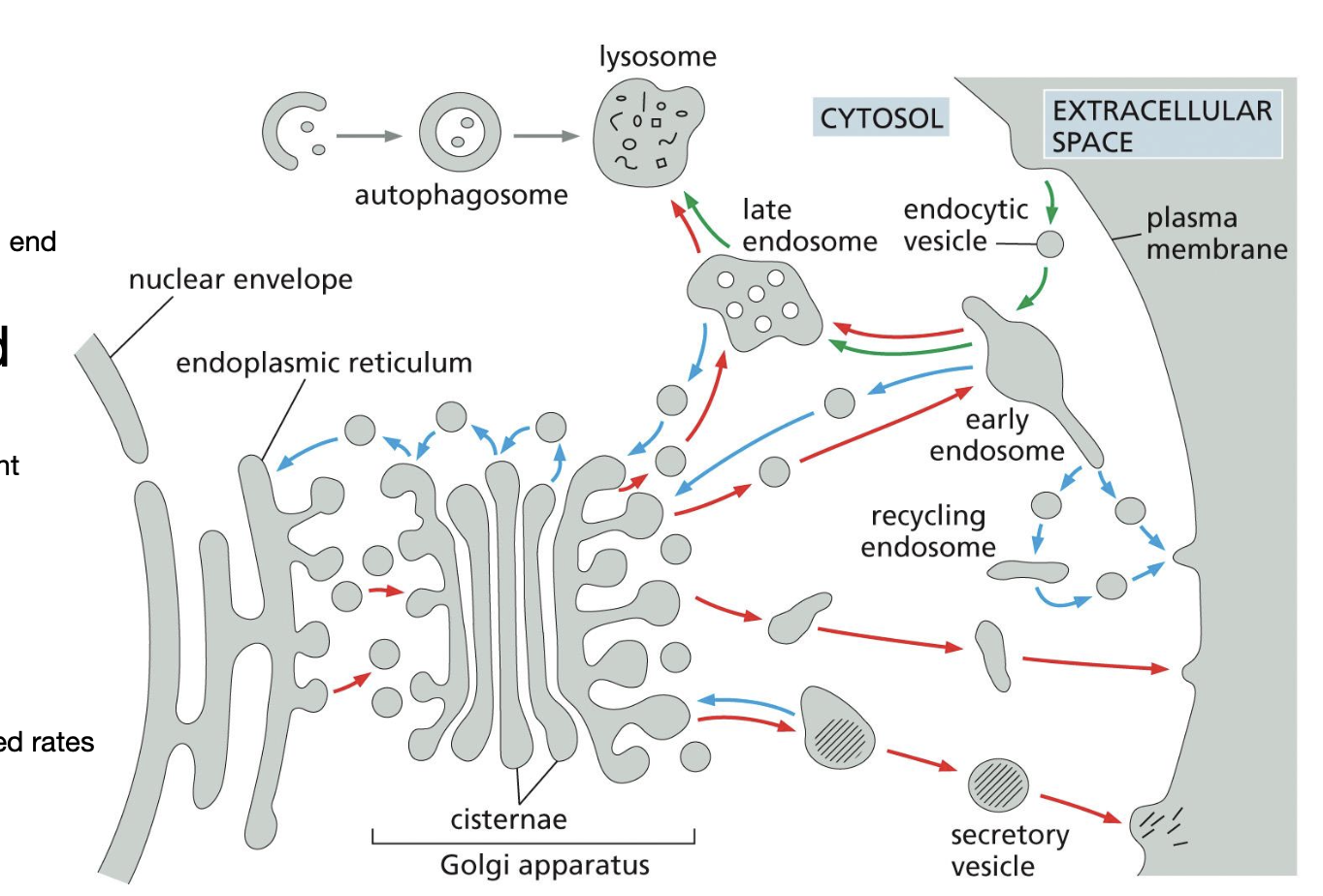

<ul><li><p>Some trafficking routes are <strong>polarized</strong> </p><ul><li><p>e.g. TTC, the ends are polarized (start and end point, and the roots are polarized)</p></li></ul></li><li><p class="p1">• Proteins are organized at <strong>sorting stations </strong></p><ul><li><p class="p1">The trans golgi network (sorting the proteins before sending them out)</p></li></ul></li><li><p class="p1">Different routes are <strong>balanced</strong> by retrieval pathways</p><ul><li><p class="p1">reverse pathways, the same, but balanced rates</p></li></ul></li></ul><p></p>
4
New cards

Type 1: exocytosis


5
New cards

Constitutive secretion

is the ā€œdefault pathwayā€ - found in all eukaryotic cells

  • • Most cargo moves through constitutive secretion

  • • Specific signals do not seem to be required for constitutive secretion


<p>is the ā€œdefault pathwayā€ - found in all eukaryotic cells</p><ul><li><p>• Most cargo moves through c<strong>onstitutive secretion</strong> </p></li><li><p>• <strong>Specific signals do not seem to be required </strong>for constitutive secretion</p></li></ul><p></p>
6
New cards

Regulated secretion

  • releases material in response to signal

    • Regulated secretion vesicles are fully- formed but do not fuse with the plasma membrane until a signal is received

    • e.g. Mast cell releasing stored histamine

  • Gets extra phospholipids (like a boost)


7
New cards

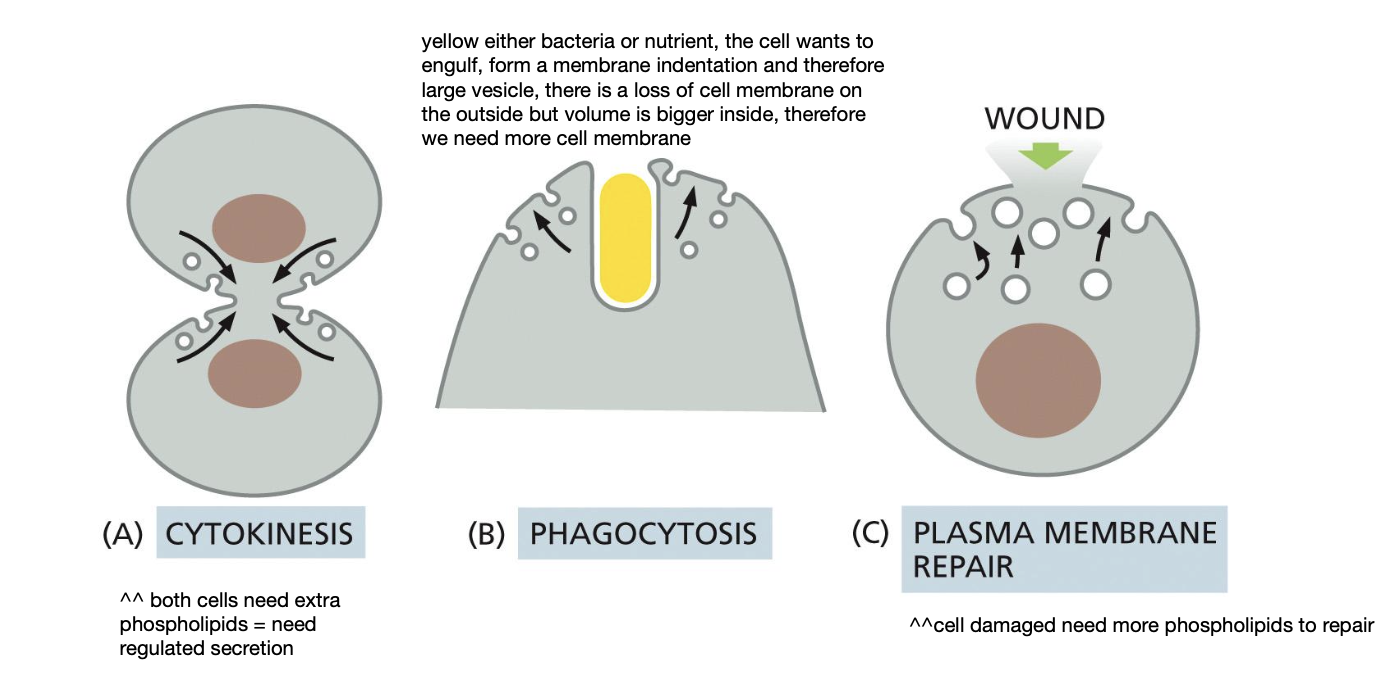
Regulated secretion can deliver extra membrane material

  • three reasons why we need to do this


  • cytokinesis (need more phospholipids)

  • phagocytosis (loss of phospholipids = need more)

    • Why? the decrease in the cell membrane will make the contents inside more squished (reducing surface area but content remains the same)

  • Plasma membrane repair

    • Need phospholipids for repair


<ul><li><p>cytokinesis (need more phospholipids)</p></li><li><p>phagocytosis (loss of phospholipids = need more)</p><ul><li><p>Why? the decrease in the cell membrane will make the contents inside more squished (reducing surface area but content remains the same)</p></li></ul></li><li><p>Plasma membrane repair</p><ul><li><p>Need phospholipids for repair</p></li></ul></li></ul><p></p>
8
New cards

Secretion can release concentrated cargo (both constitutive and regulated)

  • how does this work, and what vesicles does this apply to?


• Clathrin-coated vesicles can return membrane back to the Golgi

• This shrinks the vesicle and makes the cargo more concentrated
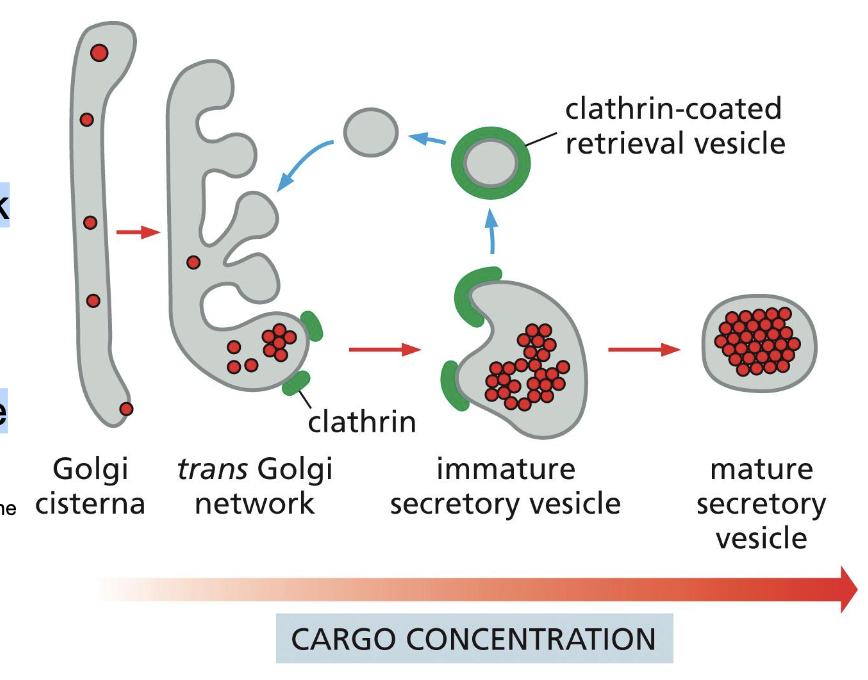
<p><strong>• Clathrin-coated vesicles</strong> can return membrane back to the Golgi </p><p>• This shrinks the vesicle and makes the cargo <strong>more concentrated</strong></p>
9
New cards

type 2: exocytosis, endocytosis, recycling


10
New cards

Endocytosed proteins have 3 options

1. Recycling to the same domain of the plasma membrane

2. Transcytosis to the other domain of the plasma membrane

^^ moving to the other side of the cell

3. Degradation in the lysosome
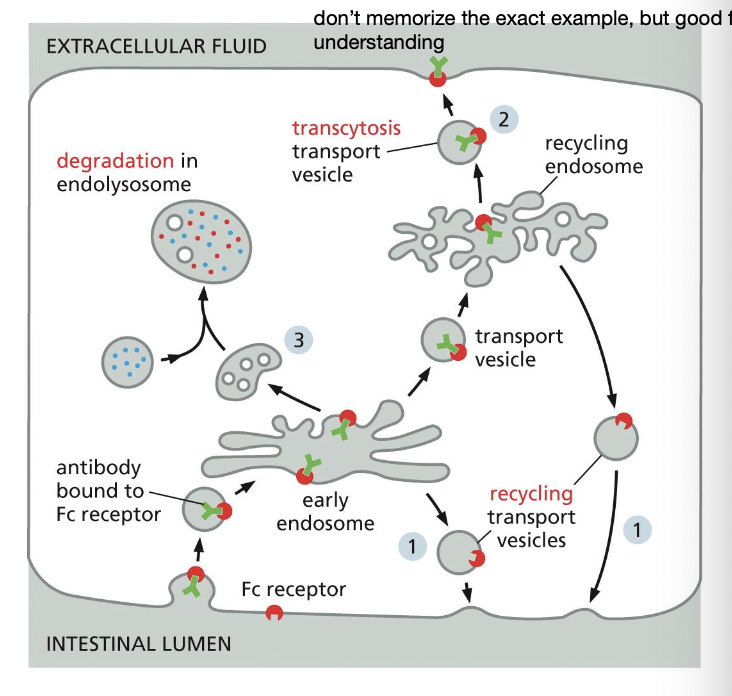
<p>1. <strong>Recycling</strong> to the same domain of the plasma membrane </p><p>2. <strong>Transcytosis</strong> to the other domain of the plasma membrane </p><p> ^^ moving to the other side of the cell </p><p>3. <strong>Degradation</strong> in the lysosome</p>
11
New cards

Cholesterol uptake as an example of endocytosis
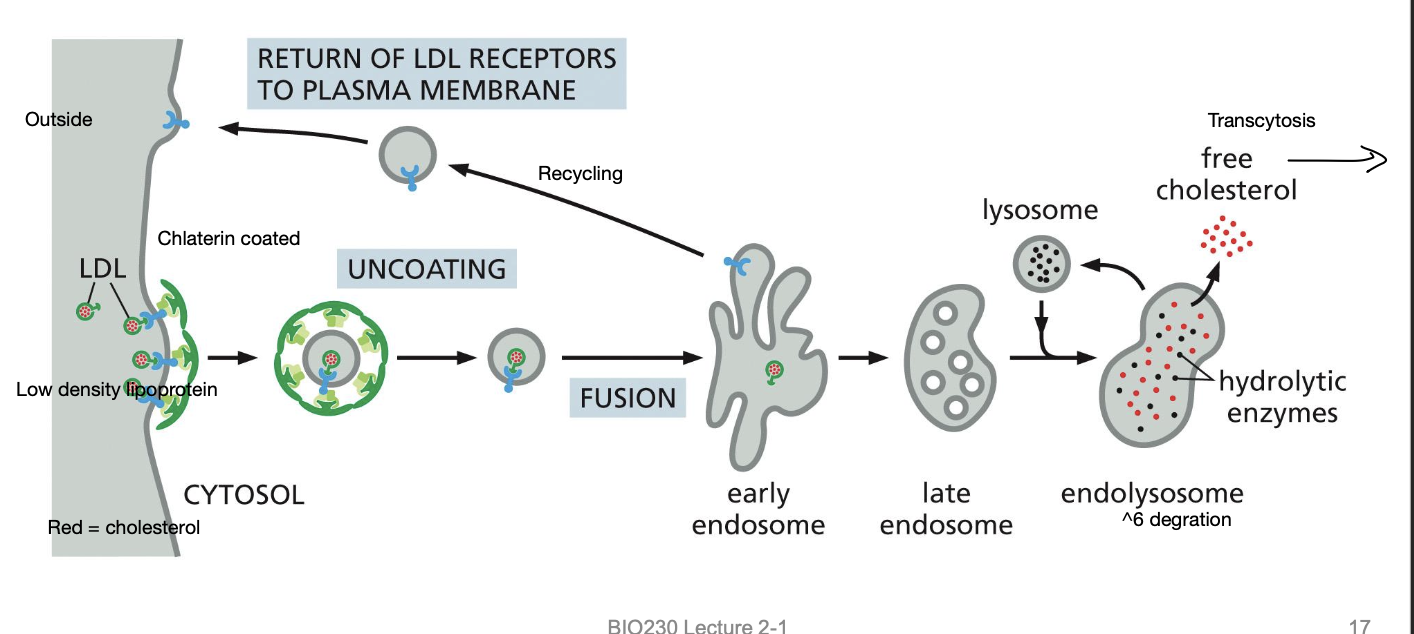
knowt flashcard image
12
New cards

Three types of membrane changes during vesicle trafficking

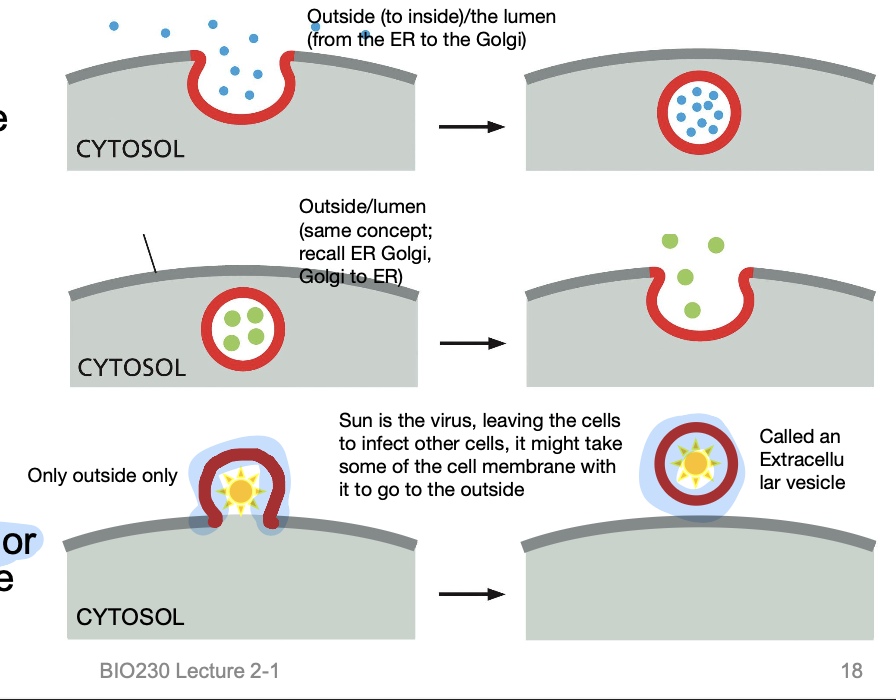
1. Vesicle forms from the donor membrane into the cytoplasm

  • Outside/lumen to inside (e.g. from the ER out to the Golgi)

2. Vesicle fusion: vesicle merges with a target membrane

  • Outside/lumen to inside (e.g. Golgi vesicle to fuse with the ER)

3. Vesicle forms from a donor membrane away from the cytoplasm

  • Only outside only Sun is the virus, leaving the cells to infect other cells, it might take some of the cell membrane with it to go to the outside - the vesicle is then called an Extracellular vesicle

<p>1. Vesicle forms from the donor membrane into the cytoplasm </p><ul><li><p>Outside/lumen to inside (e.g. from the ER out to the Golgi) </p></li></ul><p>2. Vesicle fusion: vesicle merges with a target membrane </p><ul><li><p>Outside/lumen to inside (e.g. Golgi vesicle to fuse with the ER)</p></li></ul><p>3. Vesicle forms from a donor membrane away from the cytoplasm</p><ul><li><p>Only outside only Sun is the virus, leaving the cells to infect other cells, it might take some of the cell membrane with it to go to the outside - the vesicle is then called an <strong>Extracellular vesicle </strong></p></li></ul><p></p>
13
New cards

Vesicles coats are selective of cargo and specifically targeted

  • explain the different coats and where they go (four types)


  • Clathrin: goes from the trans golgi to the endosome to extracellular and back again

  • COPI: goes between golgi and golgi to ER

  • COPII: ER to golgi

  • retromer: only found in the early endosome


<ul><li><p>Clathrin: goes from the trans golgi to the endosome to extracellular and back again</p></li><li><p>COPI: goes between golgi and golgi to ER</p></li><li><p>COPII: ER to golgi</p></li><li><p>retromer: only found in the early endosome</p></li></ul><p></p>
14
New cards

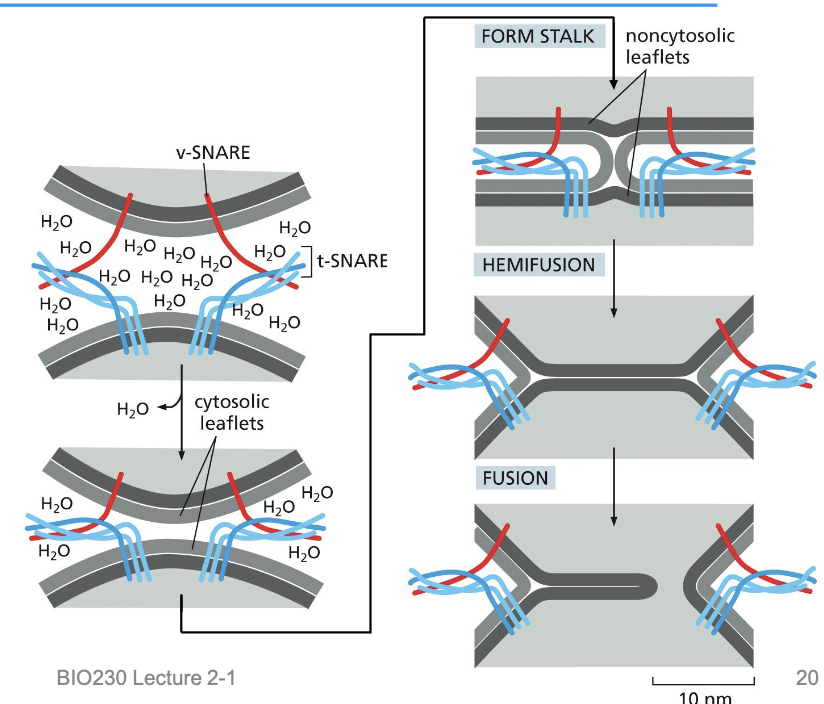
SNARE proteins help to mediate vesicle fusion

• Both t-SNAREs & v- SNAREs are required

• t-SNARES and v-SNARES must be on opposite membranes
<p>• Both t-SNAREs &amp; v- SNAREs are required </p><p>• t-SNARES and v-SNARES must be on opposite membranes</p>
15
New cards

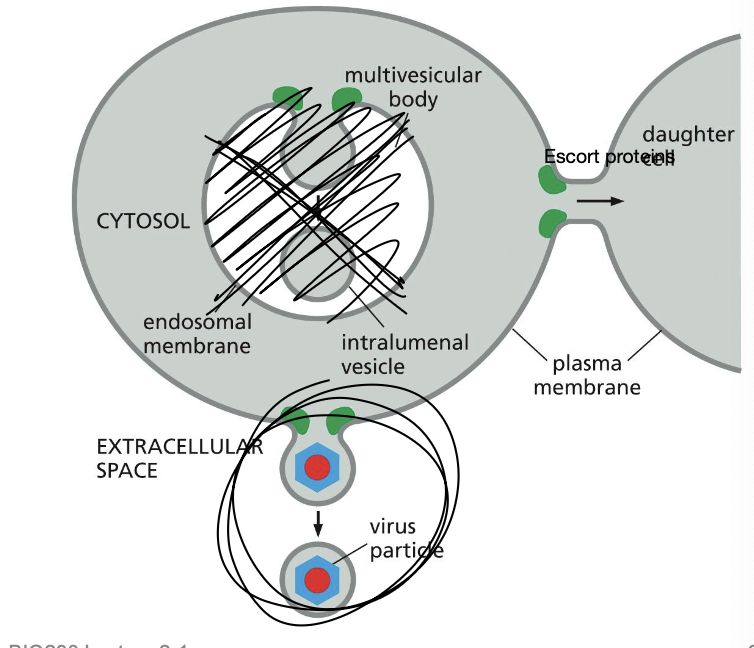
ESCRT proteins can form vesicles away from the cytoplasm

  • • Vesicles can form away from the cytoplasm (into lumen or extracellular space)

  • • Vesicle formation machinery is in the cytoplasm

<ul><li><p>• Vesicles can form away from the cytoplasm (into lumen or extracellular space) </p></li><li><p>• Vesicle formation machinery is in the cytoplasm</p></li></ul><p></p>
16
New cards

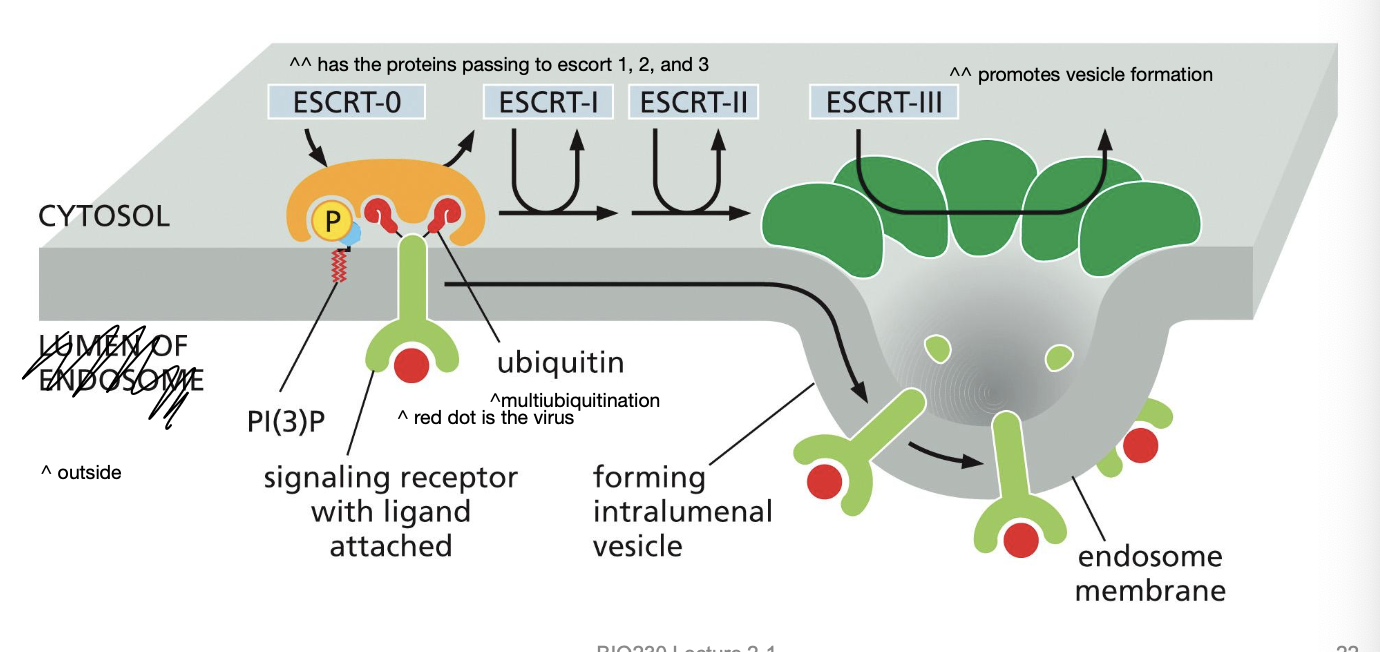
ESCRT proteins can form vesicles away from the cytoplasm

  • 0 binds to multiubuitination with the receptor that is binding to the virus and PI3P

  • Goes and passes through 1, 2, and 3 to finally inside the vesicle

<ul><li><p>0 binds to multiubuitination with the receptor that is binding to the virus and PI3P</p></li><li><p>Goes and passes through 1, 2, and 3 to finally inside the vesicle </p></li></ul><p></p>
17
New cards

Phosphoinositides ā€œlabelā€ different membrane domains

  • • Different membrane domains and compartments contain different lipids

  • • Different types of phosphoinositides (PIPs) are found at different subcellular locations


18
New cards

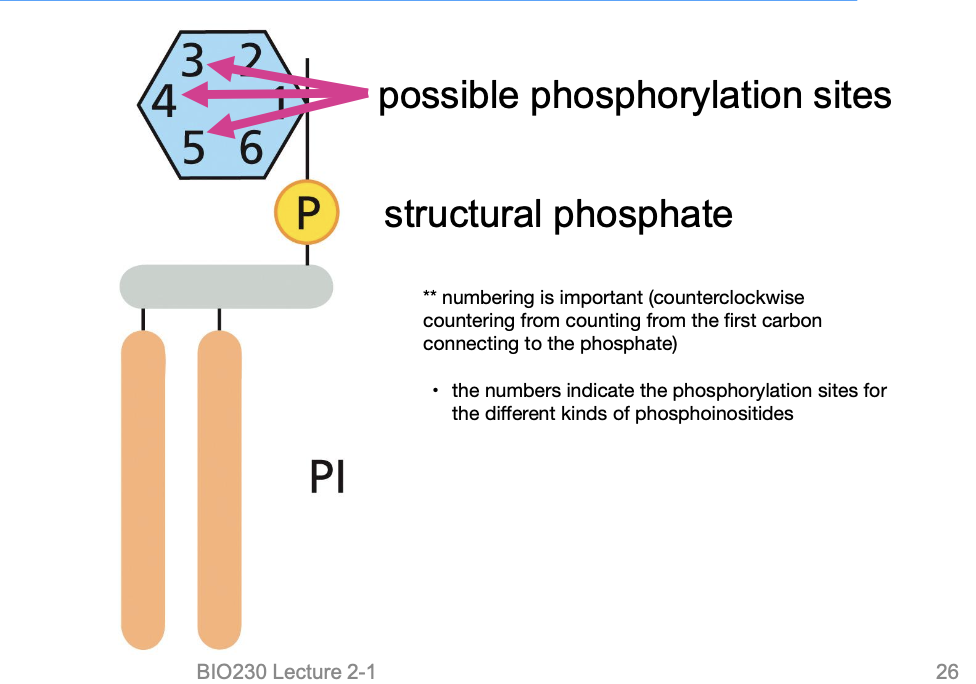
All phosphoinositides (PIPs) share the same basic structure


<p></p>
19
New cards
<p>Phosphoinositides can be phosphorylated on the inositol sugar</p><ul><li><p>indicate numebering</p></li></ul><p></p>

Phosphoinositides can be phosphorylated on the inositol sugar

  • indicate numebering


knowt flashcard image
20
New cards

Phosphoinositides are named by their phosphorylated groups

  • give an example and provide naming structure
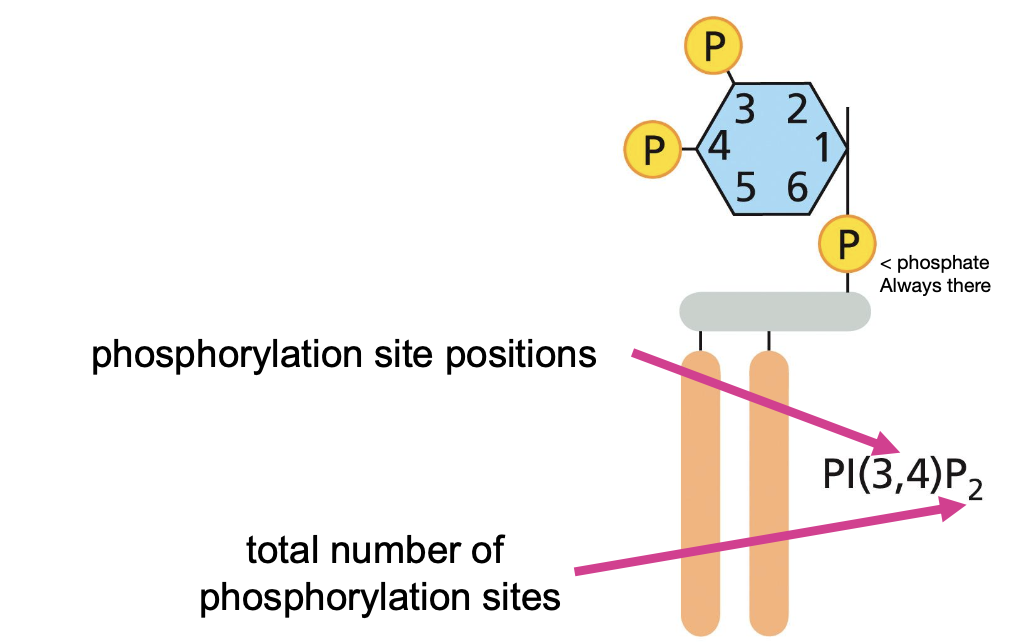

knowt flashcard image
21
New cards

Phosphoinositides are interconverted by kinases & phosphatases

  • What does a kinase do

  • what does a phosphatase do?

  • How much of kinases and phosphatase do we have?

  • try to draw the flowchart for it


knowt flashcard image
22
New cards

Different proteins bind to different PIPs

  • what is the purpose of the proteins


  • proteins bind and mediate the membrane trafficking bacterium

  • e.g. the exterior membrane proteins will bind with PI4,5,P2 (phospholipid type)

  • e..g the PII3P (phospholipid type) binds to proteins found in endosomes


<ul><li><p>proteins bind and mediate the membrane trafficking bacterium</p></li><li><p>e.g. the exterior membrane proteins will bind with PI4,5,P2 (phospholipid type)</p></li><li><p>e..g the PII3P (phospholipid type) binds to proteins found in endosomes</p></li></ul><p></p>
23
New cards

PI(4,5)P2 targets what?

  • clathrin coat assembly

  • coat assembly with cargo receptors with cargo

  • budding formation (forming the coat)

  • vesical formation

  • uncoating once vesicle is formed


<ul><li><p>clathrin coat assembly</p></li><li><p>coat assembly with cargo receptors with cargo</p></li><li><p>budding formation (forming the coat)</p></li><li><p>vesical formation</p></li><li><p>uncoating once vesicle is formed</p></li></ul><p></p>
24
New cards

Explain how PI(4,5) does this job?

  • adaptor proteins (which is the inner clatherin coat) will bind to the PIP, which then also binds to cargo receptors (and therefore cargo which binds to the receptors) and outer clatherin


<ul><li><p>adaptor proteins (which is the inner clatherin coat) will bind to the PIP, which then also binds to cargo receptors (and therefore cargo which binds to the receptors) and outer clatherin</p></li></ul><p></p>
25
New cards

Rab GTPases are molecular switches that can direct vesicles

Rab GTPases can act like molecular switches

GEF (exchange factor) exchanges GDP for GTP turning the gene on

GAP (activating protein) activates GTPase turning it off as GTP gets hydrolyzes into GDP

<p>Rab GTPases can act like molecular switches</p><p class="p2">GEF (exchange factor) exchanges GDP for GTP turning the gene on</p><p class="p2">GAP (activating protein) activates GTPase turning it off as GTP gets hydrolyzes into GDP</p>
26
New cards

Rabs and PIPs combine to give membranes different identities

  • the early endosome


  • initially RAB5-GDP if off and bound to GDI which prevents the GDP from turning on

  • wtih Rab5GEF activates, GDI dissassociates and Rab5-GDP turns on into GTP

  • The Rab5-GTP recruits PI 3-kinase

  • it phosphorylates the PIP to turn in into PI(3)

  • PI(3)P recruits more Rab5-GEF

  • and More rab5-GEF makes more active Rab5-GTP

  • This allows for Rab effector proteins to bind


<ul><li><p>initially RAB5-GDP if off and bound to GDI which prevents the GDP from turning on</p></li><li><p>wtih Rab5GEF activates, GDI dissassociates and Rab5-GDP turns on into GTP</p></li><li><p>The Rab5-GTP recruits PI 3-kinase</p></li><li><p>it phosphorylates the PIP to turn in into PI(3)</p></li><li><p>PI(3)P recruits more Rab5-GEF</p></li><li><p>and More rab5-GEF makes more active Rab5-GTP</p></li><li><p>This allows for Rab effector proteins to bind </p></li></ul><p></p>
27
New cards

Rabs and SNAREs work together in vesicle targeting & fusion

RabGTP docks onto the fishing line rab effector proteins bringin it closer to the membrane

The v and t snares work together to merge the vesicle membranes together
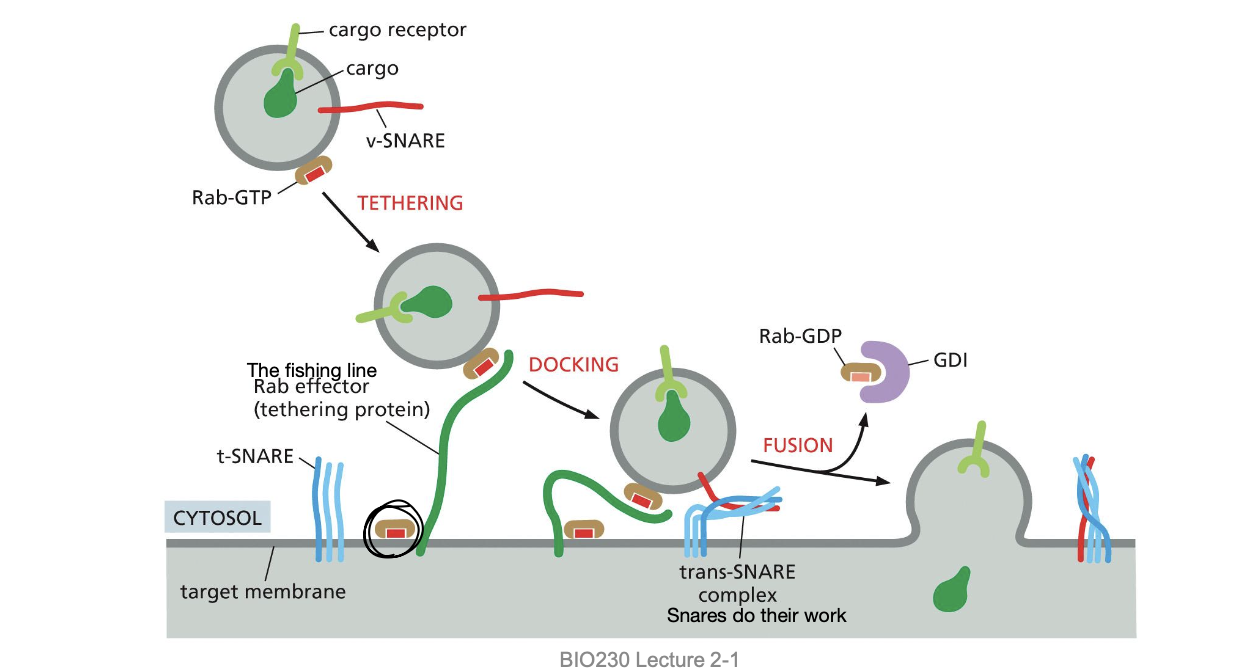
<p>RabGTP docks onto the fishing line rab effector proteins bringin it closer to the membrane</p><p>The v and t snares work together to merge the vesicle membranes together</p>