Muscular System
 Call Kai
 Learn
 Practice Test
 Spaced Repetition
 Match
 Flashcards
 Knowt Play
1/26

There's no tags or description
Looks like no tags are added yet.
27 Terms
Muscle Cells
A muscle cell is elongated (up to 3 feet) unlike other cells
They build gather and organize
Muscle Types
Skeletal Muscle
Smooth Muscle
Cardiac Muscle
Skeletal Muscle
Skeletal muscle tissue is packaged into the skeletal muscles, organs that attach to and cover the skeleton.
Skeletal muscle fibers are the longest muscle cells
Voluntary
It can contract rapidly and exert tremendous power, but it tires easily and must rest after short periods of activity
Multinuclei cause the muscle can be long
Cells run parallel to each other

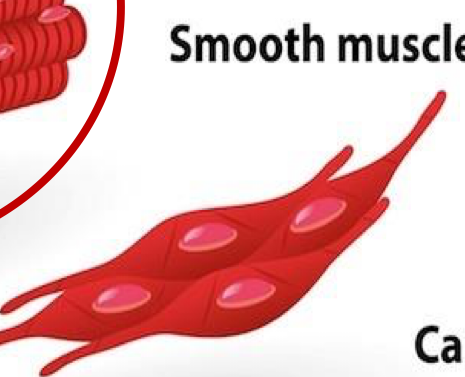
Smooth Muscle
Smooth muscle tissue is found in the walls of hollow visceral organs, such as the stomach, urinary bladder, and respiratory passages
It forces fluids and other substances through internal body channels.
Forms valves to regulate the passage of substances through internal body openings, dilates and constricts the pupils of your eyes, and forms the arrector pili muscles attached to hair follicles.
Consists of elongated cells
Involuntary
Its contractions are slow and sustained
For hollow organs
Uninucliated
Cardiac Muscle
Cardiac muscle tissue occurs only in the heart
Involuntary
Usually contracts at a fairly steady rate set by the heart’s pacemaker, but neural controls allow the heart to speed up for brief periods
Cylindrical and branch
Communicate thru ends
Uninucliated

Function of Skeletal Muscles
Produce Movement (articulation)
Ambulation (movement of bones at joints)
Stop movement
Posture
Stabilize joints
Facial expression
Control Movement of Various Substances
Sphincters
Voluntary
Respiration
Diaphragm (the muscle of respirataion)
Protection
Underlying organs
Homeostasis
Heat production (shivering, and contraction produces heat)
Structure of Skeletal Muscles
Muscle Fibres
Enodmysium
Fascicle/fasciculus
Perimysium
Epimysium
Make up the tendon (extends beyond muscle tissue)
Arteries, veins, nerves

“Myocite”
“Muscle Cell”
Fascicle Arrangement/Shapes
Parallel (don’t generate much force)
Convergent (bundles of vassiculi come together, powerful and insert in specific area)
Pennate (strong, produce lots of force, fatigue quickly)
Unipennate
Bipennate
Multipennate
Sphincters (contract=smaller circle, relax=widens, ex.anus)
Spiral (wraps around bone allowing for rotation)
Fusiform (thicker in midsection, and tappers away from mid)
Naming of Muscles: Shape
Orbicularis - circular
Serratus - jagged like a saw or knife
Trapezius - trapezoid shape
Quadratus - 4 sides
Naming of Muscles: Size
Maximus - big
Medius - medium
Minimus - small
Major - big
Minor - small
Vastus - huge/vast
Naming of Muscles: Length
Brevis - short
Longus - longer
Naming of Muscles: Position Relative to Midline
Lateralis - away from midline
Medialis - toward midline
Naming of Muscles: Direction
Rectus - straight (vertical)
Oblique - angle
Naming of Muscles: Location
In body
Frontalis - frontal bone
Capitis - head
Carpi - hands
Oculi - eye
Oris - mouth
Of attachments to skeleton
Superficialis - superficial
Profundus - deep
Naming of Muscles: Number of Origins
Biceps - 2
Triceps - 3
Quadriceps - 4
Naming of Muscles: Actions
Flexor
Extensor
Abductor
Adductor
Levator
Erector
Functional Groups
Agonist
Antagonist
Synergist
Fixator
Agonist
Prime mover muscle
Provides most force for a muscle movement action
Antagonist
Opposite of agonist
On opposite side of joint and produces movement (oppose or reverse movement)
Provides control of movement (slows it down)
Synergist
Muscles that are nearby
Help agonists by adding extra force, stabilizing joints, or by reducing undesirable/unnecessary movements
Fixator
Provide stabilizing forces and anchor bones
Don’t produce force, stabilizes so that other muscles can produce it
Origins
Anchoring point on a bones where a muscle originates from
on axial skeleton
Insertion
Moving muscle end where tendons attach to bone
Muscles of Facial Expression
Emotions/non-verbal communication
Originate from bone/flat tendons and insert onto the hypodermis (bone to subcutaneous tissue)
Facial Nerve (CN VII)
“Platysma”
“flat plate”
Platysma
Tenses skin of neck (like when shaving)
Depresses lower lip (pulls lower lip back and down)
Origin: fascia of chest (over pectoral muscles and deltoid)
Insertion: lower margin of mandible