Heine Chapter 6
 Call Kai
 Learn
 Practice Test
 Spaced Repetition
 Match
 Flashcards
 Knowt Play
1/35

There's no tags or description
Looks like no tags are added yet.
36 Terms

independent view of selt
the self derives its identity from inner attributes
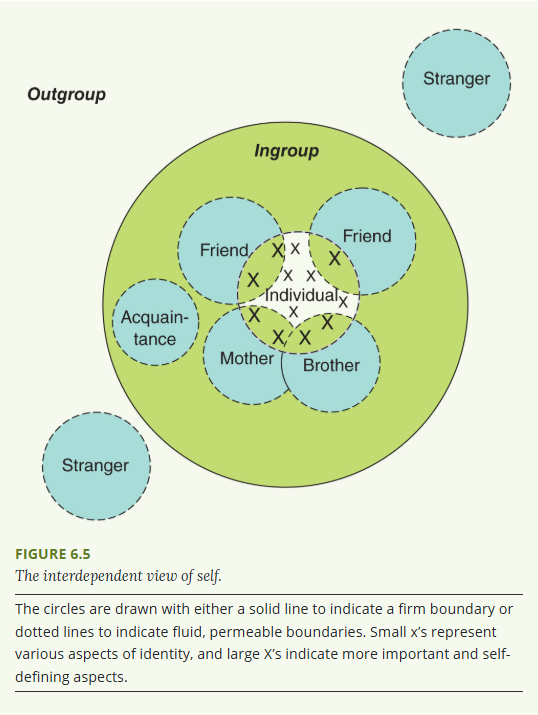
interdependent view of self
the individual is a relational entity who is fundamentally connected to, and sustained by, a number of significant relationships
B. have a self-concept that is consistent across situations
People who describe themselves primarily in terms of inner psychological attributes are likely to…
A. have an interdependent self-concept
B. have a self-concept that is consistent across siutations
C. define themselves primarily through close relationships
D. see ingroup-outgroup boundaries as rigid and central to identity
A. People with interdependent selves are characterized by strong ingroup obligations, alongside possible competition
Which of the following statements is true regarding ingroup relationships?
A. People with interdependent selves are characterized by strong ingroup obligations, alongside possible competition
B. People with independent selves have stronger relationships with ingroup members than do those with interdependent selves.
C. There is little distinction between ingroup and outgroup members for those with more interdependent selves.
D. People with independent selves are more likely to monitor the distinction between ingroup members and outgroup members than those with interdependent selves.
D. Americans of lower socio-economic status
What is a good example of an exception to the claim that Americans have independent selves?
A. people living in Montana
B. wealthy Americans
C. Americans who work for IBM
D. Americans of lower socio-economic status
B. It discouraged people from marrying their relatives.
According to Joe Henrich, which policy of the Western Church contributed the most to the rise of independent selves in the West?
A. The church encouraged families to take up wheat agriculture.
B. It discouraged people from marrying their relatives.
C. It interpreted the Bible as saying that each individual must have a personal relationship with God
D. It encouraged people to have arranged marriages.
cultural fit
the extent to which an individual is aligned with the dominant cultural meanings that surround them
C. In an individualistic culture, people who have a more independent self have better cultural fit than those with a more interdependent self do.
Which of the following statements is accurate?
A. All people who live in individualistic cultures have independent selves.
B. People either have an independent self or an interdependent self.
C. In an individualistic culture, people who have a more independent self have better cultural fit than those with a more interdependent self do.
D. There is little diversity among individuals within both individualistic and collectivist cultures with respect to sense of self.
A. a first-generation student studying at university
An example of someone who might experience poor cultural fit is…
A. a first-generation student studying at university
B. a devout Christian living in a Christian country
C. a person who likes to follow rules and lives in a tight country
D. a person who embraces traditions and lives in a rural country
shifting cultivation
soil is dup wit ha tool similar to a contemporary garden hoe; where practiced — women do most of the agricultural workis prepared by cutting and burning vegetation; this technique promotes soil fertility and is often used in tropical regions.
plow cultivation
a large animal pulls a plow to turn over the soil, requiring muscular strengths and quick bursts of energy which is why it tends to be done by men
Boserup argues that even when a country moved out of agriculture into industrial work, it tended to preserve some of the gender norms associated with traditional cultivation methods
Economist Ester Boserup agricultural theory
D. have a shorter history of plow-based agriculture
Countries with more egalitarian gender roles tend to..
A. Be more rural than places with more traditional views
B. practice more polytheistic faiths, such as Hinduism or Shintoism
C. Have more collectivistic cultural practices
D. have a shorter history of plow-based agriculture
cognitive dissonance
The distressing feeling that accompanies the awareness that one is behaving inconsistently, or against one’s sense of self-consistency.
dissonance reduction
due to cognitive dissonance, people change attitudes so they no longer appear to be so inconsistent
subjective self-awareness
A heightened sense of self-consciousness where individuals focus on their own thoughts, feelings, and behaviors, often leading to evaluation against personal standards; where we can consider ourselves from the inside out, from the perspective of the subject
objective self-awareness
state of mind where the self can be experienced as the “me” that is observed and interacted with by others
A. in how they act with particular individuals over time
Studies of East Asians have found that they tend to be quite consistent
A. in how they act with particular individuals over time.
B. in how they act across different situations.
C. in how they evaluate objects across situations.
D. particularly if they are viewed as likeable by others.
B. East Asians often view themselves in ways more similar to how they believe others are viewing them.
Studies that compare East Asians and Westerns in terms of how they view themselves find that…
A. East Asians are more commonly in a state of subjective self-awareness
B. East Asians often view themselves in ways more similar to how they believe others are viewing them.
C. Westerners tend to have more memories from a third-person perspective
D. East Asians are more likely to give different evaluations of themselves when they are looking in a mirror
growth mindset (incremental theory of self)
the belief that we can easily change, and are expected to change
fixed mindset (entity theory of self)
theory that aspects of the self are resistant to change
five-factor model
a psychological theory suggesting that five broad dimensions (openness, conscientiousness, extraversion, agreeableness, and neuroticism) can describe human personality traits.
factor analysis
a statistical method for identifying groups of things that are alike or different
openness to experience
reflects a person’s creativity and curiosity about the worldco
conscientiousness
indicates how responsible, dependable, and self-disciplined a person is in their actions and behaviors.
extraversion
indicates how outgoing, social, or dominant a person is in social situations.
agreeableness
refers to a warm, pleasant, and considerate tmperament
neuroticism
indicates emotional instability and unpredictability
niche-diversity hypothesis
proposes that when people live in an environment where there are opportunities for many different skill sets and traits to be cultivated and rewarded, personality comes to take on a larger set of basic underlying factors as people compete with each other for the different roles that are available
C. There are more distinct niches in American than in Tsimane society
The reason that research with Americans points to a larger number of personality factors than does research with the Tsimane is most likely because…
A. Tsimane people do not think about individual differences in personality.
B. Tsimane people focus more on relationships than Americans do.
C. There are more distinct niches in American than in Tsimane society
D. Americans tend to have more of an independent self than Tsimane people do.
a. Kenyan undergraduates and tribal people (e.g., the Samburu) view the self in highly different ways.
Research comparing the self -concepts of Americans and Kenyans has been found:
a. Kenyan undergraduates and tribal people (e.g., the Samburu) view the self in highly different ways.
b. All Kenyan populations had similar kinds of self-concepts.
c. Americans were the only participants who described themselves primarily in terms of personal attributes
d. The Samburu describe themselves primarily in terms of personal attributes.
e. None of the above
e. The Same brain regions will be activated when he’s thinking about himself and his mother
Ambrose has an independent self, and Hayden has an interdependent self. Knowing only this, which of the following is probably true about Hayden?
a. He draws a weaker distinction between a stranger at the bus stop and his brother.
b. He feels his identity is primarily based on his sense that he’s an outgoing and extraverted person.
c. He acts the same way regardless of the context or situation.
d. He is more motivated to be unique and different from others.
e. The Same brain regions will be activated when he’s thinking about himself and his mother
d. Men and women score similarly on agency.
Based on research exploring gender comparisons of the self-concept, what statement below is true?
a. Women tend to have self-concepts more like Asians, whereas men have self-concepts more like Westerners.
b. Women have more of a collectivistic self-view than Westerners.
c. Men score higher on assertiveness than women.
d. Men and women score similarly on agency.
e. Men and women score similarly on relatedness.
d. Americans view themselves more negatively, and Japanese do not change.
What happens when people evaluate themselves while facing a mirror?
a. People from all cultures become more self-critical in front of a mirror.
b. Americans view themselves more positively, and Japanese view themselves more negatively.
c. Americans view themselves more negatively, and Japanese view themselves more positively.
d. Americans view themselves more negatively, and Japanese do not change.
e. People from all cultures view themselves more positively in front of a mirror.
d. Marriage to relatives were discouraged by the Western Church.
Which explanation for why independent selves are more common in Western countries than in non-Western countries is better supported by evidence?
a. Herding livestock is a more common practice in Western than non-Western countries.
b. There are relatively more men than women in Western countries than in non-Western countries.
c. The plough was used more in Western countries than in non-Western countries.
d. Marriage to relatives were discouraged by the Western Church.
e. There have historically been more pathogens and parasites in Western countries than in non-Western countries.
e. are less evident in small-scale societies with fewer niche
The Big Five personality traits
a. are clearly observed only in Western cultural contexts.
b. do not vary significantly in magnitude across cultures.
c. are believed to be unique to humans
d. emerge identically cross-culturally, regardless of the language from which the trait terms are derived.
e. are less evident in small-scale societies with fewer niches