Energy in Living Systems 115 Exam 2
 Call Kai
 Learn
 Practice Test
 Spaced Repetition
 Match
 Flashcards
 Knowt Play
1/79

There's no tags or description
Looks like no tags are added yet.
80 Terms
fitness
an individual’s ability to produce viable, fertile offspring
commencialism
occurs when one species benefits but the other in unaffected (ie. epiphytic orchid benefits from growing on a tree but tree is unaffected)
competition
occurs when individuals use the same resources and ends up hurting both in end
consumption
occurs when one organisms eats or absorbs nutrients from another
mutualism
occurs when two species interact in a way that confers fitness benefits for both
infraspecific competition
competition within species
interspecific competition
competition between species
niche
range of resources used by a species
competitive exclusion principle
principle that two species cannot coexist in the same ecological niche in same area because one species will out compete the other
fundamental nuche
the total theoretical range of resources that a species can use
realized niche
the portion of a fundamental niche that a species actually occupies (usually due to competition)
fitness trade off
an inescapable compromise between two traits that cannot be optimized simultaneously
niche differentiation
resource partioning- organism faced with competition (and are loosing) start to exploit different resources over time
character displacement
evolutionary change that occurs in species traits, enabling a species to exploit different resources (ie Galapagos finches)
coevolutionary arms race
a series of adaption and counter of better defense and better attack
constitutive defenses
traits that help individuals avoid being eaten (ie. camouflage, quick escape, toxins, schooling, armor, and mimicry)
batesian mimicry
a harmless species resembles a dangerous one (ie. toxic and nontoxic frogs)
mullerian mimicry
two or more dangerous species resemble each other (ie wasps, bees, and yellow jackets)
inducible defenses
physical, chemical, or behavioral defensive traits that are induced in prey in response to being eaten (ie, mussels increase shell thickness in presence of crabs)
Levels of Ecological Organizations
Organisms: individual animal
Populations: a group of same species
Community: various groups of different species
Ecosystem: community and non-living environment
Nitrogen fixing bacteria
rhizobia and mycorrhizae
Mutualism between nitrogen fixing bacteria and plant roots
Plants provided leghemoglobin to rhizobia or mycorrhizae(fungi), which binds to oxygen and takes it away from the bacteria so nitrogenase in the bacteria/fungi can fix nitrogen needed for plant to grow and survive. This is important because nitrogenase is poisoned by oxygen and won’t be able to fix nitrogen if it comes in too much contact with it. Also, nitogrenase requires a lot of energy, and the plant roots provide that energy to the bacteria carrying that enzyme. TRADE OFF- plant provides energy and takes away oxygen, nitrogen fixing bacteria provides nitrogen
Heterocyst
A plant cell that contains nitrgoenase and NO photosynthetic pigmentation. Outlines compartmentalization and specialization because nitrogen fixation is able to occur in heterocyst without oxygen from photosynthesis posing the enzyme.
generalists
organisms that feed on a broad range of food
specialists
organisms that feed on one or a very small range of food
when generalists and specialists are in the same niche what happens?
specialists outcompete generalists because specialists are inertially “better” or more adapted to exploting their resource than generalist who exploit multiple. SO, generalists are forced to use a realized niche
exponential growth
no immigration/emigration happening, occurs with new species introduced to new environment. Expected population = r (growth rate) * N (current population
logistic growth
density- dependent, decrease in growth as population size approaches carrying capacity. expected population = r (growth rate) * N (current population) * {[K (carrying capacity) - N (current population]/ K (crying capacity)}
density dependent factors
habitt
competition for resources
predation pressure
disease
social stress
species richness
number of species in a community
species eveness
how evenly represented are these species in a community
why do communities differ in species richness?
climate: water availability/temperature/seasonality
resource abundance/primary productivity
area: large area= more species
environmental heterogeneity: differences within environment
shelter avalibilty
keystonespceis/interactions
history: geological history IE GLACIERS= less species
island communities: less diverse
keystone species
have a disproportionally large affect on community structure, relative to their abundance
types of keystone species
keystone predator (ie grey wolf in Yellowstone)
keystone prey/producers (ie krill in ocean bc so many depend on them)
keystone ecosystem engineers (ie beavers making dams, elephants knocking down trees in Savana)
GPP
Gross Primary Productivity: total amount of energy captures
NPP
Net Primary Productivity: how much of GPP is captured and incorporated in plant use . NPP=GPP- R (chemical energy lost via cellular respiration)
food chain
one possible pathway of energy flow (ie grazing food chain [producer-herbivor-predator] or de composer food chain [detritus-decomposer-predator])
food web
detailed description of all possible food chains in ecosystem
Why not all energy reaches different trophic levels?
consumption efficiency: portion of biomass actually eaten (ie only leafs of plant is eaten by deer)
assimilation efficiency: “digestion” portion of consumed energy actually absorbed/digested (ie bones and hair not digested
production effdecenty: “conversion” portion of absorbed energy that is converted to new biomass
Nutrient cycling
(also humans add to atmospheric pool of carbon dioxide by burning fossil fuels)

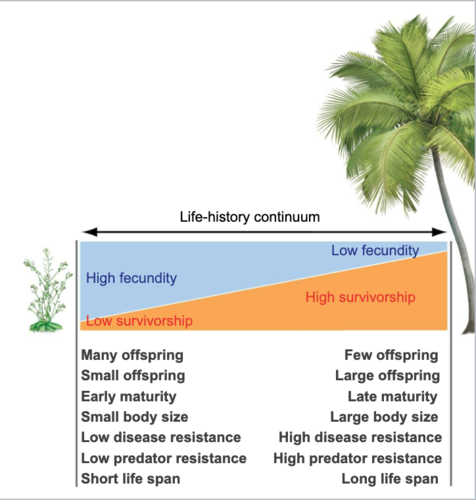
Life History Trade-Offs
phenological shifts
shifts in timing (ie winter coat
range shifts
moving across the landscape to track ideal climate conditions
How might biotic interactions influence shift responses?
Mating season changes, occupancy of shelter by other organisms, competition for resources if organisms move to different landscape
Permeability of substances
(also regular non polar molecules, like steroids, cross more easily than small non polar)

Fluidity
the ability of phospholipid in bilayer to move around and interact
What affects fluidity?
Temperature:colder the temperature, less fluidity
Saturation: more unsaturated, less fluidity
Cholesterol: more cholesterol, less fluid/more permeable
Intergral proteins
NONPOLAR so can bind and interact with non polar region of phospholipid bilayer. If were polar, it wouldn’t interact with non polar region and would change shape, and therefore function.
covalent bonds
share electrons and must have similar electron affinities
non polar covalent bonds
equal electron sharing, no charge
polar covalent bonds
unequal electron sharing due to one molecule have slightly higher electronegativity, partial positive and partial negative charge
ionic bonds
electronegativity difference exceeds 1.7 between atoms/molecules. forms when 1 atom gives up electron (s) and other takes it
Properties of water
polar
high specific het
high heat potential
expands when gets colder/ice is less dense than liquid state
capillary action: surface tension, adhesion, cohesion (all bc of hydrogen bonds)
readily forms hydrogen bonds
solvent fro polar and ionic substances
types of diffusion

active and secondary transport

Ion channels
selective protein pores in a membrane only allow certain ions in
Gated Channel
opens and closes. TWO types:
ligand gate: molecule will bind to channel to open/close its gate
voltage gated channel: charge environment determines whether gate will open/close
carrier protein
blind, flip release

osmosis
transfer of water across membrane

What makes an amino acid chain polar/nonpolar?
If it has a component with OXYGEN or NITROGEN bound to a hydrogen, giving it a partial positive and negative charge
Structure of phospholipid
non polar tails interact with each other and polar head face away from each other to make bilayer

Cholestral
cholesterol on membrane DECREASES PERMEABILITY (ability for stuff to pass through membrane)
protein synthesizing process
Ribosome reads mRNA and synthesizes protein→ gets developed more in rER → gets modified and sorted in Golgi apparatus → transport vesicles carry to designated destination based on ER localization signal

Pulse chase Experiment
Pulse: expose cells to high concentration of amino acids for short time. proteins made will be labeled with that amino acid
Chase: amino acid label is washed away and proteins made after won’t be labeled
Tracks movement and time of labeled proteins
ER localization signal
protein sequence at beginning of protein that determines destination of protein and whether it is synthesized in rER or a free standing ribosome.
Golgi Sorting Process
protein carry tags
proteins are sorted in Golgi based on tags
transport vesicles bud off the Golgi into destinations
transport vesicles attach and fuse at different destinations

Motor proteins
kinesin: “walks” on microtubule towards plus end and carries transport vesicle
dynein: changes shapes and moves adjacently towards minus of microtubule
both use ATP and is energetically costly
3 cytoskeleton components
Actin filaments: two coiled strands that maintain CELL SHAPE and resist tension, moves cell via muscle contraction and CELL DIVIDING
Intermediate filaments: fibers the twist around into thicker cables, RESISTENT TO MECHANICAL STRESS
Microtubules: hollow tubes that maintains cell shape, provides tracks fro active transport, INTERCELLULAR MOVEMENT
glycosylation
addition of sugars to proteins: amino acid is modified by adding sugar and IMPACTS protein folding, stability, cell to cell recognition, and protein function
process that occurs in Golgi
Trade offs of cytoskeleton
-energy consuming
-reduces flexibility and movement bc of extra stability
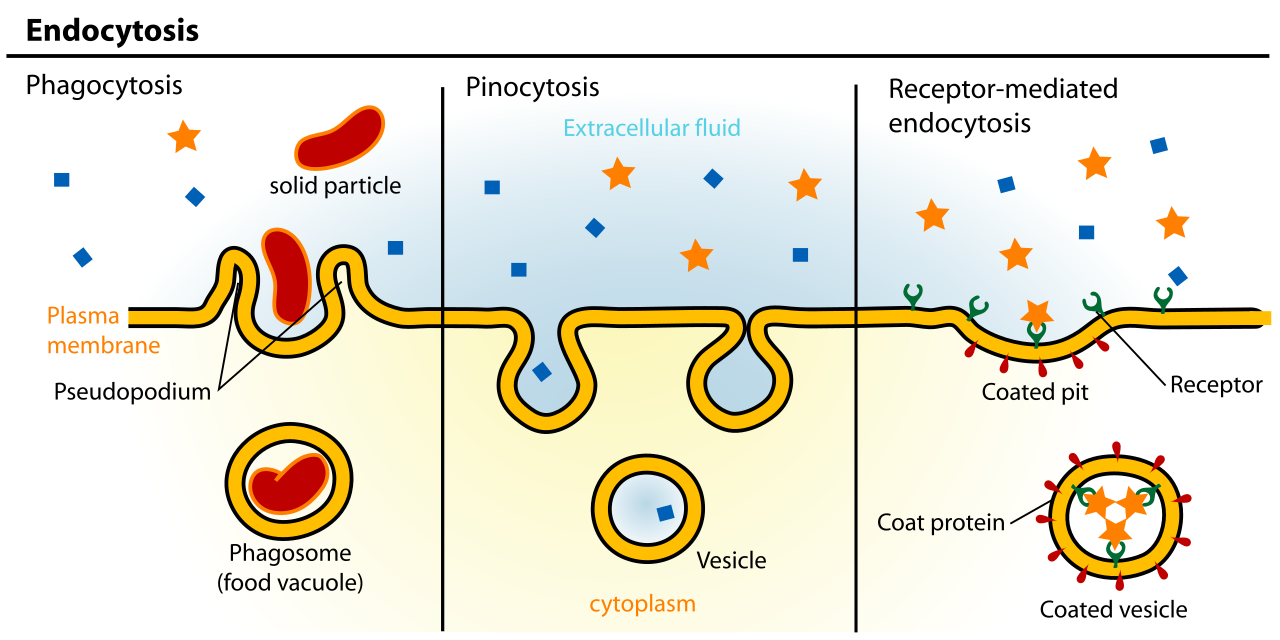
endocytosis
plasma membrane budding into vesicles
exocytosis
vesicle leaving cell -OR- vesicle merge to make membrane bigger
3 types of endocytosis
receptor-mediated: cell selectively absorbs specific target molecules only after they lock into matching receptor proteins on outer membrane
phagocytosis: “cell eating” cell engulfs large particles by wrapping outer membrane around them
autophogy: a cell’s internal recycling system that safely breaks down and digests own damaged parts or old organelles (recycles in lysosome)

trophic cascade
a phenom that happens when a keystone species is removed altering abundance of other species
aposematic coloring
when a toxic species is brightly colored to warn predators that they’re toxic
low fecundity
low birth rates but high survivorship
high fecundity
high birth rates but low survivorship
Allee effect
easier to find a mate because there’s more organisms. ONLY POSTIVE effect of high density
what’s harder to maintain, heat or cold?
heat because its harder to expel heat then it is to warm up
circadian
nitrogen fixation at night without photosynthesis